Reference diagram
LETTER · Download PDF (2 pages)
Free original resources
Plan a 24-hour clock face from scratch: place numerals 0–23, add minute ticks, and position hour and minute hands for given times.
Original reference diagrams, four practice exercises and separate worked answers. All files are free. No signup required.
LETTER · Download PDF (2 pages)
LETTER · Download PDF (4 pages)
LETTER · Download PDF (4 pages)
Choose A4 or US Letter for your printer. The reference and answer illustrations are not physical rulers; follow the scale instruction printed on the practice worksheet.
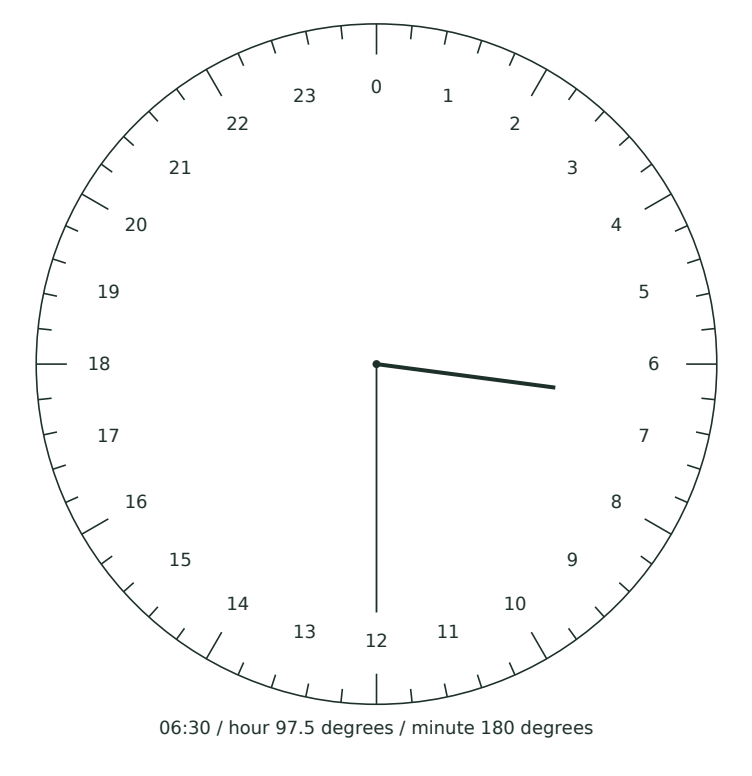
A 24-hour clock face shows all twenty-four hours around one circle, so the hour hand makes a single sweep each day. This guide gives a repeatable construction: establish a center and reference line, space numerals evenly, add minute ticks, then place hands using simple arithmetic. The convention here is that the top of the face is 0 (midnight), numerals increase clockwise, and the hour hand moves continuously while the minute hand completes one turn per hour. Letter styles and numeral shapes may vary; placement and hand angles are what the rubric checks.
Mark a center point on blank paper. Draw a light vertical line through it from top to bottom; this is the 0–12 reference line. The top end is 0, the bottom end is 12. Draw a circle centered on the point, large enough that numerals will not crowd the rim.
Keep construction lines light so they can be erased or left faint. Measure the actual circle radius with a ruler and record it; all spacing calculations use that measured value.
Each hour occupies 360 ÷ 24 = 15 degrees. Starting at 0 and moving clockwise, the numeral positions are 0, 15, 30, … 345 degrees. A protractor set at C makes each placement checkable. Numerals 0–9 may be written as single digits; 10–23 use two digits. Keep every numeral upright relative to the page unless your convention states otherwise, and keep digit height consistent.
If a protractor is unavailable, use a compass to step a length equal to the circle radius around the rim, starting at 0. This gives six equal 60-degree sectors. Draw their radii, bisect each sector to make twelve 30-degree sectors, then bisect again to make twenty-four 15-degree sectors. Label positions clockwise from 0.
Use two separate scales. The inner hour scale has 24 numerals at 15-degree spacing. The outer minute scale has 60 evenly spaced ticks at 6-degree spacing (360 divided by 60); make every fifth minute tick longer. Do not place five minute ticks inside each 24-hour numeral interval: the two scales have different spacing and do not align at every hour numeral. The minute hand turns 6 degrees per minute. The hour hand turns 15 degrees per hour plus 0.25 degrees per minute.
For a time written as H:MM in 24-hour form, minute-hand angle = 6 × MM degrees clockwise from 0. Hour-hand angle = 15 × H + 0.25 × MM degrees clockwise from 0. Both angles are measured from the top reference line. If an angle exceeds 360, subtract 360.
Verify three things: numeral spacing, minute-tick count, and hand angles. Opposite hour numerals should differ by 12. Count 60 minute ticks around the outer ring, at 6-degree spacing, independently of the 24 hour numerals. Recompute both hand angles independently and compare with the drawn lines. Small drawing errors are acceptable if the computed angle is within a stated tolerance you choose and label as a hypothetical example, such as plus or minus 2 degrees.
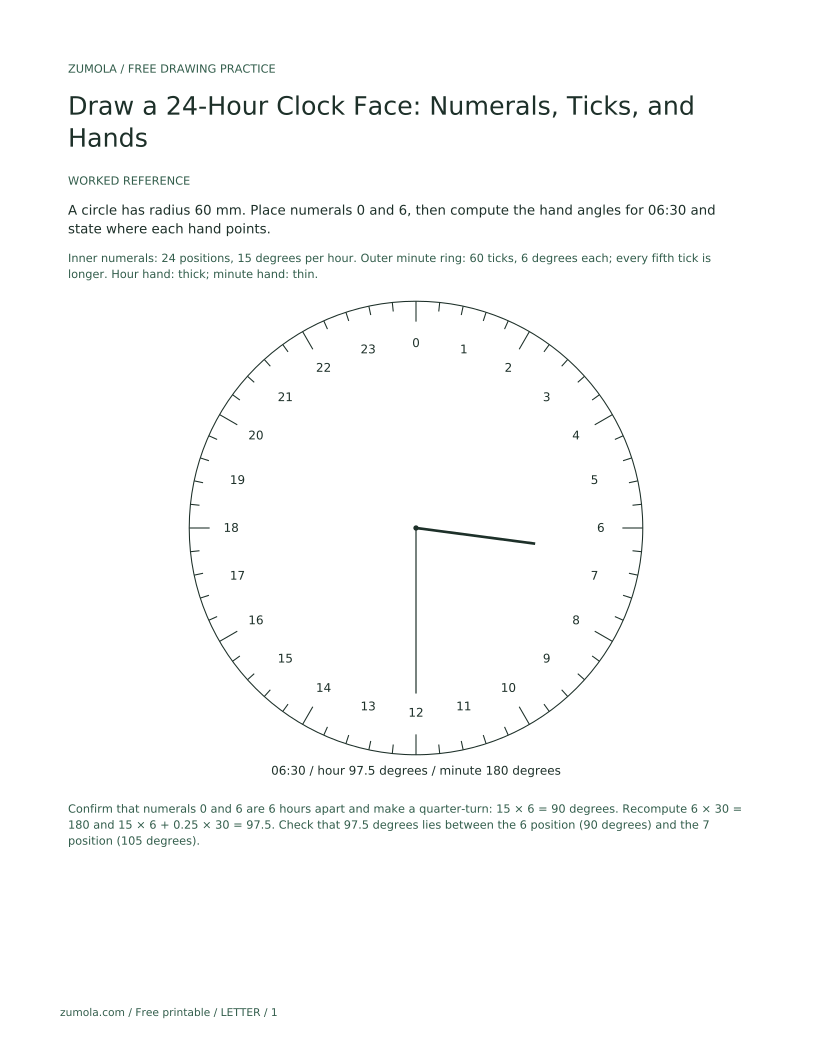
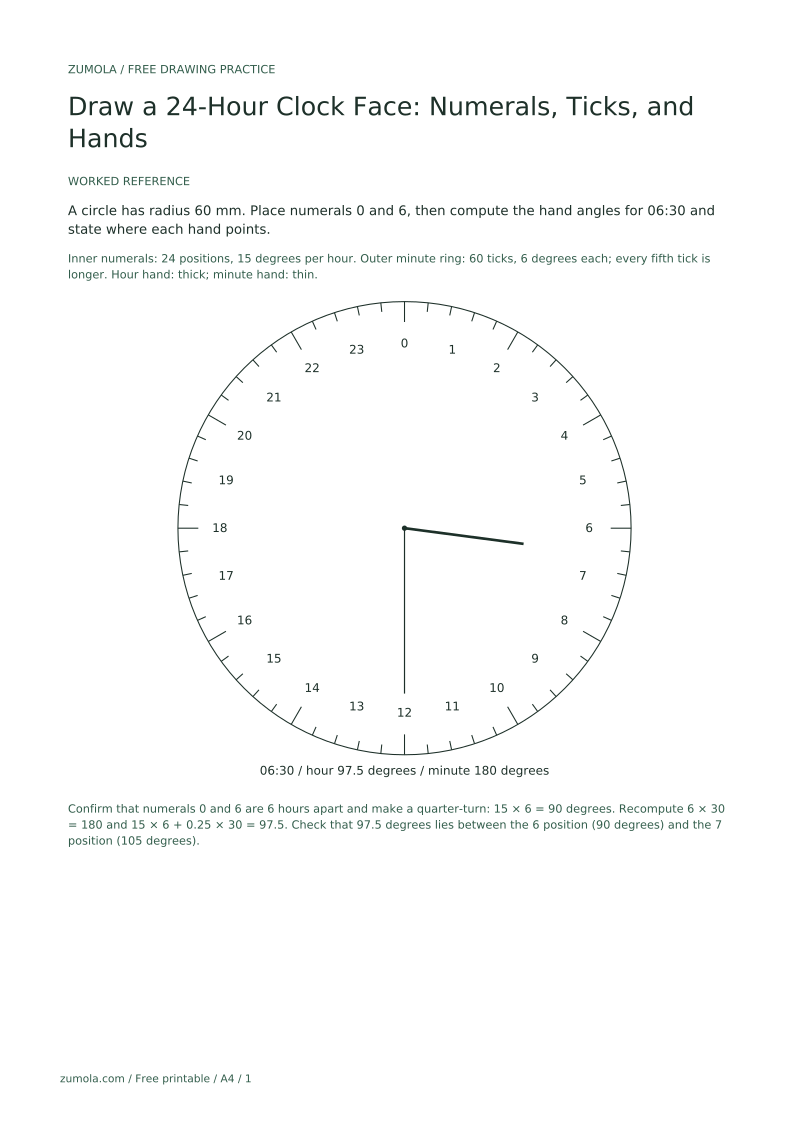
A circle has radius 60 mm. Place numerals 0 and 6, then compute the hand angles for 06:30 and state where each hand points.
Numeral 0 is at the top (0 degrees). Numeral 6 is at 15 × 6 = 90 degrees clockwise, which is the right side of the circle. For 06:30, minute angle = 6 × 30 = 180 degrees, so the minute hand points to the bottom (toward numeral 12). Hour angle = 15 × 6 + 0.25 × 30 = 90 + 7.5 = 97.5 degrees, so the hour hand points slightly past numeral 6 toward numeral 7.
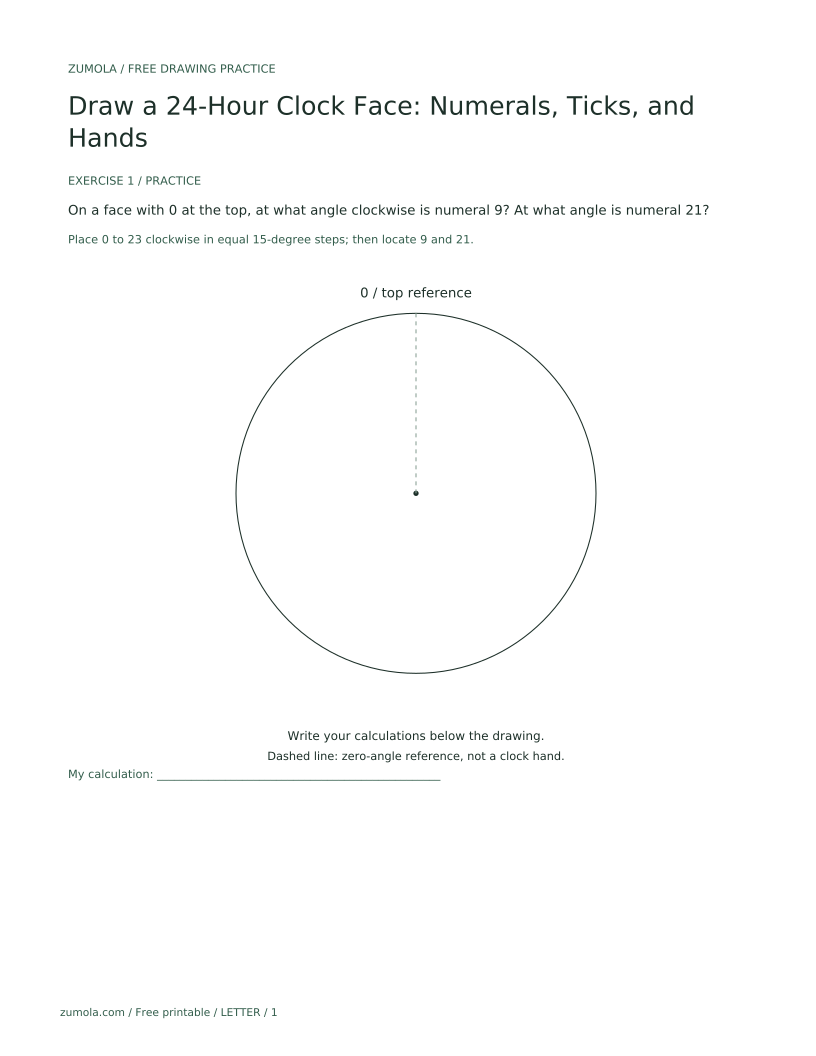
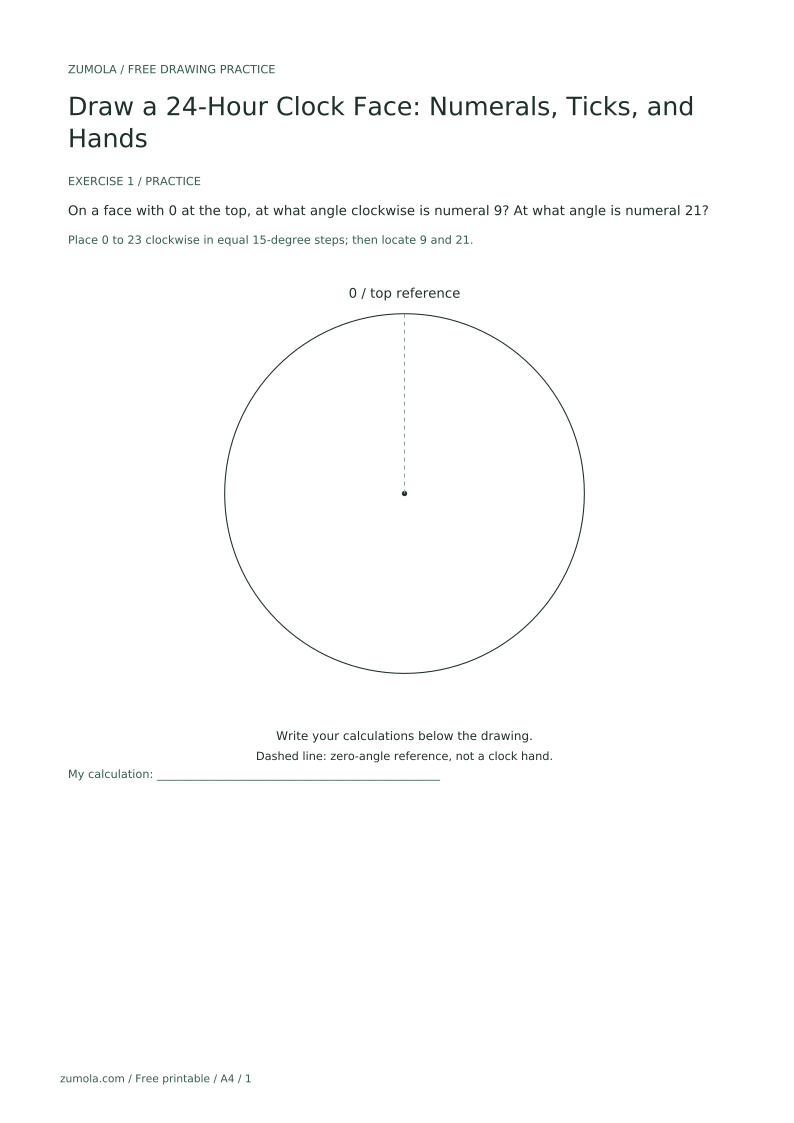
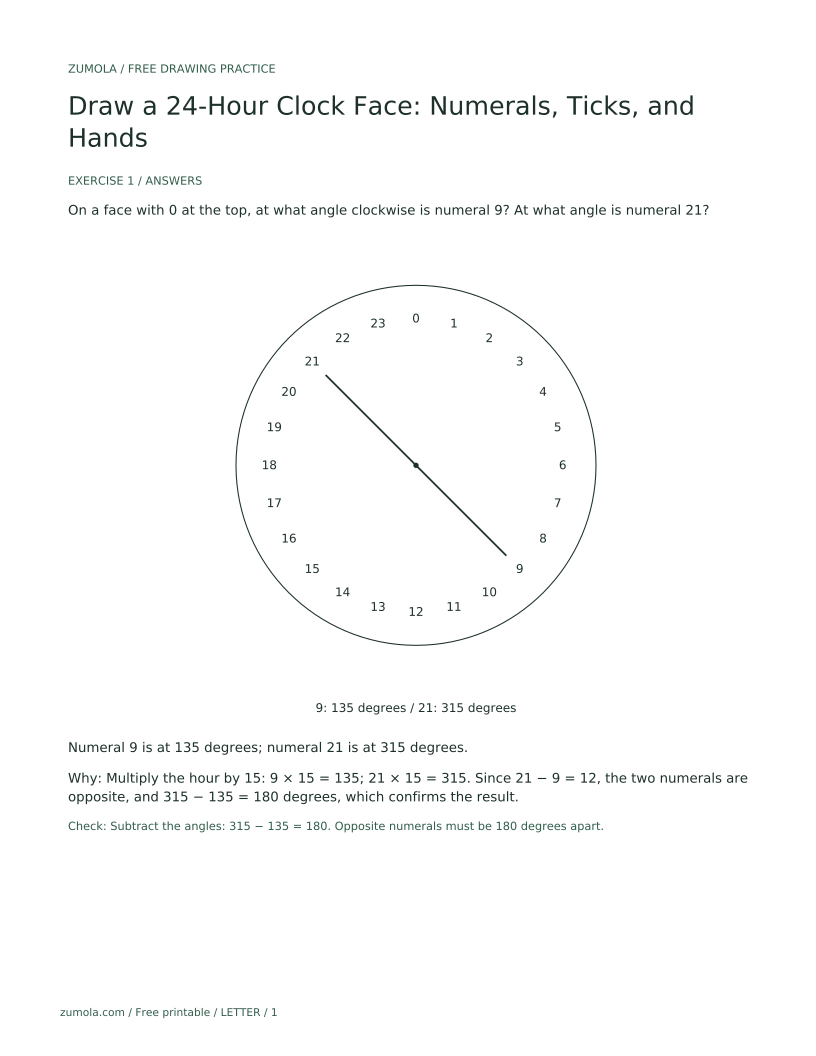
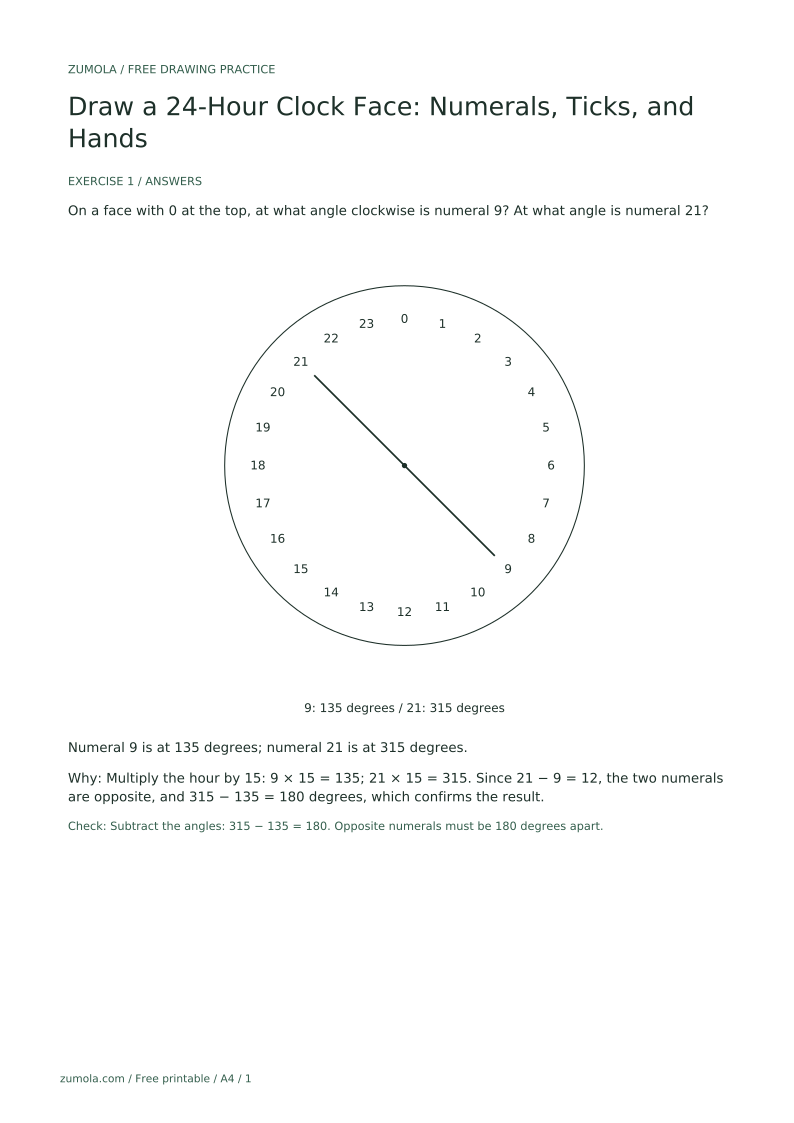
On a face with 0 at the top, at what angle clockwise is numeral 9? At what angle is numeral 21?
Numeral 9 is at 135 degrees; numeral 21 is at 315 degrees.
Multiply the hour by 15: 9 × 15 = 135; 21 × 15 = 315. Since 21 − 9 = 12, the two numerals are opposite, and 315 − 135 = 180 degrees, which confirms the result.
Check: Subtract the angles: 315 − 135 = 180. Opposite numerals must be 180 degrees apart.
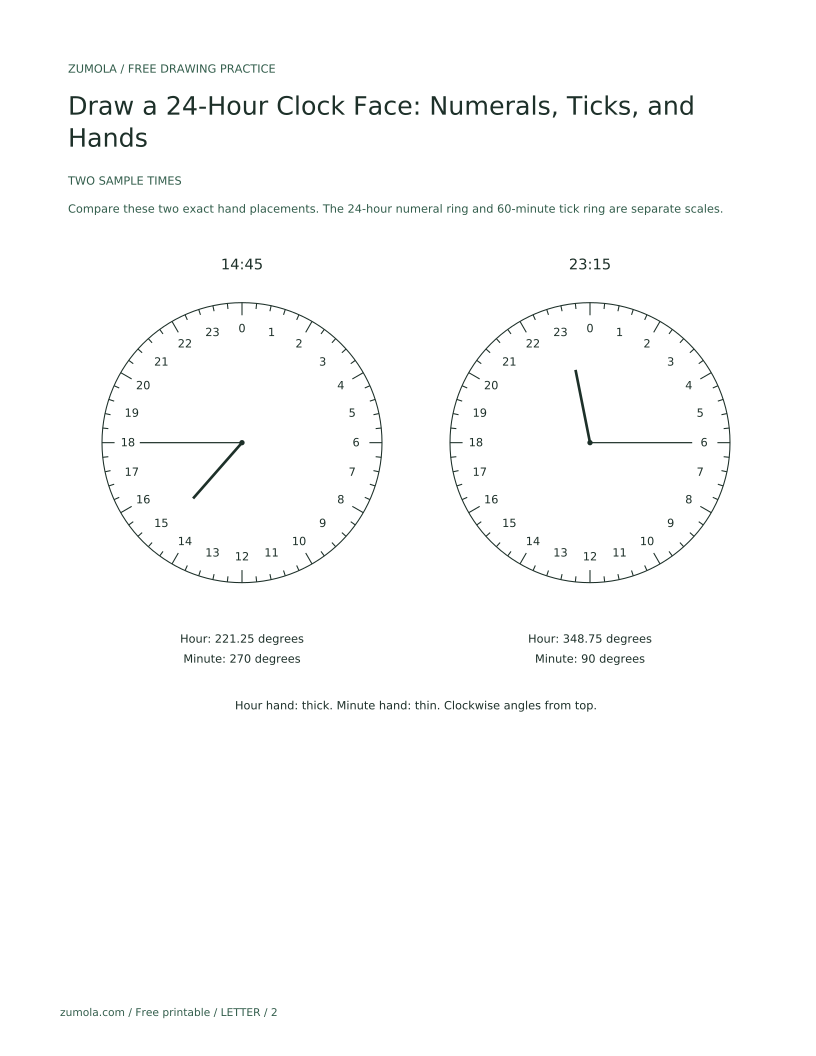
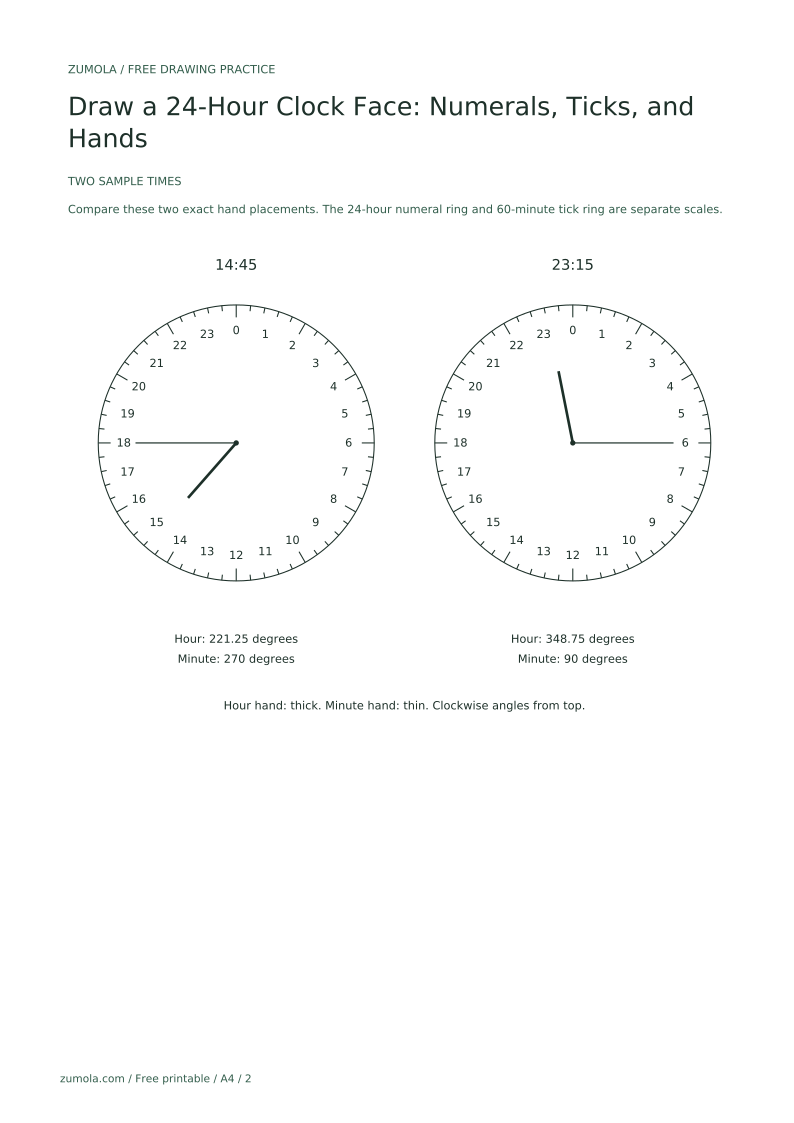
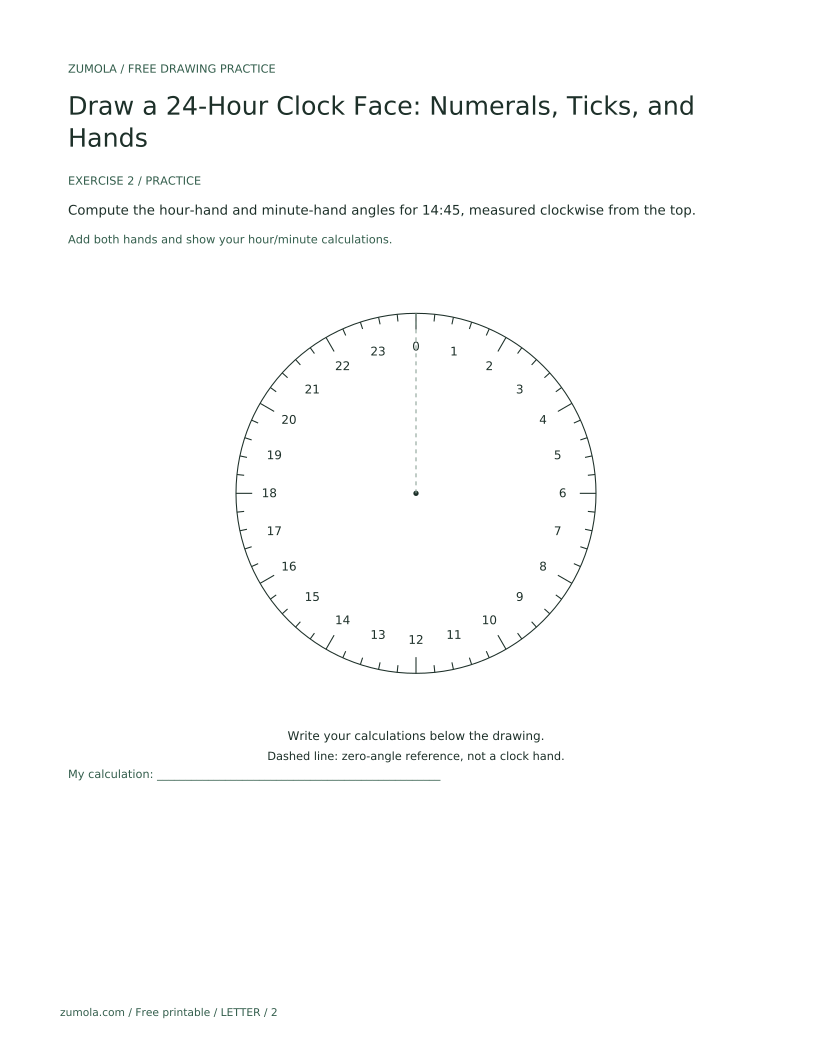
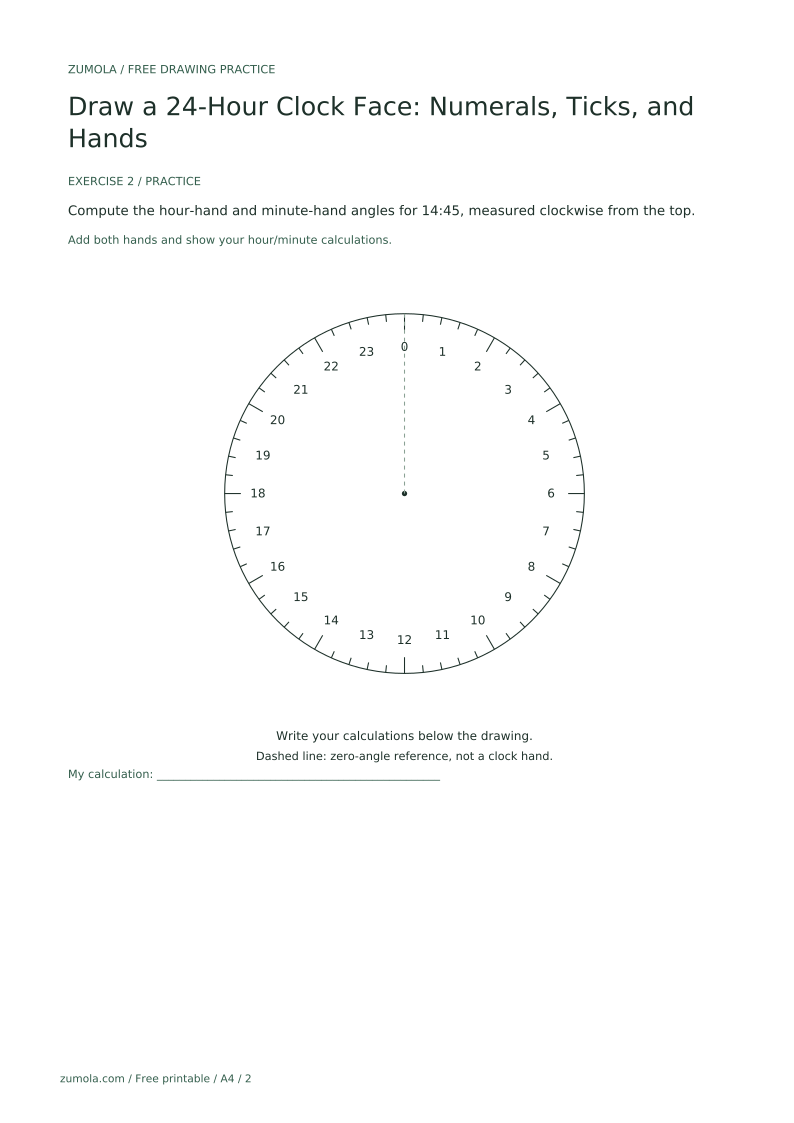
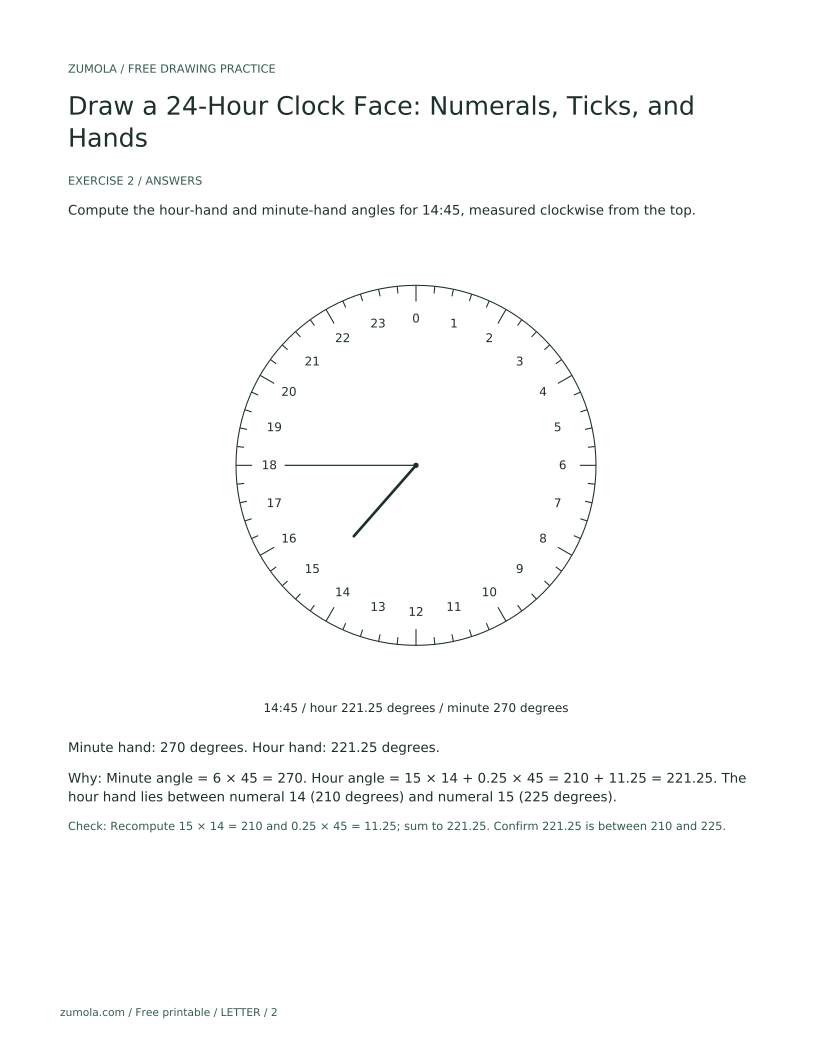
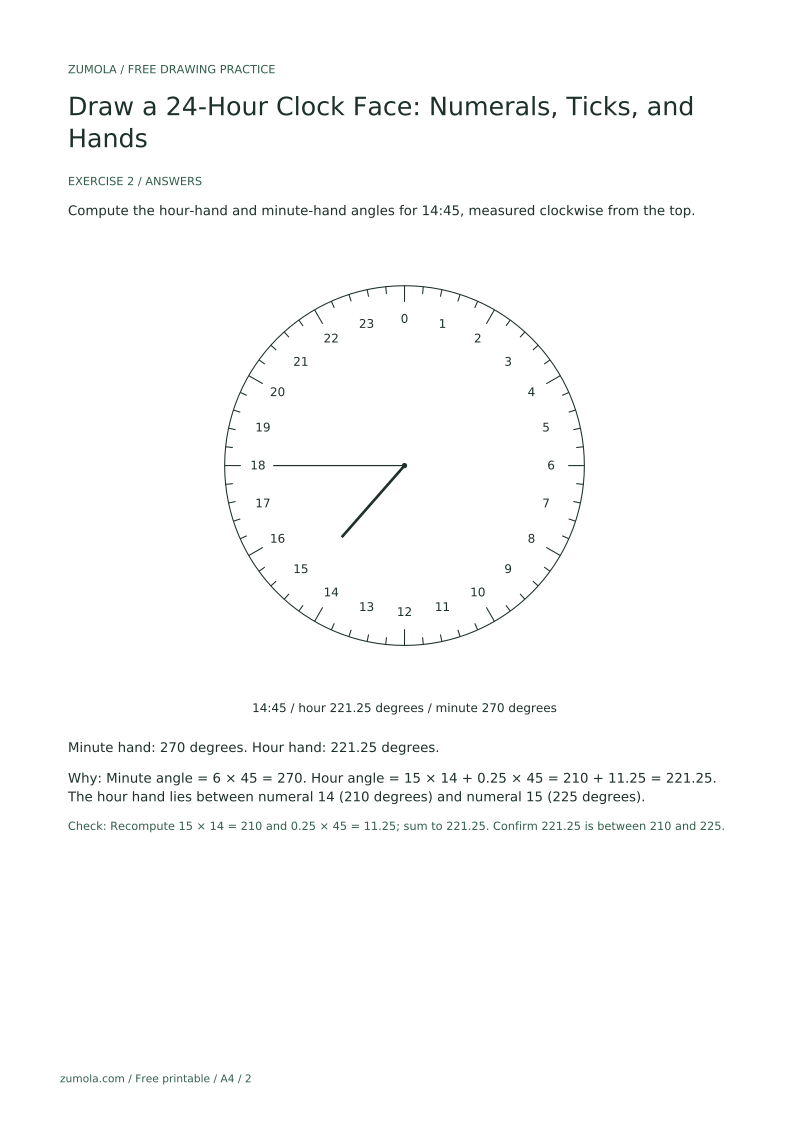
Compute the hour-hand and minute-hand angles for 14:45, measured clockwise from the top.
Minute hand: 270 degrees. Hour hand: 221.25 degrees.
Minute angle = 6 × 45 = 270. Hour angle = 15 × 14 + 0.25 × 45 = 210 + 11.25 = 221.25. The hour hand lies between numeral 14 (210 degrees) and numeral 15 (225 degrees).
Check: Recompute 15 × 14 = 210 and 0.25 × 45 = 11.25; sum to 221.25. Confirm 221.25 is between 210 and 225.
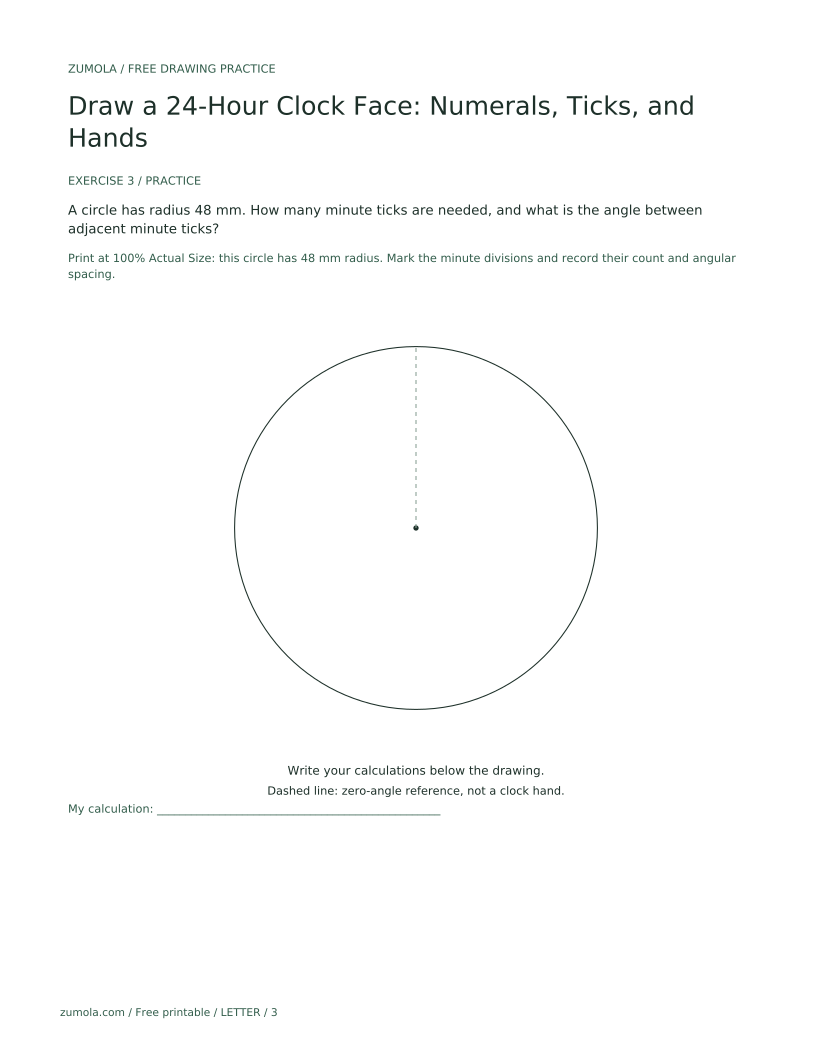
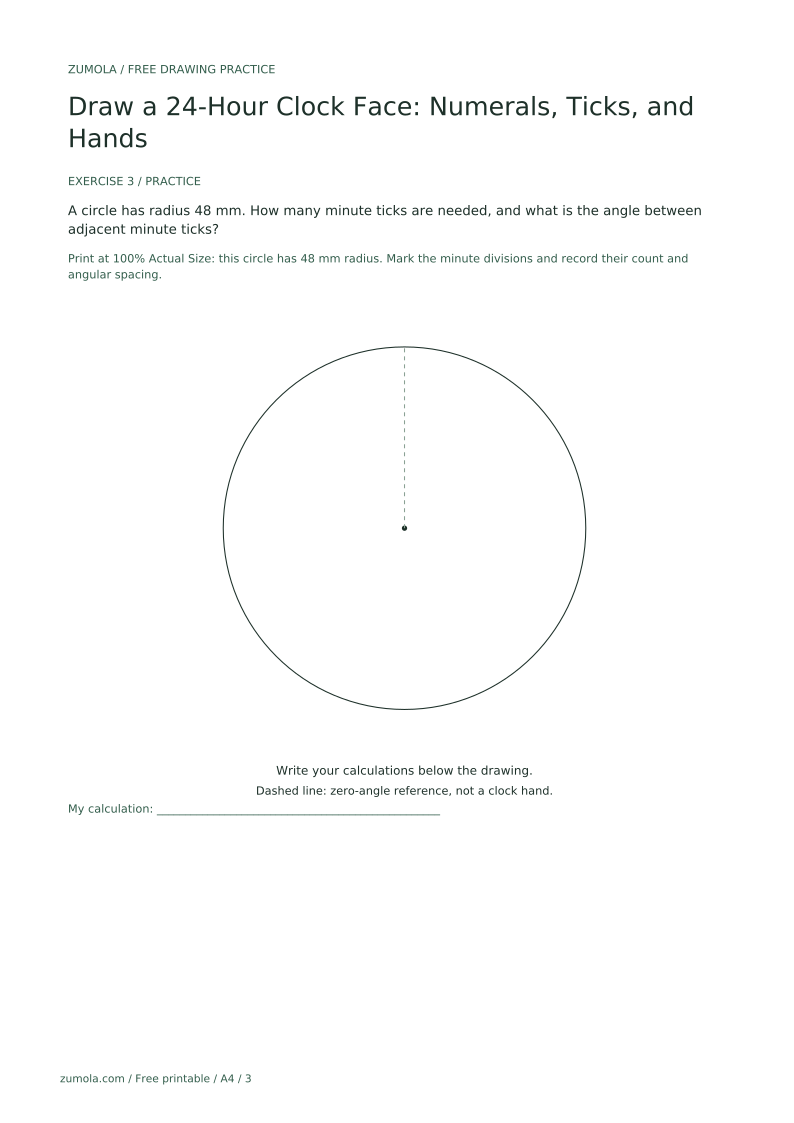
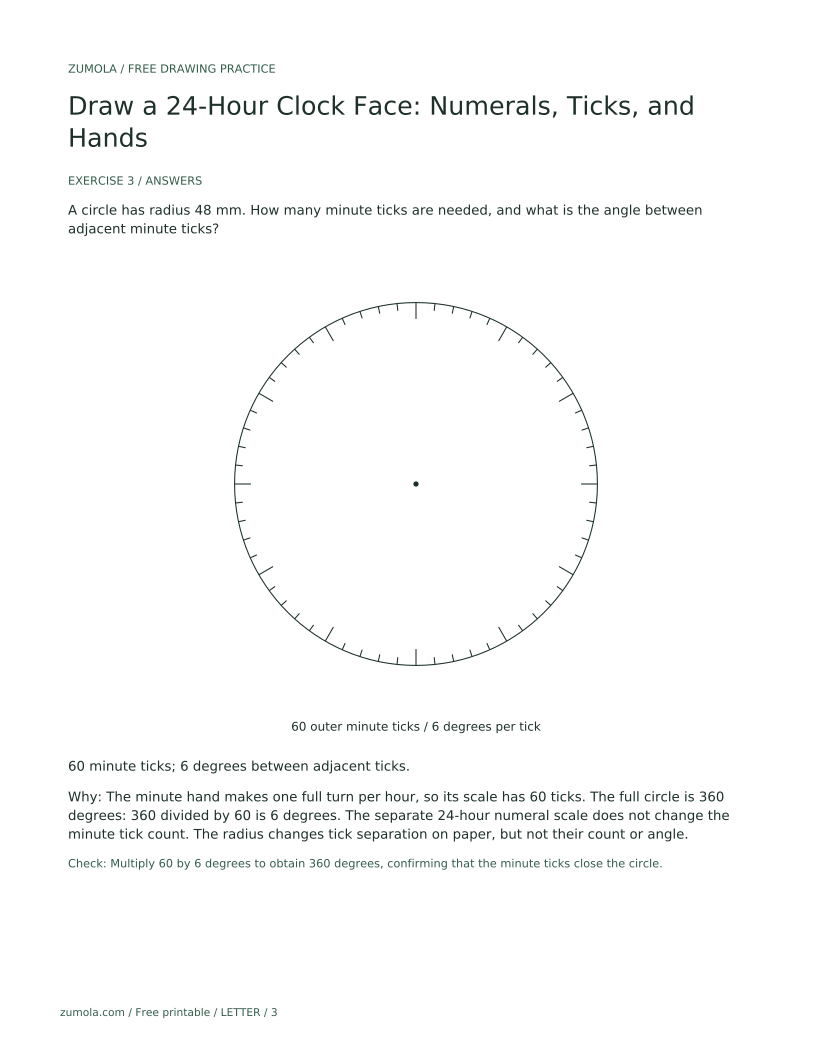
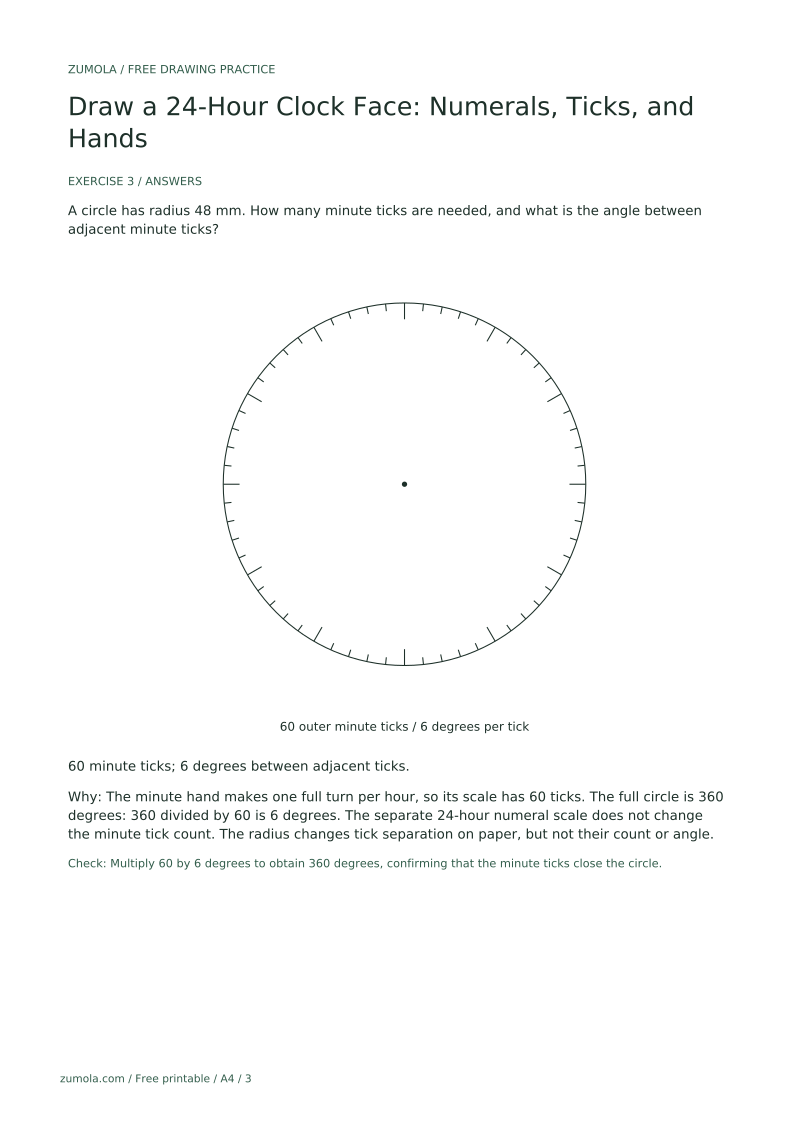
A circle has radius 48 mm. How many minute ticks are needed, and what is the angle between adjacent minute ticks?
60 minute ticks; 6 degrees between adjacent ticks.
The minute hand makes one full turn per hour, so its scale has 60 ticks. The full circle is 360 degrees: 360 divided by 60 is 6 degrees. The separate 24-hour numeral scale does not change the minute tick count. The radius changes tick separation on paper, but not their count or angle.
Check: Multiply 60 by 6 degrees to obtain 360 degrees, confirming that the minute ticks close the circle.
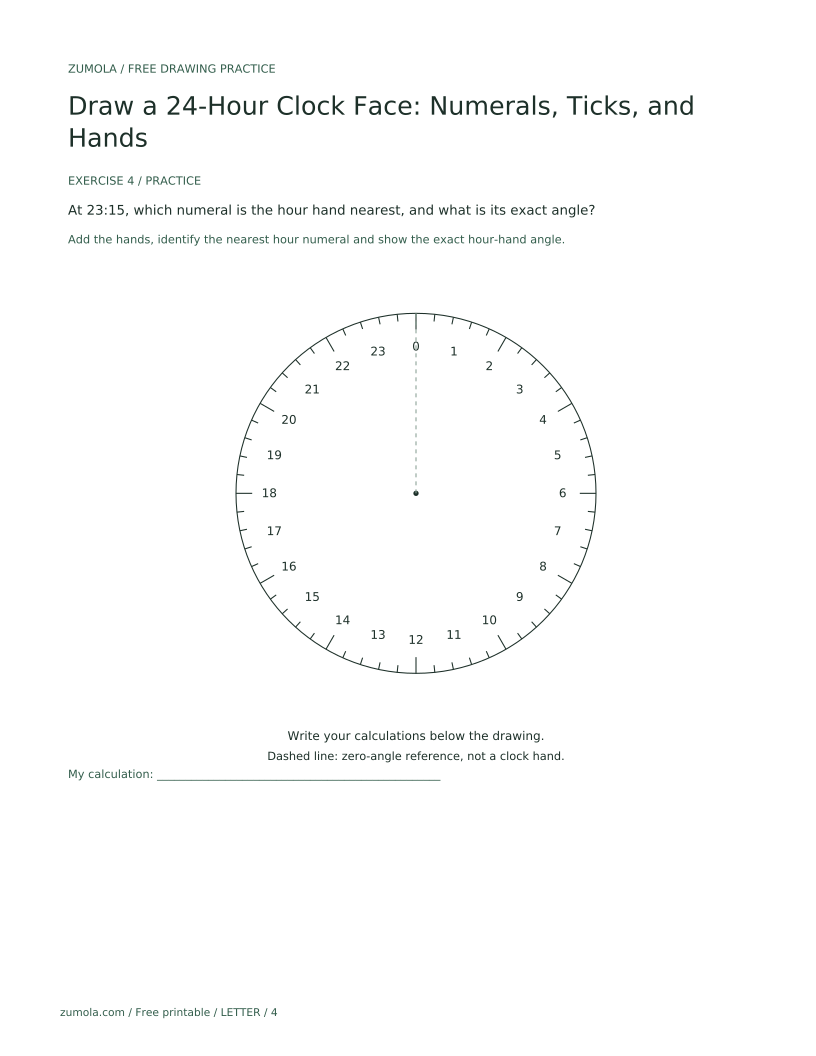
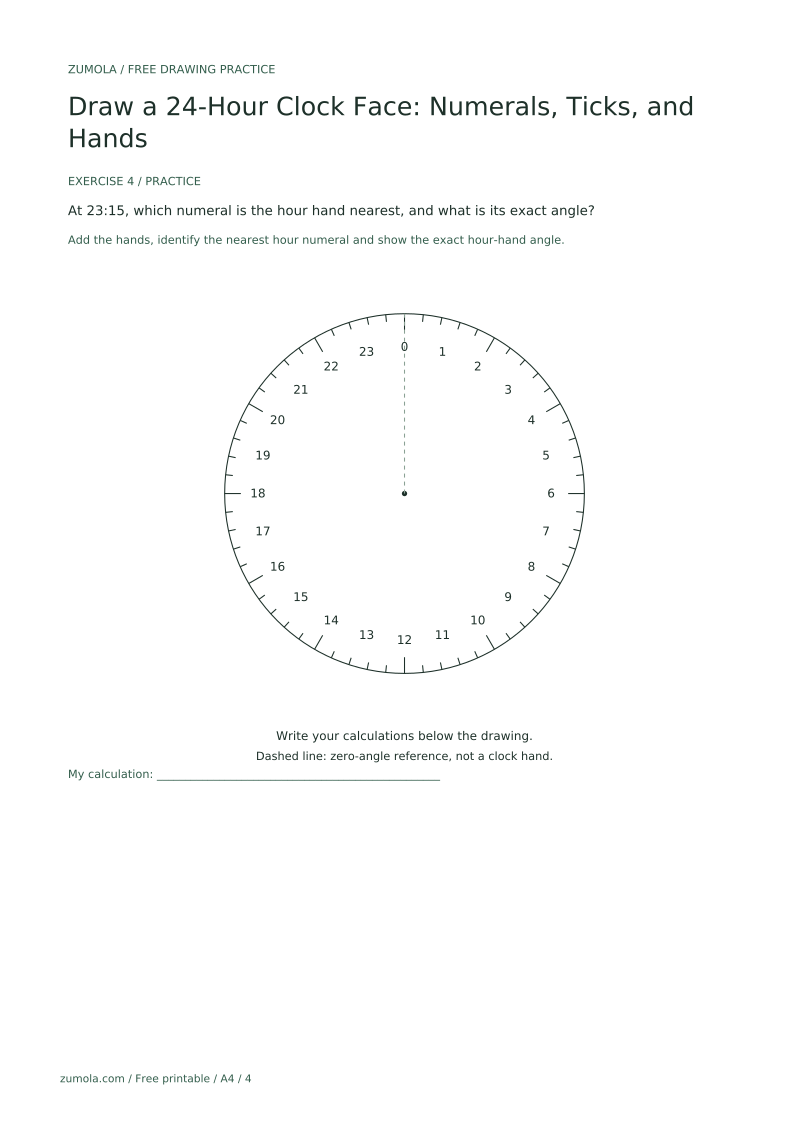
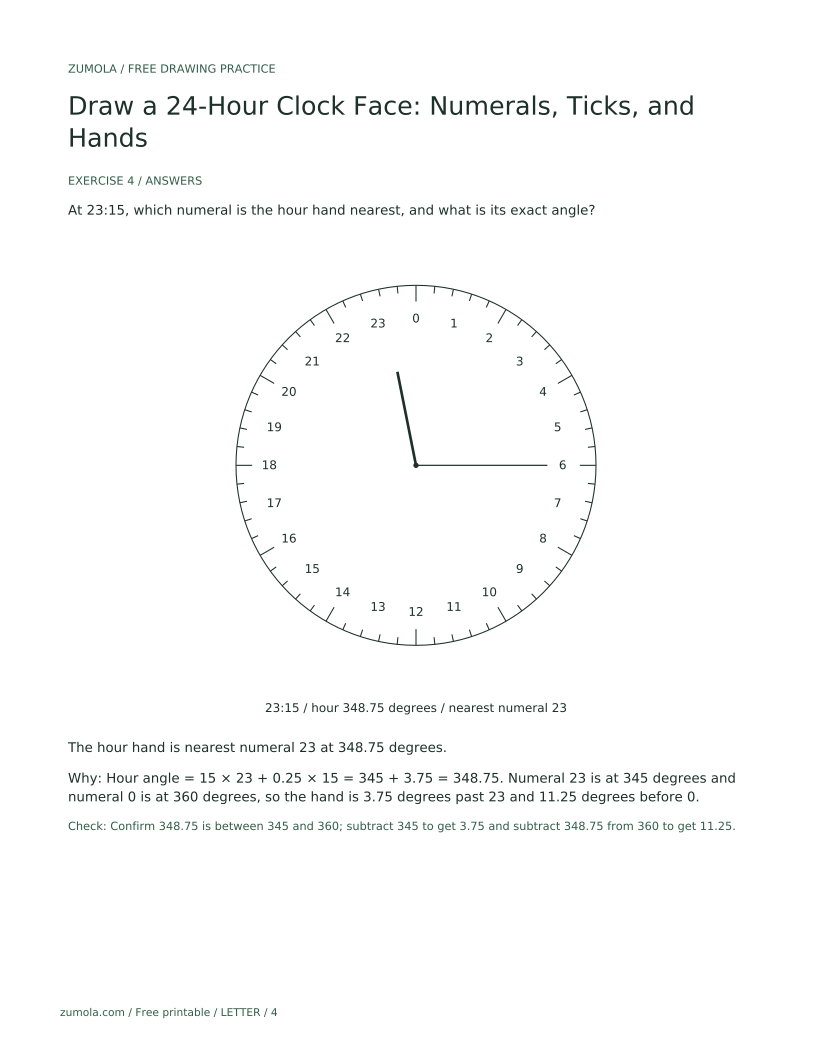
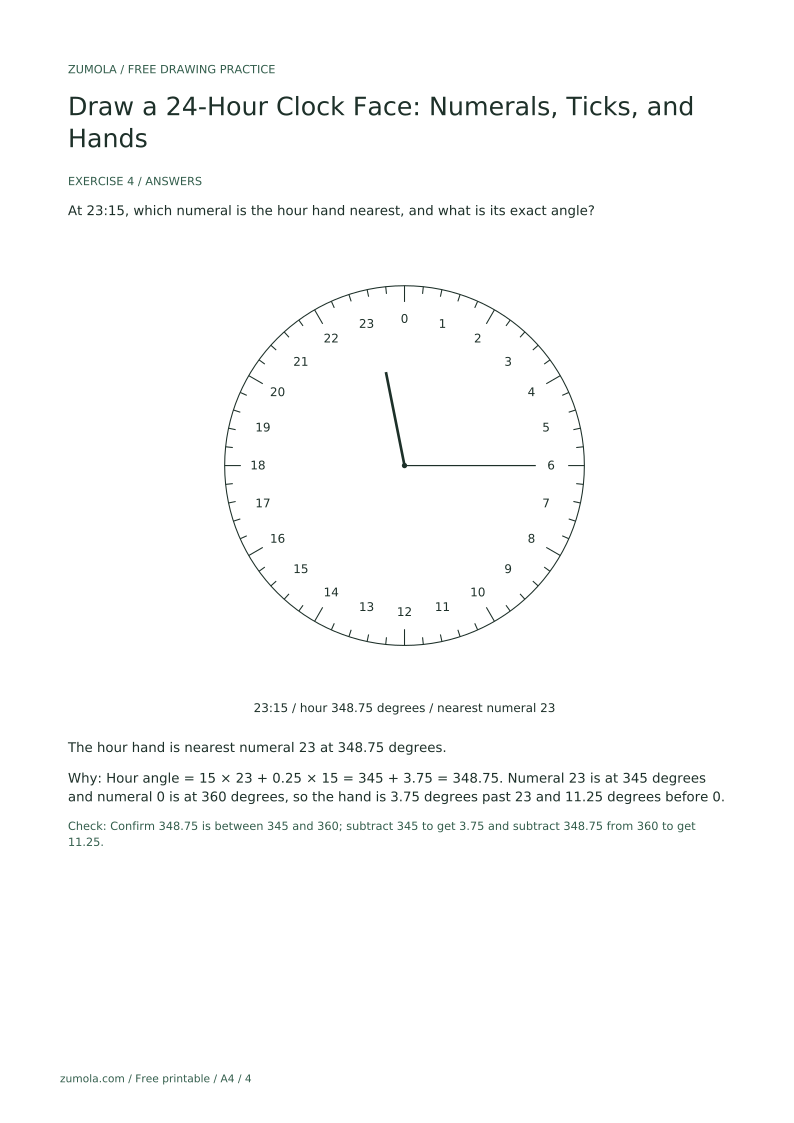
At 23:15, which numeral is the hour hand nearest, and what is its exact angle?
The hour hand is nearest numeral 23 at 348.75 degrees.
Hour angle = 15 × 23 + 0.25 × 15 = 345 + 3.75 = 348.75. Numeral 23 is at 345 degrees and numeral 0 is at 360 degrees, so the hand is 3.75 degrees past 23 and 11.25 degrees before 0.
Check: Confirm 348.75 is between 345 and 360; subtract 345 to get 3.75 and subtract 348.75 from 360 to get 11.25.
Use 15-degree spacing for 24 hours; verify by counting 24 numerals around the full circle.
Add 0.25 degrees per minute to the hour angle so the hand moves continuously.
Measure clockwise from the top reference line, the same direction numerals increase.
Keep 24 hour numerals at 15-degree spacing and 60 outer minute ticks at 6-degree spacing. Mark the two scales separately.
A 24-hour face starts the day at 0 (midnight). Placing 0 at the top and increasing clockwise keeps the arithmetic simple: hour angle equals 15 times the hour plus a minute correction.
Use 60 ticks on the outer minute ring, at 6-degree spacing. The inner hour ring has 24 numerals at 15-degree spacing; the two scales are independent.
Yes. Numeral shape and letter style may vary. The rubric checks position, spacing, tick count, and hand angles, not a single handwriting style.
Extend the reference line beyond the circle and measure angles at the center with a straightedge aligned to each mark. Measure your actual tools and label any tolerance you choose as a hypothetical example.