Free original lessons
Shrub Drawing: Branch-and-Leaf Construction
Learn to draw a shrub by building branch structure first, then adding foliage clusters. Includes steps, practice tasks, and a rubric for valid alternatives.
Free lesson
Four exercises
Worked answers
Object Drawing Lessons
A shrub is a woody plant with multiple stems arising near the ground, unlike a tree with a single trunk. This lesson teaches a reliable construction method: establish the branch skeleton, then attach foliage clusters. The convention is simple: draw light construction lines first, then firm outlines. Leaf shapes vary by species, so the rubric rewards consistent, plausible choices rather than one universal leaf. All measurements are hypothetical examples; measure your own paper and tools.
Practice materials: Printable downloads are not available for this lesson yet. Use the instructions and four exercises below.
Reference illustration
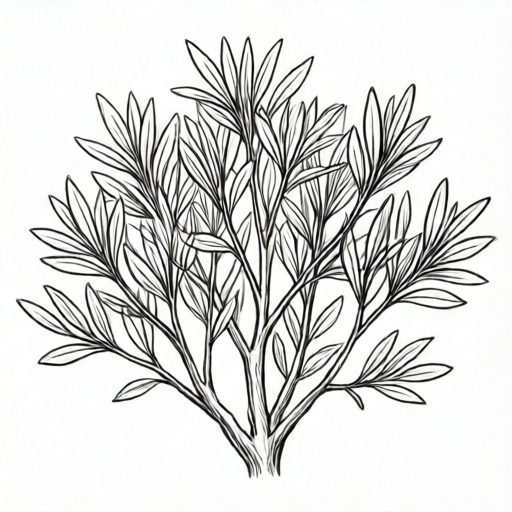
Use the stated measurements and conventions for each exercise.
Branch Skeleton First
Begin by drawing a light ground line and a small root crown point. From that point, draw three to five main stems that spread outward and upward. Each stem should fork once or twice, creating a branching network. Keep forks at different heights so the shrub looks natural.
Use a simple convention: construction lines are light and thin; final branch lines are darker and slightly thicker. This helps you revise without erasing. Branch thickness can taper from base to tip, but exact taper is a style choice, not a rule.
- Mark a ground line and a root crown point at the center.
- Draw three to five main stems from the crown, spreading outward.
- Add one or two forks per main stem at varied heights.
- Check that no branch crosses another without a clear overlap point.
Foliage Clusters
Foliage is added as clusters, not individual leaves everywhere. A cluster is an oval or rounded shape that follows the branch tips. Draw clusters at branch ends and along outer stems, leaving some inner branches visible. This shows structure while suggesting density.
Within each cluster, draw a few leaf shapes using a consistent convention: for example, simple ovals with a center vein, or pointed leaves with two side veins. Choose one leaf style and repeat it. Valid alternatives include rounded, pointed, or lobed leaves, as long as the choice is consistent and plausible for a shrub.
- Draw oval cluster shapes at branch tips and along outer stems.
- Leave gaps so some inner branches remain visible.
- Add leaf shapes inside clusters using one consistent style.
- Vary cluster size slightly to avoid a mechanical look.
Refining and Checking
After clusters are placed, darken the final branch lines and cluster outlines. Remove or lighten construction lines only if your convention allows; otherwise keep them as a record of your process. Check that the shrub reads as multiple stems from the ground, not a single trunk.
Use simple arithmetic to check balance: if you drew five main stems, count how many reach the left and right halves of the page. A difference of one or two is acceptable. Also check that at least one inner branch is visible through the foliage.
- Darken final branch and cluster outlines.
- Count main stems on each side of the center line.
- Confirm at least one inner branch is visible.
- Label your leaf style choice in a corner note.
Worked example
Draw a shrub with four main stems, two forks per stem, and five foliage clusters. Use oval leaves with a center vein. Check that two inner branches remain visible.
Worked answer
A completed drawing shows a ground line, a root crown point, four stems spreading outward, each with two forks at varied heights. Five oval clusters sit at branch tips and outer stems, with two inner branches visible through gaps. Leaf style is consistent oval with center vein, noted in the corner.
Four practice exercises
Exercise 1
Draw a shrub skeleton with exactly three main stems and one fork per stem. Do not add foliage. Mark the root crown point.
Show answer and check
A light drawing shows a ground line, a marked root crown point, three stems spreading outward, and one fork on each stem at different heights.
Why: This isolates branch construction before foliage, making structure easy to check.
Check: Count three stems from the crown and one fork per stem; confirm fork heights differ.
Exercise 2
Add four foliage clusters to your three-stem skeleton. Use pointed leaves with two side veins. Leave one inner branch visible.
Show answer and check
Four pointed-leaf clusters sit at branch tips or outer stems; one inner branch remains uncovered.
Why: Cluster placement and leaf consistency are the focus; the visible inner branch proves structure is preserved.
Check: Count four clusters, confirm one leaf style, and trace at least one inner branch to the crown.
Exercise 3
Draw a shrub with five main stems. Place clusters so that the left and right halves of the page each have at least two stems reaching them. Note your leaf style.
Show answer and check
Five stems spread from the crown; at least two reach each half. Clusters follow branch tips. A corner note states the leaf style.
Why: This practices balance using simple counting rather than exact symmetry.
Check: Count stems per half; a difference of one or two is acceptable. Confirm the style note exists.
Exercise 4
Create a final shrub drawing using your chosen convention. Include a root crown point, three to five stems, varied forks, and at least four clusters. Add a small key explaining your line convention and leaf style.
Show answer and check
A complete shrub drawing with labeled convention key, readable branch structure, consistent leaf style, and visible inner branch.
Why: The final task combines structure, foliage, and documentation so the drawing can be assessed fairly against valid alternatives.
Check: Use the rubric: count stems, check fork variety, count clusters, confirm inner branch visibility, and read the key for consistency.
Common mistakes
- Drawing a single trunk like a tree. Start with three to five stems from the root crown point.
- Filling every branch with leaves so structure disappears. Leave gaps and keep some inner branches visible.
- Mixing many leaf shapes in one drawing. Choose one leaf convention and repeat it consistently.
- Making all forks at the same height. Vary fork heights to create natural branching.
Self-check rubric
- Branch structure shows three to five main stems from a root crown point.
- Forks occur at varied heights and connect logically.
- Foliage is drawn as clusters, not scattered individual leaves.
- At least one inner branch remains visible through foliage.
- Leaf style is consistent and plausible for a shrub; alternatives are accepted if noted.
- Construction and final lines follow a stated convention.
Questions and answers
How many main stems should a shrub have?
Three to five is a practical range for this exercise. More stems can work if the page allows, but keep the count checkable.
Must every leaf be drawn individually?
No. Clusters suggest foliage. Draw a few representative leaves inside each cluster using one consistent style.
What if my leaf style differs from the example?
Valid alternatives are accepted if the style is consistent and plausible for a shrub. Note your choice so the rubric can assess consistency.
Can I erase construction lines?
Yes, if your convention allows. Otherwise keep them light. The key is that final lines are clear and the branch structure is readable.