Free original lessons
Cat Eyes Drawing: Slit Pupil, Almond Lids, and Fur Rim
Learn to draw cat eyes with a vertical slit pupil, almond-shaped lids, and a soft fur rim using measured construction and clear checks.
Free lesson
Four exercises
Worked answers
Object Drawing Lessons
Cat eyes combine a narrow vertical slit pupil with an almond lid opening and a fur rim that frames the eye. This lesson builds the eye in layers: first the almond boundary, then the slit pupil, then the iris and fur rim. You will use a simple convention for eye height and lid curvature so that your drawing can be checked without relying on a single universal style. All measurements are hypothetical examples; measure your own paper and tools before drawing.
Practice materials: Printable downloads are not available for this lesson yet. Use the instructions and four exercises below.
Reference illustration
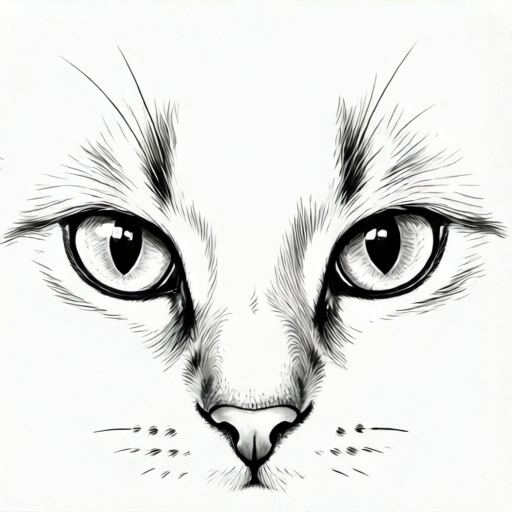
Use the stated measurements and conventions for each exercise.
Set the almond boundary and eye axis
Begin by drawing a light horizontal axis line for the eye. Mark a center point. The almond shape is wider than it is tall: for a hypothetical example, make the eye width 60 mm and the eye height 24 mm. These numbers are examples only; choose values that fit your paper. The upper lid curves more steeply than the lower lid, and the outer corner sits slightly higher than the inner corner in many cat eye drawings.
Use a light construction line to connect the inner corner, the top midpoint, the outer corner, and the bottom midpoint. Check that the top midpoint is above the axis and the bottom midpoint is below it. The almond should taper at both corners, not end in blunt points.
- Draw a horizontal axis and mark the center.
- Mark inner and outer corners at equal distances from the center.
- Mark the top midpoint above the axis and the bottom midpoint below it.
- Connect the four points with smooth curves, keeping the upper curve fuller than the lower curve.
- Check that the shape is wider than tall and that both corners taper.
Place the vertical slit pupil
The slit pupil is a narrow vertical shape centered on the eye axis. For a hypothetical example, make the pupil width 4 mm and the pupil height 18 mm inside a 24 mm eye height. The pupil should not touch the top or bottom lid; leave a small iris margin. The slit is usually slightly wider at the middle and tapers toward both ends.
Draw the pupil with two gentle curves rather than a single straight line. Check symmetry by measuring the distance from the pupil to the inner corner and to the outer corner; these distances should be close but need not be identical in a stylized drawing.
- Mark the pupil center on the eye axis.
- Mark the top and bottom of the pupil, leaving an iris margin.
- Draw two gentle vertical curves to form the slit.
- Check that the pupil is centered and narrower than the iris.
- Darken the pupil only after the almond and iris are confirmed.
Add iris, lid thickness, and fur rim
The iris fills the almond around the pupil. Draw a light oval or almond-shaped iris boundary inside the lid opening, leaving a thin lid line visible. The lid thickness is a second line just outside the almond, not a heavy outline. The fur rim is a broken, soft edge around the eye, made of short strokes that follow the lid direction.
For the fur rim, use short strokes that point away from the eye. Do not draw a continuous thick border. Check that the fur rim does not cover the pupil or the inner corner. The lower lid fur often points downward, while the upper lid fur points upward and outward.
- Draw the iris boundary inside the almond.
- Add a thin lid line outside the almond.
- Draw short fur strokes around the upper and lower lids.
- Keep the fur rim broken and directional.
- Check that the pupil remains visible and centered.
Compare and refine with check boxes
Use two small comparison boxes beside your drawing. In the first box, sketch only the almond and slit pupil. In the second box, sketch the same eye with the fur rim. Compare the two boxes to see whether the fur rim changes the apparent eye shape. This helps you keep the almond readable.
Refine by erasing construction lines and strengthening the pupil and lid lines. Keep the fur rim lighter than the pupil. Check the drawing at arm's length: the almond should still read as an eye, and the slit should still be vertical.
- Sketch a simplified almond and pupil in a comparison box.
- Sketch the same eye with fur rim in a second box.
- Compare the two boxes for shape clarity.
- Erase construction lines and strengthen key lines.
- Check the final drawing at arm's length.
Worked example
Draw a cat eye with a 50 mm wide almond, a 20 mm high almond, and a slit pupil 3 mm wide and 14 mm high. Describe the construction and one check.
Worked answer
Draw a horizontal axis and mark the center. Mark corners 25 mm from the center. Mark the top midpoint 10 mm above the axis and the bottom midpoint 10 mm below. Connect with smooth curves, keeping the upper curve fuller. Draw the pupil centered on the axis, 3 mm wide and 14 mm high, leaving a 3 mm iris margin above and below. Check that the pupil height plus two margins equals 20 mm: 14 + 3 + 3 = 20 mm.
Four practice exercises
Exercise 1
Draw an almond 40 mm wide and 16 mm high. Mark the center and the four boundary points. State the distance from the center to each corner.
Show answer and check
Corners are 20 mm from the center. Top and bottom midpoints are 8 mm above and below the axis.
Why: Half of 40 mm is 20 mm, and half of 16 mm is 8 mm. These marks set a 2.5 to 1 width-to-height ratio.
Check: Measure corner distances and midpoint distances; confirm 20 mm and 8 mm.
Exercise 2
Inside a 16 mm high almond, draw a slit pupil 10 mm high. Leave equal iris margins above and below. State the margin.
Show answer and check
Each margin is 3 mm because 16 minus 10 equals 6, and 6 divided by 2 equals 3.
Why: The pupil height plus two equal margins must equal the almond height.
Check: Measure the top and bottom margins; both should be 3 mm.
Exercise 3
A drawing has an almond 30 mm wide and 15 mm high. Is the width-to-height ratio greater or less than 2 to 1? Show the arithmetic.
Show answer and check
The ratio is 2 to 1 because 30 divided by 15 equals 2.
Why: Divide width by height to compare with the 2 to 1 benchmark.
Check: Recalculate 30 divided by 15 and confirm the result is 2.
Exercise 4
Sketch two comparison boxes: one with only the almond and slit pupil, one with the fur rim added. Describe one difference a viewer should notice.
Show answer and check
The fur rim should soften the outer edge without changing the almond's tapered corners or hiding the vertical slit.
Why: The comparison boxes test whether the fur rim supports the eye shape rather than replacing it.
Check: Place the boxes side by side and confirm the almond and slit remain readable in both.
Common mistakes
- Making the pupil a straight rectangle. Use two gentle curves that taper at the top and bottom, and leave an iris margin.
- Drawing the almond as a circle or oval. Taper both corners and make the upper lid curve fuller than the lower lid.
- Using a continuous thick outline for the fur rim. Use short, broken strokes that follow the lid direction and keep the rim lighter than the pupil.
- Letting the pupil touch the lids. Measure a small iris margin above and below the pupil before darkening it.
Self-check rubric
- Almond boundary is wider than tall and tapers at both corners.
- Upper lid curve is fuller than the lower lid curve.
- Slit pupil is vertical, centered, and narrower than the iris.
- Pupil leaves a visible iris margin above and below.
- Fur rim uses short, broken, directional strokes and does not hide the pupil.
- Construction lines are lightened or removed in the final drawing.
- Valid alternatives are accepted if the almond reads clearly and the slit remains vertical.
Questions and answers
Does the pupil have to be perfectly centered?
A centered pupil is easiest to check, but a slight offset can be valid in a stylized drawing. Keep the offset small and consistent with the lid shape.
How wide should the fur rim be?
There is no universal width. Use short strokes that suggest fur without hiding the almond. Measure your own drawing and keep the rim lighter than the pupil.
Can I use a ruler for the almond?
Yes. A ruler helps set the axis and corner marks. Remove or lighten construction lines after the curves are drawn.
What if my eye looks too tall?
Check the width-to-height ratio. For the hypothetical example, width 60 mm and height 24 mm gives a ratio of 2.5 to 1. Adjust your marks before redrawing the curves.