Free original lessons
Holiday Drawings: Ornament, Tree, and Snowman Construction
Learn to draw three holiday subjects using simple shapes, proportion guides, and a defined line convention. Includes practice tasks, a worked example, and a rubric.
Free lesson
Four exercises
Worked answers
Object Drawing Lessons
This lesson teaches construction drawing for three holiday subjects: a hanging ornament, a decorated tree, and a snowman. You will use a consistent line convention, simple geometric guides, and checkable proportions. The goal is not a single correct picture but a clear, well-proportioned drawing that follows the stated construction steps. All measurements are hypothetical examples; measure your own paper and tools. Work in pencil so guides can be lightened or erased.
Practice materials: Printable downloads are not available for this lesson yet. Use the instructions and four exercises below.
Reference illustration
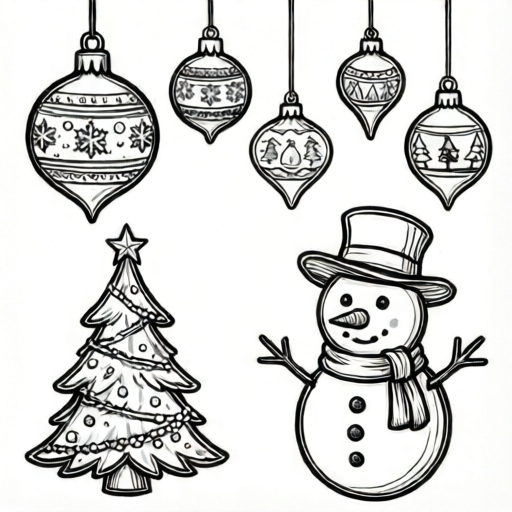
Use the stated measurements and conventions for each exercise.
Line Convention and Proportion Guides
Use two line types: construction lines (light, thin, and removable) and final lines (darker and confident). Construction lines define shape and position; final lines define the drawing you keep. X-height means the distance from baseline to midline for lowercase letters, but for drawing we adapt it as a vertical unit: choose a unit height U for the main body of each subject and keep all sub-parts as simple multiples of U. For example, if U is 2 cm, an ornament body might be 1.5U tall and a snowman's middle ball 1U tall. These numbers are hypothetical; measure your paper and choose a U that fits.
Before drawing, mark a vertical center line and a horizontal baseline. Mark U on a scrap strip of paper to use as a measuring tool. Keep all guides light enough to erase. Check proportions by counting U units rather than guessing.
- Mark a vertical center line and a horizontal baseline on your paper.
- Cut a paper strip and mark your chosen unit U on it.
- Use U to mark key heights and widths lightly along the center line.
- Draw construction lines first, then final lines over them.
- Erase construction lines only after the final lines are complete.
Ornament Construction
An ornament is built from a body shape, a cap, and a hanging loop. Choose a body shape: circle, oval, or teardrop. The cap sits on top and is narrower than the body. The loop is a small open shape above the cap. Keep the cap height about 0.25U and the loop about 0.2U. These are hypothetical examples; adjust to your U.
Center the body on the vertical center line. The widest point of the body should be halfway up the body height. The cap should be centered and its width about one-third of the body width. The loop should sit directly above the cap center.
- Draw a light vertical center line and mark the body height using U.
- Draw the body outline as a circle, oval, or teardrop centered on the line.
- Mark the cap height above the body and draw a narrow trapezoid or rectangle.
- Draw a small loop above the cap, centered on the line.
- Darken final lines and erase construction lines.
Tree Construction
A tree is built from a trunk and stacked triangular or rounded tiers. Use three tiers for a simple tree. Each tier is wider than the one above it. The trunk is a narrow rectangle below the lowest tier. Keep tier heights equal or slightly increasing downward. For example, with U = 2 cm, tier heights might be 1U, 1.2U, and 1.4U, and tier widths might be 1.5U, 2.5U, and 3.5U. These are hypothetical examples.
Center the trunk on the vertical line. Stack tiers so each tier's bottom edge overlaps the top of the tier below slightly. This overlap hides the joint. Add a star or simple topper only if it fits your paper; the topper is optional and not required for proportion.
- Draw a vertical center line and mark the trunk height (about 0.5U).
- Draw the trunk as a narrow rectangle centered on the line.
- Mark three tier heights upward from the trunk top.
- Draw each tier as a triangle or rounded triangle, wider than the one above.
- Overlap tier bottoms slightly, darken final lines, and erase guides.
Snowman Construction
A snowman is built from three stacked circles or ovals: bottom, middle, and head. The bottom is largest, the middle is smaller, and the head is smallest. A common proportion is bottom diameter 2U, middle 1.5U, and head 1U. These are hypothetical examples. Stack the circles so each sits slightly into the one below to show connection.
Add simple features: two eyes, a carrot nose, a mouth, and optional stick arms. Keep features centered on the vertical line. Arms attach at the middle circle's sides. A hat or scarf is optional and should not change the body proportions.
- Draw a vertical center line and mark the bottom circle diameter (2U).
- Draw the bottom circle centered on the line.
- Mark the middle circle diameter (1.5U) above and draw it overlapping the bottom slightly.
- Mark the head diameter (1U) above and draw it overlapping the middle slightly.
- Add centered features and optional arms, then darken final lines and erase guides.
Worked example
Using U = 2 cm, construct an ornament with a circular body 1.5U tall, a cap 0.25U tall, and a loop 0.2U tall. Describe the steps and check the total height.
Worked answer
Body height = 1.5 × 2 = 3 cm. Cap height = 0.25 × 2 = 0.5 cm. Loop height = 0.2 × 2 = 0.4 cm. Total height = 3 + 0.5 + 0.4 = 3.9 cm. Draw a vertical center line, mark 3.9 cm total, place the body circle centered with its widest point at 1.5 cm above the body bottom, draw the cap centered above the body, and draw the loop centered above the cap. Check that cap width is about one-third of body width and that all parts share the center line.
Four practice exercises
Exercise 1
Using U = 3 cm, construct an ornament with an oval body 1.2U tall, a cap 0.3U tall, and a loop 0.2U tall. State the total height and the cap width if cap width is one-third of body width when body width is 1U.
Show answer and check
Body height = 1.2 × 3 = 3.6 cm. Cap height = 0.3 × 3 = 0.9 cm. Loop height = 0.2 × 3 = 0.6 cm. Total height = 3.6 + 0.9 + 0.6 = 5.1 cm. Body width = 1 × 3 = 3 cm. Cap width = one-third of 3 = 1 cm.
Why: Multiply each U multiple by U = 3 cm. Add the three heights for total height. Body width is 1U = 3 cm; cap width is one-third of that.
Check: Re-add 3.6 + 0.9 + 0.6 = 5.1 cm. Confirm cap width 1 cm is less than body width 3 cm and that all parts share the center line.
Exercise 2
Using U = 2 cm, construct a three-tier tree with tier heights 1U, 1.2U, and 1.4U from top to bottom and trunk height 0.5U. State the total height and check that each lower tier is wider than the one above if widths are 1.5U, 2.5U, and 3.5U.
Show answer and check
Tier heights: 2 cm, 2.4 cm, 2.8 cm. Trunk height = 1 cm. Total height = 2 + 2.4 + 2.8 + 1 = 8.2 cm. Widths: 3 cm, 5 cm, 7 cm. Each lower tier is wider: 3 < 5 < 7.
Why: Multiply each multiple by U = 2 cm. Add tier heights and trunk height. Compare widths in order from top to bottom.
Check: Re-add 2 + 2.4 + 2.8 + 1 = 8.2 cm. Confirm 3 cm < 5 cm < 7 cm and that tiers overlap slightly at joints.
Exercise 3
Using U = 4 cm, construct a snowman with bottom diameter 2U, middle diameter 1.5U, and head diameter 1U. State each diameter and the total stacked height if circles overlap by 0.2U at each joint.
Show answer and check
Bottom diameter = 8 cm, middle = 6 cm, head = 4 cm. Overlap = 0.2 × 4 = 0.8 cm at each joint. Total height = 8 + 6 + 4 − 0.8 − 0.8 = 16.4 cm.
Why: Multiply diameters by U = 4 cm. Sum diameters, then subtract one overlap for each of the two joints.
Check: Re-add 8 + 6 + 4 = 18 cm, subtract 1.6 cm for two overlaps, get 16.4 cm. Confirm diameters decrease from bottom to head.
Exercise 4
Using U = 2.5 cm, construct an ornament with a teardrop body 1.4U tall and 0.8U wide, a cap 0.2U tall, and a loop 0.15U tall. State the total height and check that the cap width (one-third of body width) is less than body width.
Show answer and check
Body height = 3.5 cm, body width = 2 cm, cap height = 0.5 cm, loop height = 0.375 cm. Total height = 3.5 + 0.5 + 0.375 = 4.375 cm. Cap width = one-third of 2 ≈ 0.67 cm, which is less than 2 cm.
Why: Multiply each multiple by U = 2.5 cm. Add heights for total. Compute cap width as one-third of body width and compare.
Check: Re-add 3.5 + 0.5 + 0.375 = 4.375 cm. Confirm 0.67 cm < 2 cm and that the teardrop is centered on the vertical line.
Common mistakes
- Drawing final lines before construction lines are complete. Finish all light construction lines first, check proportions with U, then darken final lines.
- Making the ornament cap wider than the body. Keep cap width about one-third of body width and center it on the vertical line.
- Stacking tree tiers without overlap, leaving gaps. Overlap each tier's bottom slightly over the tier below to hide the joint.
- Making snowman circles equal in size. Use decreasing diameters: bottom largest, middle smaller, head smallest.
Self-check rubric
- Construction lines are light and final lines are darker and confident.
- All parts are centered on the vertical center line.
- Proportions use a consistent unit U and match the stated multiples within a small tolerance.
- Ornament cap is narrower than the body and the loop sits above the cap center.
- Tree tiers are stacked with slight overlap and each tier is wider than the one above.
- Snowman circles decrease in size from bottom to head and overlap slightly.
- Features and optional additions do not distort the main proportions.
- Valid alternative shapes (oval or teardrop ornament, rounded tree tiers) are accepted if proportions and centering are correct.
Questions and answers
Do I have to use the exact unit U given in the examples?
No. The numbers are hypothetical. Choose a U that fits your paper and keep all parts as consistent multiples of that U.
Can I use a different ornament body shape?
Yes. Circle, oval, and teardrop are all valid. The rubric checks centering, cap proportion, and loop placement, not a single body shape.
How many tree tiers should I draw?
Three tiers are suggested for simplicity. More tiers are acceptable if each is wider than the one above and proportions remain consistent.
What if my snowman's arms are uneven?
Arms are optional. If drawn, attach them at the middle circle's sides and check that both start at the same height. Small differences are acceptable under the rubric.