Free original lessons
Mule Deer Drawing: Body, Ear, and Forked Antler Construction
Learn to draw a mule deer using proportion guides, large ear shape breakdown, and forked antler branching steps with clear checks and practice tasks.
Free lesson
Four exercises
Worked answers
Object Drawing Lessons
This lesson teaches a repeatable method for drawing a mule deer. You will build the body from simple proportion guides, shape the oversized ears that distinguish mule deer, and construct forked antlers with clear branching logic. All measurements are relative to the deer's own body units, so the method scales to any paper size. Use a pencil and eraser; keep construction lines light until the final pass. The convention for line quality is defined in the rubric: construction lines are thin and broken, final contour lines are firm and continuous, and shading is optional. Letter styles and handwriting vary, so the rubric rewards clear, checkable construction rather than a single perfect line. Work through the sections in order, then attempt the four practice exercises. Each exercise is self-contained and includes reasoning and a check method so you can verify your own result.
Practice materials: Printable downloads are not available for this lesson yet. Use the instructions and four exercises below.
Reference illustration
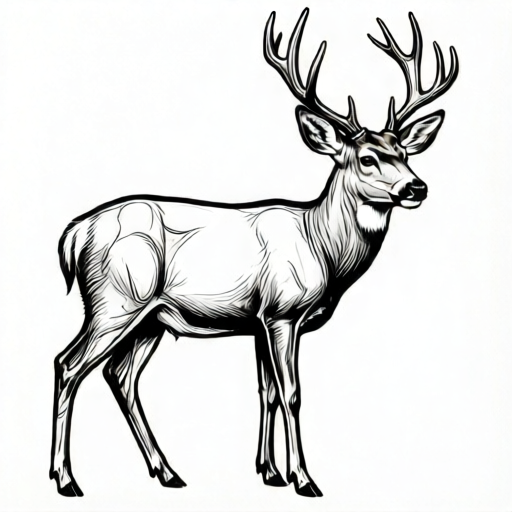
Use the stated measurements and conventions for each exercise.
Body Proportion Guides
Begin with a side-view body built from three overlapping ovals: chest, midsection, and hindquarters. Use the deer's head length as one unit (1 U). A typical mule deer body from chest to rump is about 3.5 U long, and the shoulder height is about 2.5 U. These are hypothetical example values for practice; measure your own reference if you have one. Place the chest oval first, then the midsection, then the hindquarters, overlapping each by about one-third. Add a neck line from the chest to the head position, angled slightly forward. Add four leg lines as simple tapered rectangles, with the front legs under the chest and the rear legs under the hindquarters. Keep all lines light and broken so you can adjust them.
Check the body before adding details: the back line should be nearly level from shoulders to rump, the belly line should curve gently upward toward the hindquarters, and the legs should be about 1.2 U long measured from the belly line to the hoof. Shoulder height (2.5 U) is measured from the top of the back at the shoulder down to the hoof, so the body depth from back to belly is 2.5 − 1.2 = 1.3 U; keep that relationship consistent when you adjust leg length, and make the chest oval about 1.3 U tall to match. If the body looks too long, shorten the midsection oval rather than the chest or hindquarters. If the legs look too short, lengthen them evenly and recheck that back-to-hoof height still reads as 2.5 U. Mark the shoulder and hip joints with small circles to guide later contour lines.
- Draw a chest oval about 1 U wide and 1.3 U tall.
- Draw a midsection oval overlapping the chest by one-third.
- Draw a hindquarters oval overlapping the midsection by one-third.
- Add a neck line from the chest to the head position at about 45 degrees.
- Add four tapered leg rectangles, each about 1.2 U long.
- Check back levelness, belly curve, and leg length before proceeding.
Large Ear Shape Breakdown
Mule deer ears are large and rounded, often described as mule-like. Draw each ear as a teardrop with a wide rounded top and a narrow base. The ear length is about 0.8 U, and the width at the widest point is about 0.45 U. Place the ears on the head oval at about 10 o'clock and 2 o'clock positions, angled slightly outward. The inner ear line should follow the outer contour but stop short of the tip, leaving a small margin. Use a broken construction line for the outer shape and a firm line for the final contour.
Check the ear shape by comparing width to length: the widest point should be about halfway up the ear, not at the base. The two ears should be roughly symmetrical in size but may differ slightly in angle. If one ear looks too narrow, widen the top curve rather than the base. If the ears look too small, increase both length and width by the same proportion so the shape stays consistent.
- Mark the ear base points on the head oval at 10 o'clock and 2 o'clock.
- Draw a teardrop outline for each ear, wide at the top and narrow at the base.
- Add an inner ear line that stops short of the tip.
- Check that the widest point is about halfway up each ear.
- Adjust symmetry by matching length and width, not by copying every curve.
Forked Antler Branching Steps
Mule deer antlers branch with forks rather than a single main beam with tines. Start with a main beam from the head base, curving slightly backward and upward. The main beam length is about 1.5 U. At about two-thirds of the beam, add a fork: split the line into two branches, each about 0.5 U long. One branch continues upward and the other angles outward. From the outward branch, add a second fork near its end, creating two short points. Keep the branching angles between 30 and 45 degrees so the antlers look natural. Use light construction lines first, then firm final lines.
Check the antler construction by counting forks: a simple practice set has one main fork and one secondary fork per antler. The branches should not cross each other, and the tips should be rounded rather than sharp. If the antlers look too crowded, lengthen the main beam before adding forks. If the forks look uneven, measure each branch length and adjust to about 0.5 U. Remember that antler shape varies among individual deer, so the rubric accepts valid alternatives that follow the forking logic.
- Draw the main beam from the head base, curving backward and upward.
- Mark the first fork at about two-thirds of the beam length.
- Split into two branches, one upward and one outward, each about 0.5 U.
- Add a second fork near the end of the outward branch.
- Check that branches do not cross and tips are rounded.
- Adjust branch lengths to about 0.5 U if uneven.
Final Contour and Self-Check
Once the construction lines are correct, draw firm final contour lines over the body, ears, and antlers. Keep the final lines continuous and slightly darker than the construction lines. Add the eye as a small oval, the nose as a rounded triangle, and the hooves as small dark wedges. Shading is optional; if you shade, use light strokes that follow the body form. Do not erase all construction lines until you have checked the final contour against the proportion guides.
Final check: the body should be about 3.5 U long and 2.5 U tall at the shoulder, the ears about 0.8 U long, and the antlers with at least one fork per antler. Compare your drawing to these checkable values. If a value is off by more than its rubric tolerance (0.2 U for body length, shoulder height, and ear length; 0.1 U for ear width), adjust that part before finishing. The rubric below lists the specific criteria for a complete drawing.
- Draw firm final contour lines over the body, ears, and antlers.
- Add eye, nose, and hooves with simple shapes.
- Check body length, shoulder height, ear length, and antler forks.
- Adjust any part that is off by more than its rubric tolerance (0.2 U for body length, shoulder height, and ear length; 0.1 U for ear width).
- Erase construction lines only after the final check passes.
Worked example
Draw a side-view mule deer with body length 3.5 U, shoulder height 2.5 U, ear length 0.8 U, and one main fork plus one secondary fork per antler. Use U = 2 cm for this example.
Worked answer
Body length = 7 cm, shoulder height = 5 cm, ear length = 1.6 cm, ear width = 0.9 cm. Main beam length = 3 cm, each branch = 1 cm. The drawing shows a chest oval 2 cm wide and 2.6 cm tall, a midsection oval overlapping by one-third, and a hindquarters oval overlapping by one-third. Legs are 2.4 cm long, so body depth from back to belly is 5 − 2.4 = 2.6 cm, matching the chest oval height. Ears are teardrops 1.6 cm long and 0.9 cm wide at the midpoint. Antlers have a main beam 3 cm long with a fork at 2 cm, two branches of 1 cm each, and a secondary fork on the outward branch. Check: 3.5 × 2 = 7 cm; 2.5 × 2 = 5 cm; 0.8 × 2 = 1.6 cm; 0.45 × 2 = 0.9 cm; 1.5 × 2 = 3 cm; 0.5 × 2 = 1 cm; 1.2 × 2 = 2.4 cm; 1.3 × 2 = 2.6 cm.
Four practice exercises
Exercise 1
Using U = 3 cm, draw a side-view mule deer body with length 3.5 U and shoulder height 2.5 U. Add four legs each 1.2 U long. Do not add ears or antlers yet.
Show answer and check
Body length = 10.5 cm, shoulder height = 7.5 cm, leg length = 3.6 cm. The drawing shows three overlapping ovals and four tapered leg rectangles.
Why: Multiply each unit value by 3 cm: 3.5 × 3 = 10.5, 2.5 × 3 = 7.5, 1.2 × 3 = 3.6. Overlap ovals by one-third to keep the body continuous.
Check: Measure the drawn body length and shoulder height with a ruler. They should be within 0.6 cm of 10.5 cm and 7.5 cm (0.2 U at U = 3 cm). Check that legs are within 0.6 cm of 3.6 cm.
Exercise 2
Draw two mule deer ears with length 0.8 U and width 0.45 U using U = 4 cm. Place them at 10 o'clock and 2 o'clock on a head oval. Add inner ear lines that stop short of the tips.
Show answer and check
Ear length = 3.2 cm, ear width = 1.8 cm. The ears are teardrops with wide rounded tops and narrow bases, angled slightly outward.
Why: Multiply 0.8 × 4 = 3.2 and 0.45 × 4 = 1.8. The widest point is halfway up each ear. Inner lines follow the outer contour but leave a small margin at the tip.
Check: Measure each ear length and width. They should be within 0.8 cm of 3.2 cm (0.2 U at U = 4 cm) and within 0.4 cm of 1.8 cm (0.1 U at U = 4 cm). Check that the widest point is near the midpoint and that inner lines do not touch the tip.
Exercise 3
Draw one antler with a main beam 1.5 U long using U = 2 cm. Add a main fork at two-thirds of the beam, with two branches each 0.5 U long. Add a secondary fork on the outward branch. Do not let branches cross.
Show answer and check
Main beam = 3 cm, fork point at 2 cm, each branch = 1 cm. The secondary fork splits the outward branch into two short points.
Why: 1.5 × 2 = 3 cm for the main beam. Two-thirds of 3 cm is 2 cm. Each branch is 0.5 × 2 = 1 cm. The secondary fork is placed near the end of the outward branch.
Check: Measure the main beam and branches. They should be within 0.4 cm of 3 cm and 1 cm (0.2 U at U = 2 cm). Check that branches do not cross and that angles are between 30 and 45 degrees.
Exercise 4
Combine the body, ears, and antlers into one side-view mule deer drawing using U = 2.5 cm. Body length 3.5 U, shoulder height 2.5 U, ear length 0.8 U, ear width 0.45 U, main beam 1.5 U, branches 0.5 U. Add eye, nose, and hooves.
Show answer and check
Body length = 8.75 cm, shoulder height = 6.25 cm, ear length = 2 cm, ear width = 1.125 cm, main beam = 3.75 cm, branches = 1.25 cm. The drawing includes all parts with firm final contour lines.
Why: Multiply each unit value by 2.5 cm. Place ears at 10 o'clock and 2 o'clock, antlers at the head base, and legs under the body. Check each part against its unit value before finalizing.
Check: Measure each part and compare to the calculated values within 0.5 cm (0.2 U at U = 2.5 cm). Check that the body has three overlapping ovals, ears are teardrops, antlers have forks, and final lines are firm.
Common mistakes
- Drawing the body too long by stretching the chest or hindquarters. Shorten the midsection oval instead, keeping chest and hindquarters proportional.
- Making the ears too small or too pointed. Increase both length and width to about 0.8 U by 0.45 U, and round the top curve.
- Adding antler tines instead of forks. Split the main beam into two branches at the fork point, then fork one branch again.
- Letting antler branches cross or angle too sharply. Keep branching angles between 30 and 45 degrees and check that branches do not intersect.
- Erasing construction lines before checking proportions. Complete the final contour check against the unit values first, then erase.
Self-check rubric
- Body length is within 0.2 U of 3.5 U.
- Shoulder height is within 0.2 U of 2.5 U.
- Ear length is within 0.2 U of 0.8 U and width is within 0.1 U of 0.45 U.
- Each antler has at least one main fork and one secondary fork.
- Antler branches do not cross and angles are between 30 and 45 degrees.
- Final contour lines are firm and continuous; construction lines are light and broken.
- Valid alternatives are accepted if proportion checks pass and forking logic is followed.
Questions and answers
What makes a mule deer drawing different from other deer?
The large rounded ears and forked antler branching are the key features. Body proportions are similar to other deer, but the ear size and fork logic are specific to mule deer.
Do I need to use exact measurements?
No. The unit values are hypothetical examples for practice. Use them as relative guides and adjust to your paper size and reference.
Can I draw the deer facing forward instead of sideways?
Yes, but this lesson uses a side view for clear proportion checks. A forward view requires different guides for symmetry and foreshortening.
How many antler forks should I draw?
For practice, draw one main fork and one secondary fork per antler. Real antlers vary, so the rubric accepts valid alternatives that follow the forking logic.
What if my ears look uneven?
Match length and width rather than copying every curve. Small differences in angle are acceptable.