Free original lessons
Tennis Court Plan Drawing: Labeled Zones and Scale
Learn to draw a tennis court plan with service boxes, net, and baseline. Use a simple scale, label zones, and check your work with arithmetic.
Free lesson
Four exercises
Worked answers
Object Drawing Lessons
A tennis court plan is a top-down drawing that shows the court outline, the net line, the baseline, and the service boxes. This lesson teaches a reliable drawing order and a simple scale method so your plan is clear and checkable. You will use a defined convention: the baseline is the back boundary line, the net runs across the middle, and service boxes are the two rectangles on each side of the net between the service line and the net. Letter styles and handwriting vary, so labels may be printed, cursive, or mixed as long as they are readable and placed clearly. All numerical examples are hypothetical; measure your own paper and tools before drawing.
Practice materials: Printable downloads are not available for this lesson yet. Use the instructions and four exercises below.
Reference illustration
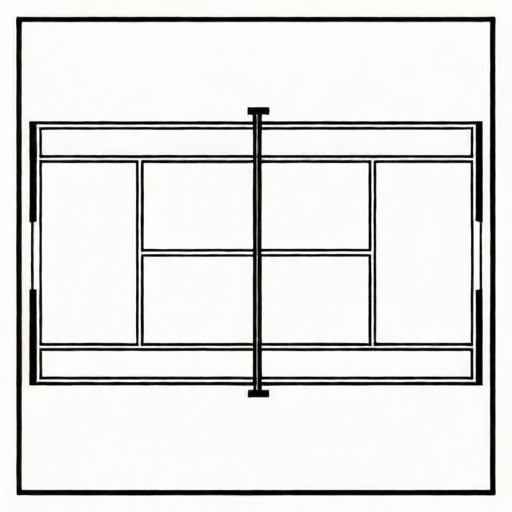
Use the stated measurements and conventions for each exercise.
Set the scale and outer boundary
Choose a simple scale that fits your paper. For example, let 1 cm on paper represent 2 m on the court. A full tennis court is 23.77 m long and 10.97 m wide for doubles, but for this lesson use rounded hypothetical values: length 24 m, width 11 m. At 1 cm = 2 m, the drawing is 12 cm long and 5.5 cm wide. Measure your paper first and confirm the drawing fits with room for labels.
Draw a rectangle for the outer boundary. Mark the four corners lightly. This rectangle represents the full doubles court. The baseline is the short back line at each end; the sidelines are the long side lines. Keep lines straight by checking with a ruler or by counting grid squares if you use a grid.
- Measure the paper and decide a scale, such as 1 cm = 2 m (hypothetical).
- Convert court length and width to paper units: 24 m becomes 12 cm; 11 m becomes 5.5 cm.
- Draw the outer rectangle and label it 'Doubles court boundary'.
- Mark the two baselines at the short ends and label them 'Baseline'.
Place the net and service lines
The net crosses the court at the midpoint of the length. At the hypothetical scale, half of 12 cm is 6 cm from either baseline. Draw a line across the width at that midpoint and label it 'Net'. The net line divides the court into two halves.
The service line is parallel to the net and set back from it. A common service box depth is about 6.4 m from the net to the service line; for this lesson use a hypothetical 6 m. At 1 cm = 2 m, that is 3 cm from the net on each side. Draw a line parallel to the net, 3 cm away on each half, and label it 'Service line'. The area between the net and the service line is the service box zone.
- Find the midpoint of the length and draw the net line across the width.
- Measure 3 cm from the net on each side (hypothetical 6 m at 1 cm = 2 m).
- Draw service lines parallel to the net on both halves.
- Label the net line and both service lines clearly.
Add the center service line and label zones
The center service line runs from the net to the service line, splitting the service zone into two service boxes on each side. Draw a short line perpendicular to the net, centered on the width, from the net to each service line. Label the four service boxes: 'Left service box' and 'Right service box' on each half. Use left and right as seen from the baseline facing the net, and state that convention on the drawing.
Label the remaining zones: the back court area between the baseline and the service line, the net line, and the sidelines. Keep labels outside the court outline where possible, with short leader lines. Handwriting may vary; the rubric checks that each label is readable and points to the correct zone, not that it matches a single style.
- Draw the center service line from the net to each service line.
- Label the four service boxes using a stated left/right convention.
- Label the baselines, net, service lines, and sidelines.
- Check that every label is readable and placed near the correct zone.
Check the plan with simple arithmetic
Verify your drawing by converting measurements back to court units. If the net is 6 cm from each baseline on paper and the scale is 1 cm = 2 m, then the net is 12 m from each baseline, giving a total length of 24 m. If the service line is 3 cm from the net, that represents 6 m. The width of 5.5 cm represents 11 m. These checks catch scale mistakes before you finalize the plan.
Also check that the center service line is centered: half of 5.5 cm is 2.75 cm from each sideline. If your center line is not at 2.75 cm, adjust it. Use the same units throughout and write the scale on the drawing so another person can check it.
- Write the scale on the drawing, for example '1 cm = 2 m (hypothetical)'.
- Measure the net distance from each baseline and convert back to meters.
- Measure the service line distance from the net and convert back.
- Confirm the center service line is at half the width and adjust if needed.
Worked example
Draw a tennis court plan at a hypothetical scale of 1 cm = 2 m using length 24 m and width 11 m. Place the net at the midpoint, service lines 6 m from the net, and a center service line. Label the baselines, net, service lines, and four service boxes.
Worked answer
The drawing is a 12 cm by 5.5 cm rectangle. The net is a line across the width at 6 cm from each baseline. Service lines are 3 cm from the net on each side. The center service line runs from the net to each service line at 2.75 cm from each sideline. Labels: Baseline at both short ends, Net at the middle line, Service line on both halves, and Left/Right service box on each half with the viewing convention stated.
Four practice exercises
Exercise 1
At a hypothetical scale of 1 cm = 3 m, a court is 24 m long and 12 m wide. What are the paper dimensions of the outer rectangle?
Show answer and check
8 cm long and 4 cm wide.
Why: Divide each court dimension by 3 m per cm: 24 ÷ 3 = 8 cm; 12 ÷ 3 = 4 cm.
Check: Multiply back: 8 cm × 3 m/cm = 24 m; 4 cm × 3 m/cm = 12 m.
Exercise 2
A plan uses 1 cm = 2 m. The net is drawn 6 cm from each baseline. What total court length does this represent?
Show answer and check
24 m.
Why: The net is at the midpoint, so each half is 6 cm. Total paper length is 12 cm. At 1 cm = 2 m, 12 cm represents 24 m.
Check: Convert each half: 6 cm × 2 m/cm = 12 m; two halves give 24 m.
Exercise 3
A court plan is 5.5 cm wide at 1 cm = 2 m. Where should the center service line be placed from each sideline?
Show answer and check
2.75 cm from each sideline.
Why: The center line is at half the width: 5.5 ÷ 2 = 2.75 cm.
Check: Measure both sides; each should be 2.75 cm, and 2.75 + 2.75 = 5.5 cm.
Exercise 4
A service line is drawn 3 cm from the net at 1 cm = 2 m. A second service line is drawn 4 cm from the net on the other side. Are the two service boxes the same depth in court units? Explain.
Show answer and check
No. The first is 6 m deep; the second is 8 m deep.
Why: Convert each: 3 cm × 2 m/cm = 6 m; 4 cm × 2 m/cm = 8 m. Equal depths require equal paper distances.
Check: Compare the paper distances first; if they differ, the court depths differ at the same scale.
Common mistakes
- Drawing the net at the wrong position, such as one-third of the length instead of the midpoint. Measure half the total length from either baseline and mark the midpoint before drawing the net line.
- Labeling service boxes without stating the left/right convention. Add a note such as 'Left and right as viewed from the baseline facing the net' and place labels accordingly.
- Using different units on the same drawing, such as centimeters for length and meters for width. Convert all measurements to one paper unit before drawing and write the scale clearly.
- Forgetting the center service line, leaving the service zone as one rectangle. Draw a centered line from the net to each service line and label the four service boxes.
Self-check rubric
- Outer boundary is a rectangle with correct proportions according to the stated scale.
- Net line is at the midpoint of the length and labeled.
- Service lines are parallel to the net and placed at the stated distance on both halves.
- Center service line is centered and divides the service zone into four labeled service boxes.
- Baselines, net, service lines, and sidelines are labeled readably; left/right convention is stated.
- Scale is written on the drawing and arithmetic checks are shown or noted.
- Valid alternatives: different scale, different hypothetical dimensions, printed or cursive labels, and labels placed outside the court with leader lines are acceptable if readable and correct.
Questions and answers
Do I need exact professional court dimensions?
No. This lesson uses hypothetical rounded values to teach the drawing method. Measure your own paper and tools, and label any chosen numbers as examples.
Can I use a different scale?
Yes. Choose any scale that fits your paper, convert all measurements consistently, and write the scale on the drawing so it can be checked.
What if my handwriting is uneven?
Readability matters more than style. Print, cursive, or mixed lettering is acceptable if each label is clear and points to the correct zone.
How do I know the center service line is correct?
It should be at half the court width. At the hypothetical scale, half of 5.5 cm is 2.75 cm from each sideline.