Free original lessons
Bumblebee Drawing: Wing, Stripe, and Leg Construction
Learn to draw a bumblebee by building body ovals, adding striped abdomen bands, attaching two wings, and placing six legs with clear steps and checks.
Free lesson
Four exercises
Worked answers
Object Drawing Lessons
This plate teaches a repeatable construction for a bumblebee drawing. You will start with simple body ovals, add a striped abdomen, attach two wings, and place six legs. The method uses a defined convention: the bee's body is drawn as a set of overlapping ovals, stripes are bands across the abdomen, wings are two teardrop shapes attached at the thorax, and legs are jointed lines. Letter styles and handwriting vary, so the rubric rewards clear construction and proportion rather than a single perfect outline. All measurements are hypothetical examples; measure your own paper and tools. Work lightly at first, then darken final lines.
Practice materials: Printable downloads are not available for this lesson yet. Use the instructions and four exercises below.
Reference illustration
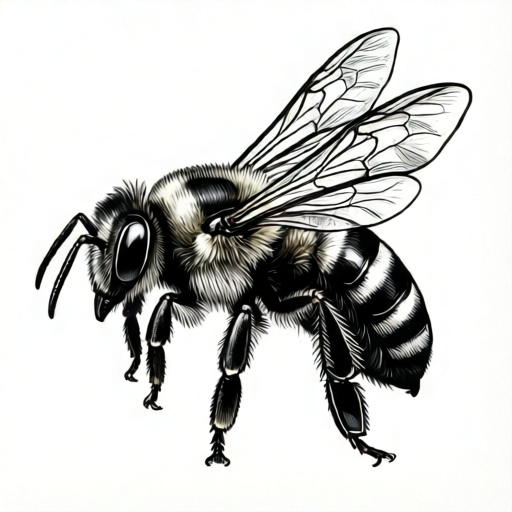
Use the stated measurements and conventions for each exercise.
Body Ovals and Proportion
Begin with two ovals: a smaller head oval and a larger abdomen oval, joined by a middle thorax oval. A useful hypothetical proportion is head width 1 unit and head length 1 unit, thorax width 1.2 units, and abdomen width 1.8 units, with the abdomen about 2.5 times as long as the head (about 2.5 units). Keep the body tilted slightly upward so the bee reads as flying or hovering.
Draw the ovals lightly. Check that the thorax overlaps both the head and abdomen slightly; this overlap makes the body read as one connected form. The abdomen should taper toward the rear, so draw it as an egg shape rather than a perfect circle.
- Draw a small head oval about 1 unit wide and 1 unit long.
- Draw a thorax oval about 1.2 units wide, overlapping the head by one third.
- Draw an abdomen egg shape about 1.8 units wide and about 2.5 units long, overlapping the thorax.
- Check that the abdomen is about 2.5 times the head length and that the three ovals overlap slightly.
Striped Abdomen Bands
Divide the abdomen into bands using curved lines that follow its outer edge. A common bumblebee pattern alternates dark and light bands. Use three dark bands and two light bands as a hypothetical example, but any clear alternating pattern is valid if it follows the abdomen curve.
Draw the band lines from one side of the abdomen to the other, curving them slightly toward the rear. Keep band widths roughly equal; a checkable rule is that no band should be more than twice the width of another. Shade dark bands with parallel strokes and leave light bands mostly open.
- Mark five evenly spaced points along the abdomen's top edge.
- Draw curved lines across the abdomen through those points, following the outer curve.
- Shade alternate bands with light parallel strokes.
- Check band widths are within a 2:1 ratio and that lines do not cross.
Wings and Legs
Attach two wings at the top of the thorax. Draw each wing as a teardrop shape pointing outward and slightly back. The front wing is larger; a hypothetical ratio is front wing length 2 units and rear wing length 1.4 units. Wings should not cover the head or the striped abdomen.
Place six legs along the lower thorax and upper abdomen. Each leg has three segments: a short upper segment, a middle segment, and a lower segment ending in a small foot. Space the legs evenly and angle them slightly outward. Check that all six legs attach to the body and that no two legs cross.
- Draw the front wing as a teardrop from the thorax top, length about 2 units.
- Draw the rear wing smaller, length about 1.4 units, behind the front wing.
- Draw three legs on the left side and three on the right, each with three segments.
- Check wing attachment points are on the thorax and legs do not cross.
Final Check and Practice Panel
Before darkening lines, run a construction check: body ovals overlap, abdomen bands alternate and stay within a 2:1 width ratio, two wings attach at the thorax, and six legs attach to the body without crossing. Then darken the final outline and erase light construction lines.
Use the blank practice panel to draw an independent bumblebee from memory. Keep the same construction order: ovals, stripes, wings, legs. Compare your practice drawing to the checklist rather than to a single ideal outline.
- Run the four-part construction check.
- Darken final lines and erase construction marks.
- Draw a second bumblebee in the practice panel using the same order.
- Self-check the practice drawing against the rubric.
Worked example
A student draws a bumblebee with head width 1 unit, thorax width 1.2 units, abdomen width 1.8 units, and abdomen length 2.5 units. The abdomen has five bands with widths 0.4, 0.5, 0.4, 0.6, and 0.5 units. Two wings attach at the thorax, and six legs are drawn without crossing. Check the band width ratio and the abdomen-to-head length ratio, then state whether the construction passes.
Worked answer
The widest band is 0.6 units and the narrowest is 0.4 units. The ratio is 0.6 ÷ 0.4 = 1.5, which is within the 2:1 limit. The abdomen length is 2.5 units and the head length is 1 unit, so the ratio is 2.5, which matches the target of about 2.5 times the head length. Two wings attach at the thorax, and six legs do not cross. The construction passes the check.
Why: Band width ratio is found by dividing the widest band by the narrowest. A ratio of 1.5 is less than 2, so the stripes are acceptably even. The abdomen-to-head length ratio is 2.5 ÷ 1 = 2.5, which matches the target of about 2.5 times the head length. The other checks are stated as satisfied, so the drawing meets the construction rules.
Check: Re-measure the widest and narrowest bands, divide the larger by the smaller, and confirm the result is 2 or less. Divide abdomen length by head length and confirm the result is close to 2.5. Then count two wings at the thorax and six non-crossing legs.
Four practice exercises
Exercise 1
A bumblebee drawing has abdomen bands of widths 0.3, 0.7, 0.4, 0.5, and 0.6 units. Find the widest and narrowest bands, compute the ratio, and state whether the stripes pass the 2:1 check.
Show answer and check
Widest band 0.7 units, narrowest 0.3 units. Ratio 0.7 ÷ 0.3 ≈ 2.33, which is greater than 2, so the stripes do not pass the check.
Why: Divide the widest by the narrowest. Since 2.33 exceeds 2, at least one band is more than twice another, so the stripe widths are too uneven.
Check: Re-read the five widths, confirm the largest and smallest values, and recompute 0.7 ÷ 0.3. Compare the result to 2.
Exercise 2
A student plans a bee with head width 1 unit, thorax width 1.2 units, and abdomen width 1.8 units. The drawn abdomen is 2.5 units long and the head is 1 unit long. Check whether the abdomen is about twice the head length and whether the widths match the plan.
Show answer and check
Abdomen length 2.5 units versus head length 1 unit gives a ratio of 2.5, which matches the target of about 2.5 times the head length. The widths 1, 1.2, and 1.8 match the plan. The proportion check passes.
Why: The target is about 2.5 times the head length, so 2.5 units is on target. The three widths are exactly as planned, so the body proportion is consistent.
Check: Multiply head length by 2.5 and compare to abdomen length. Then compare each drawn width to the planned width.
Exercise 3
A drawing shows two wings attached at the abdomen and four legs attached to the thorax. Identify the construction errors and state the corrections.
Show answer and check
The wings are attached at the abdomen instead of the thorax, and only four legs are drawn instead of six. Corrections: move both wing bases to the upper thorax, and add two more legs so there are three per side, none crossing.
Why: The convention requires two wings at the thorax and six legs attached to the body. Attaching wings to the abdomen breaks the wing rule, and four legs breaks the leg count.
Check: Count wing attachment points and leg count. Confirm wings are on the thorax and legs number six without crossings.
Exercise 4
A practice bee has body ovals that overlap, five alternating bands with widths 0.5, 0.5, 0.6, 0.5, and 0.5 units, two wings at the thorax, and six legs with one pair crossing. List which rubric items pass and which fail, then give one fix.
Show answer and check
Passes: overlapping ovals, alternating bands, band ratio 0.6 ÷ 0.5 = 1.2 (within 2:1), two wings at the thorax. Fails: six legs without crossing, because one pair crosses. Fix: re-angle the crossing legs outward so they no longer overlap.
Why: The band ratio is 1.2, which is acceptable. The only failed item is leg crossing. Re-angling the legs corrects the construction without changing the body or wings.
Check: Check each rubric item in order: ovals, bands, ratio, wings, legs. For the legs, trace each line to confirm no two cross.
Common mistakes
- Drawing the abdomen as a perfect circle, making the bee look like a beetle. Use an egg shape that tapers toward the rear and overlaps the thorax.
- Making stripe bands uneven or crossing them. Mark evenly spaced points first, then draw curved lines that follow the abdomen edge without crossing.
- Attaching wings to the abdomen instead of the thorax. Place both wing bases on the upper thorax, behind the head.
- Drawing fewer than six legs or letting legs cross. Count three legs per side and angle them outward so they do not overlap.
Self-check rubric
- Body shows three overlapping ovals: head, thorax, abdomen.
- Abdomen tapers toward the rear and is longer than the head.
- Stripes alternate and band widths stay within a 2:1 ratio.
- Two wings attach at the thorax and do not cover the head or abdomen.
- Six legs attach to the body and do not cross.
- Final lines are clear and construction lines are erased or light.
- Practice panel contains an independent bumblebee using the same construction order.
Questions and answers
How many stripes should the abdomen have?
Any clear alternating pattern is valid. A hypothetical example is three dark bands and two light bands, with band widths within a 2:1 ratio.
Can the wings be drawn in a different shape?
Yes. Teardrops are a convention, but rounded or slightly pointed wings are acceptable if they attach at the thorax and do not cover the head or abdomen.
Do the legs need to be exactly three segments?
Three segments is the teaching convention. A clear jointed leg with a foot is acceptable even if segment lengths vary.
What if my bee is tilted differently?
Tilt is flexible. Keep the body ovals overlapping and the wings attached at the thorax; the rubric checks construction, not a single angle.