Free original lessons
Draw a Dalmatian: Spotted Coat, Head Shape, and Stance
Learn to draw a Dalmatian with correct head shape, standing stance, and a balanced spotted coat pattern using a simple construction method.
Free lesson
Four exercises
Worked answers
Object Drawing Lessons
This lesson teaches a repeatable method for drawing a Dalmatian that reads as the breed rather than a generic spotted dog. You will build the body from simple shapes, refine the distinctive head and stance, then place spots using a deliberate pattern guide. All measurements are hypothetical examples; measure your own paper and tools. The convention for spot placement is defined so that valid alternatives are accepted, not a single universal answer.
Practice materials: Printable downloads are not available for this lesson yet. Use the instructions and four exercises below.
Reference illustration
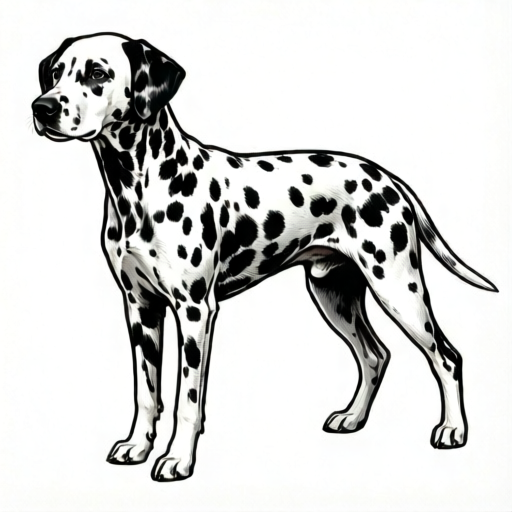
Use the stated measurements and conventions for each exercise.
Building the Dalmatian Body and Stance
Start with a standing side view because it shows the breed's balanced, athletic silhouette. Use a light pencil and keep all construction lines removable. The Dalmatian is a medium-to-large dog with a deep chest, level back, and long legs; avoid a squat or heavy build.
Define a ground line first. Place the paws on this line so the stance is stable. The front legs should be nearly vertical under the shoulders, and the rear legs angled slightly back with the hocks low. A common error is splaying the legs outward, which makes the dog look unstable.
Use simple ovals for the chest and hindquarters, a long rectangle for the torso, and a circle for the head. Connect them with straight guide lines before adding fur or spots. Check that the back line is level and the belly line rises gently toward the rear.
- Draw a horizontal ground line and mark four paw positions: two front, two rear, spaced so the dog is balanced.
- Draw an oval for the chest above the front paws and a smaller oval for the hindquarters above the rear paws.
- Connect the ovals with a long, slightly tapered rectangle for the torso; keep the top line level.
- Add a circle for the head above and slightly forward of the chest, then a short neck line connecting head to chest.
- Sketch the front legs as near-vertical tapered shapes and the rear legs with a slight backward angle at the hock.
- Refine the outline: deep chest, level back, long tail tapering from the hindquarters.
Shaping the Dalmatian Head
The Dalmatian head is moderately long with a flat skull, a slight stop, and a strong muzzle. It should not look like a Labrador (too broad) or a Greyhound (too narrow). Draw the skull as a rounded rectangle, then add a muzzle that is about half the length of the skull.
Place the eyes on a horizontal line roughly halfway between the top of the skull and the nose. Ears are medium-sized, set high, and hang close to the head with a rounded tip. Avoid erect or very long ears.
Check the head against the body before moving on: the muzzle should be about half the skull length, the ears should hang close to the cheeks, and the eye line should sit roughly halfway between the top of the skull and the nose. If the head looks too broad, narrow the skull; if it looks too narrow, widen the muzzle slightly. These are hypothetical proportions for practice, not breed standards.
- Draw a rounded rectangle for the skull, wider at the top than at the stop.
- Add a tapered muzzle about half the skull length, with a slight downward slope to the nose.
- Mark the eye line halfway down the skull and place two almond-shaped eyes.
- Draw medium ears set high, hanging close to the cheeks with rounded tips.
- Add a dark nose and a subtle mouth line; keep the expression neutral and alert.
Placing the Spotted Coat Pattern
Dalmatian spots are irregular, rounded, and distributed across the body, not in stripes or rows. Use a pattern guide: divide the body into zones (head, neck, torso, legs, tail) and place spots so no zone is empty and no zone is overcrowded. Spots should vary in size, with smaller spots on the legs and face.
A useful convention is the three-zone rule: place at least three spots in each major zone, keep spots at least one spot-width apart, and avoid placing spots exactly on the outline. This rule allows many valid arrangements; it is not a single correct answer.
Keep the spots inside the body outline and let them follow the curve of the form. On the legs, use small spots; on the torso, use medium spots; on the head, use a few small spots around the ears and muzzle. Leave the eyes and nose clear.
- Lightly divide the body into zones: head, neck, torso, front legs, rear legs, tail.
- Place three to five spots in each zone, varying size and spacing.
- Keep spots rounded and irregular, not perfectly circular or oval.
- Check that spots do not touch the outline or each other; adjust spacing as needed.
- Erase construction lines and darken the final spots last.
Checking Proportion and Readability
Before finishing, step back and check the silhouette. The dog should read as a Dalmatian from a distance: level back, deep chest, long legs, moderate head, and a spotted coat. If the body looks too heavy, narrow the torso; if the legs look short, lengthen them slightly.
Use a simple proportion check: the head should be roughly one-quarter of the total body length from nose to tail base. The legs should be about half the total height. These are hypothetical proportions for practice, not breed standards.
Finally, check spot balance. No single zone should dominate. If one area looks empty, add one or two small spots; if crowded, remove one. The goal is a readable, balanced pattern.
- Compare head length to total body length; adjust if the head is too large or small.
- Check that the back line is level and the belly line rises gently.
- Confirm the paws sit on the ground line and the stance looks stable.
- Review spot distribution across all zones and adjust for balance.
- Erase all construction lines and sign your work.
Worked example
A student draws a side-view Dalmatian with a level back, deep chest, and long legs. They place five medium spots on the torso, two small spots on the head, and none on the legs. Check the spot pattern using the three-zone rule and suggest one fix.
Worked answer
The torso and head zones meet the minimum of three spots, but the leg zones have none, so the pattern is unbalanced. Add at least three small spots to each front and rear leg zone, keeping them inside the outline and spaced apart. This satisfies the three-zone rule and improves readability.
Four practice exercises
Exercise 1
Draw a side-view Dalmatian standing on a ground line. Use the construction steps to show a level back, deep chest, and long legs. Add spots using the three-zone rule. Describe your spot placement in one sentence.
Show answer and check
A completed drawing with a level back, deep chest, long legs, paws on the ground line, and spots in all major zones. Example description: three medium spots on the torso, three small spots on the head, three small spots on each leg, and two on the tail.
Why: The construction steps ensure breed-readable proportions, and the three-zone rule ensures a balanced spotted coat rather than a generic pattern.
Check: Check that the back line is level, paws sit on the ground line, and every major zone has at least three spots. Confirm spots are inside the outline and spaced apart.
Exercise 2
A drawing has a broad head, short legs, and spots arranged in two neat rows on the torso. Identify two mistakes and state one fix for each.
Show answer and check
Mistake 1: broad head and short legs make it look like a generic dog. Fix: use the moderate head shape and lengthen the legs. Mistake 2: spots in neat rows look artificial. Fix: vary spot size and spacing irregularly using the three-zone rule.
Why: The breed-readable silhouette depends on moderate head proportions and long legs, while natural spots are irregular and distributed, not rowed.
Check: Check that spot size and spacing vary and that spots are not aligned in continuous rows; confirm the head is moderate and the legs are lengthened relative to the body.
Exercise 3
Draw only the Dalmatian head in side view: flat skull, slight stop, strong muzzle about half the skull length, eye line halfway down the skull, and medium ears set high and hanging close to the cheeks. Describe how you checked the stop and ear placement.
Show answer and check
A head drawing with a flat skull, a slight dip (stop) where the skull meets the muzzle, a muzzle about half the skull length, eyes on the halfway line, and ears set high and hanging close to the cheeks with rounded tips. Check description example: I measured the muzzle against the skull, confirmed the eye line was halfway between skull top and nose, and confirmed each ear touched the cheek line without standing away from the head.
Why: The head steps define a moderate Dalmatian head that is neither too broad nor too narrow, and the ear placement keeps the silhouette breed-readable rather than generic.
Check: Compare muzzle length to skull length (about half), confirm the eye line is halfway between skull top and nose, and check that the ears are set high and hang close to the cheeks rather than standing erect or hanging long.
Exercise 4
Draw a Dalmatian with spots only on the torso and head. Apply the three-zone rule to add spots to the remaining zones. State how many spots you added and where.
Show answer and check
Add at least three small spots to each front leg, each rear leg, and the tail. Example: three spots per leg zone and three on the tail, all inside the outline and spaced apart.
Why: The three-zone rule requires at least three spots per major zone, so empty leg and tail zones must be filled to balance the pattern.
Check: Count spots per zone and confirm each major zone has at least three. Check that added spots are inside the outline and do not touch each other.
Common mistakes
- Drawing a generic spotted dog with a broad head and short legs. Use the head and stance steps: moderate muzzle, high-set hanging ears, level back, and long legs.
- Placing spots in neat rows or stripes. Use the three-zone rule and vary spot size and spacing irregularly.
- Letting spots cross the body outline. Keep spots inside the outline and check spacing before darkening.
- Making the stance unstable with splayed legs. Place paws on a ground line and keep front legs near-vertical.
Self-check rubric
- Body silhouette reads as a Dalmatian: level back, deep chest, long legs, stable stance.
- Head shape is moderate: flat skull, slight stop, strong muzzle, high-set hanging ears.
- Spots are irregular, rounded, and distributed across all major zones using the three-zone rule.
- Spots stay inside the outline and do not touch each other or the outline.
- Construction lines are erased and the final drawing is clean and readable.
- Spots vary in size by zone: smaller on legs and face, medium on the torso, with no zone left empty or overcrowded.
Questions and answers
How many spots should a Dalmatian drawing have?
There is no fixed number. Use the three-zone rule: at least three spots per major zone, varied in size and spacing. Balance matters more than count.
Can I draw the Dalmatian facing forward?
Yes, but this lesson uses a side view because it shows stance and coat pattern more clearly. A forward view requires separate proportion checks.
What if my spots look too regular?
Vary size and spacing, and avoid placing spots in rows. Rounded, irregular shapes read better than perfect circles.
Do I need special paper or tools?
No. Use any pencil and paper. Measure your own equipment if you label dimensions; all numerical examples here are hypothetical.