Free original lessons
Musical Note Drawing: Stem and Flag Practice
Learn to draw quarter, eighth, and sixteenth notes by placing note heads, stems, and flags with a clear convention and self-check rubric.
Free lesson
Four exercises
Worked answers
Object Drawing Lessons
This lesson teaches a repeatable way to draw musical notes with stems and flags. You will use a simple convention: the note head is an oval, the stem is a straight line attached to the right side of the head, and flags curve from the stem tip. Because handwriting varies, the rubric accepts any clear, consistent note that follows the stated construction rules. All practice uses plain paper and a pencil; no printed staff is required, though a ruler-drawn baseline helps.
Practice materials: Printable downloads are not available for this lesson yet. Use the instructions and four exercises below.
Reference illustration
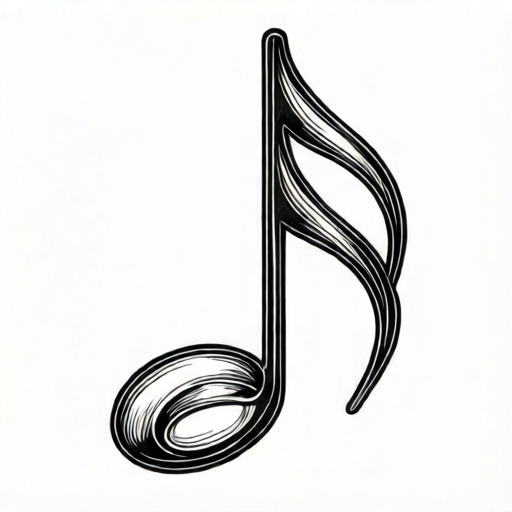
Use the stated measurements and conventions for each exercise.
Note head, stem, and flag construction
A note head is an oval, slightly wider than tall. Draw it so its center sits on the baseline you are using. The stem is a straight vertical line attached to the right edge of the note head. For notes below the middle line of a staff, the stem normally goes up from the right side; for notes on or above the middle line, the stem normally goes down from the left side. In this lesson, use the up-stem convention for all practice unless a task says otherwise.
A flag is a curved stroke that begins at the stem tip and sweeps toward the note head. One flag makes an eighth note; two flags make a sixteenth note. Flags should not touch the note head and should not cross the stem. Keep the curve smooth and open, like a small hook.
- Draw a light baseline with a ruler.
- Place the note head oval so its center is on the baseline.
- Attach a straight stem to the right side of the head, going upward about three head-heights.
- For an eighth note, add one flag from the stem tip curving down toward the head.
- For a sixteenth note, add a second flag below the first, parallel and evenly spaced.
- Check that flags do not touch the head and that the stem is straight.
Spacing and proportion
Use the note head as your unit. A comfortable stem length is about three note-head heights. Flags should be about one head-height long. Leave at least one head-width between neighboring notes so flags do not collide. If you draw a row of notes, keep the baseline consistent and align the note-head centers.
These proportions are a convention for clear handwriting, not a universal standard. Any consistent proportion that keeps the note readable is acceptable under the rubric.
- Mark note-head centers at least one head-width apart.
- Keep stem length consistent across a row.
- Keep flag length and curve consistent.
- Check that no flag overlaps a neighboring note.
Self-check and correction
After drawing, check four things: the head is an oval, the stem is straight and attached to the correct side, the flag count matches the note type, and flags do not touch the head. If a stem is slanted, redraw it as a straight line. If a flag crosses the stem, lift the curve away from the stem.
Use the rubric below to score your own page. A score of 3 or 4 on each row means the note is clear enough for another reader to identify.
- Check head shape and placement.
- Check stem straightness and attachment side.
- Count flags and compare with the intended note type.
- Check spacing and overlap.
- Redraw any note that fails two or more checks.
Worked example
Draw one eighth note using the up-stem convention. Describe each part and give a check.
Worked answer
Draw a light baseline. Place an oval note head with its center on the baseline. Attach a straight vertical stem to the right edge of the head, about three head-heights long. From the stem tip, draw one flag curving down toward the head without touching it. Check: head is oval, stem is straight and on the right, one flag, no overlap.
Four practice exercises
Exercise 1
Draw a quarter note with an up-stem. State the stem length you used in note-head heights.
Show answer and check
An oval head on the baseline with a straight up-stem on the right side and no flags. A stem of about three head-heights is acceptable.
Why: A quarter note has a head and stem but no flag. The up-stem convention places the stem on the right.
Check: Confirm the head is oval, the stem is straight and on the right, and there are zero flags.
Exercise 2
Draw two eighth notes side by side with up-stems. Keep at least one head-width between them.
Show answer and check
Two oval heads on the same baseline, each with a straight up-stem on the right and one flag. The heads are separated by at least one head-width.
Why: Each eighth note has one flag. Spacing prevents flags from colliding.
Check: Count one flag per note, check stem side, and confirm the gap between heads is at least one head-width.
Exercise 3
Draw one sixteenth note with an up-stem. Describe where the second flag goes.
Show answer and check
An oval head with a straight up-stem and two flags. The second flag sits below the first, parallel and evenly spaced, not touching the head.
Why: A sixteenth note has two flags. Even spacing keeps the note readable.
Check: Count two flags, check they are parallel and do not touch the head or cross the stem.
Exercise 4
A student draws an eighth note with the stem on the left and two flags. Identify two errors and state the fixes.
Show answer and check
Error one: stem on the left for an up-stem note; fix by attaching it to the right edge. Error two: two flags for an eighth note; fix by using one flag.
Why: The up-stem convention places the stem on the right, and an eighth note has one flag.
Check: Check stem side and flag count against the stated convention.
Common mistakes
- Drawing the stem on the left side of an up-stem note. Attach the stem to the right edge of the note head when the stem goes up.
- Making flags touch the note head. Start the flag at the stem tip and curve it outward, leaving a clear gap above the head.
- Using a slanted stem. Redraw the stem as a straight vertical line; use a ruler if needed.
- Drawing two flags for an eighth note. Count flags: one flag is an eighth note, two flags are a sixteenth note.
Self-check rubric
- Note head is an oval, wider than tall, centered on the baseline.
- Stem is straight and attached to the correct side for the chosen convention.
- Flag count matches the intended note type.
- Flags do not touch the note head or cross the stem.
- Spacing keeps neighboring notes from overlapping.
Questions and answers
Do I need a printed staff?
No. A ruler-drawn baseline is enough for this lesson. A staff row is planned as a printable resource but is not required to complete the exercises.
Can flags curve either direction?
Use the convention in this lesson: flags curve from the stem tip toward the note head. Other handwriting styles exist, but stay consistent within one page.
How long should the stem be?
About three note-head heights is a clear convention. Any consistent length that keeps flags readable is acceptable.
What if my note head is not a perfect oval?
A slightly irregular oval is fine if it is clearly wider than tall and centered on the baseline.