Free original lessons
Realistic Nose Shading: Tonal Planes and Nostril Forms
Learn to shade a realistic nose by mapping tonal planes and shaping nostril forms, with a printable reference plate and blank outline for practice.
Free lesson
Four exercises
Worked answers
Object Drawing Lessons
A realistic nose reads as a solid form when light and shadow describe its planes: the bridge, the sides, the tip, the alae, and the nostril openings. This lesson treats the nose as a small sculpture rather than a symbol. You will identify the major tonal planes, decide where the lightest and darkest values sit, and shape nostril forms that look like openings rather than dark stickers. The convention used here is simple: x-height means the distance from the baseline to the midline of a lowercase x in your normal handwriting; use it to judge small distances on your drawing. Letter styles vary, so treat x-height as a personal measuring unit, not a universal standard. All measurements are hypothetical examples unless you measure your own paper and pencil. The planned printable includes a tonal-plane reference plate and a nostril-form guide, plus a blank nose outline for independent shading; these resources are planned, not yet built.
Practice materials: Printable downloads are not available for this lesson yet. Use the instructions and four exercises below.
Reference illustration
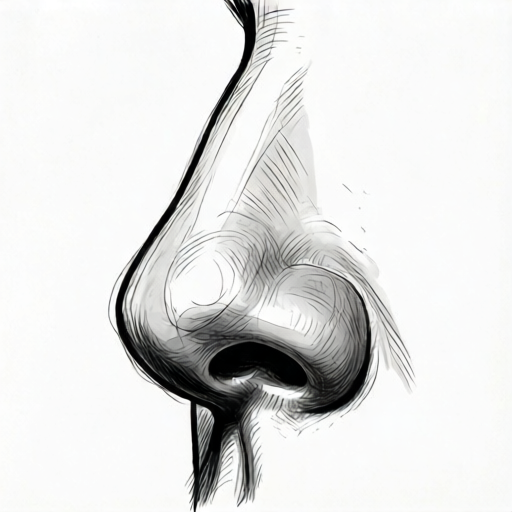
Use the stated measurements and conventions for each exercise.
Map the tonal planes before shading
Begin by drawing a nose outline that is slightly wider at the base than at the bridge. Divide the form into five tonal zones: the bridge plane, the left side plane, the right side plane, the tip plane, and the alar planes. Each zone receives a different value depending on the light direction. Choose one light direction and keep it consistent. For example, light from the upper left means the left side plane is lighter than the right side plane, and the underside of the tip is darker than the top of the tip.
Assign values in simple steps: lightest on the bridge, mid-tone on the lit side, darker on the shadow side, darkest in the nostril openings and the crease where the ala meets the cheek. Use a value scale of five steps: 1 is paper white, 5 is the darkest pencil pressure you can control without smudging. Label your zones 1 to 5 before you shade. This planning prevents the common error of making every edge equally dark.
- Draw the nose outline and mark the bridge, tip, and alae with light lines.
- Choose a light direction and label each plane with a planned value from 1 to 5.
- Shade the largest planes first using the side of the pencil, keeping edges soft.
- Reserve the darkest value for nostril openings and the ala-cheek crease.
- Check the value plan by squinting; the lightest and darkest areas should still match your labels.
Shape nostril forms as openings
A nostril is not a black oval. It is an opening with a rim, a shadow inside, and often a small highlight on the rim. Draw the nostril shape as a rounded triangle or comma, then shade the inside with your darkest value while leaving the rim slightly lighter. The rim catches light, so it should not disappear into the opening. The ala, the rounded side of the nostril, has its own plane; shade it as a curved surface that turns away from the light.
Use x-height to judge the size of the nostril opening relative to the ala. For example, if the ala is about two x-heights wide, the nostril opening might be about one x-height wide. These are hypothetical proportions; measure your own drawing and adjust. Keep the two nostrils different in shape if your reference shows asymmetry, because real noses are rarely perfectly symmetrical. The goal is a believable opening, not a matched pair of symbols.
- Draw the nostril opening as a rounded triangle or comma, not a perfect oval.
- Shade the inside with the darkest value, leaving a thin lighter rim.
- Shade the ala as a curved plane that turns away from the light.
- Compare the nostril width to the ala width using x-height as a personal unit.
- Soften the outer edge of the ala where it meets the cheek, but keep the nostril rim crisp.
Blend edges and check the whole form
Blend only where planes curve gradually. The bridge to side transition is usually soft; the nostril rim and the ala-cheek crease are usually sharper. Use a light touch and avoid blending the darkest nostril value into the rim, or the opening will look like a smudge. Step back from the drawing and compare the lightest and darkest areas. If the nose looks flat, the mid-tones are probably too similar; if it looks striped, the edges are too hard.
A useful check is to turn the drawing upside down. Upside down, you see shapes and values rather than a nose symbol. Confirm that the darkest area is still the nostril opening and that the bridge is still the lightest large plane. Adjust any plane that breaks the light direction you chose. This check is simple and does not require special equipment.
- Blend soft transitions on the bridge and side planes with a light touch.
- Keep sharp edges at the nostril rim and the ala-cheek crease.
- Turn the drawing upside down and check the value pattern.
- Adjust any plane that contradicts the chosen light direction.
- Compare the final values to your original 1-to-5 labels.
Worked example
A nose is drawn with light from the upper left. The bridge is labeled value 1, the left side plane value 2, the right side plane value 4, the tip underside value 3, and the nostril openings value 5. Describe the shading order and one check.
Worked answer
Shade the bridge first with light pressure, then the left side plane slightly darker, then the right side plane darker still. Shade the tip underside as a mid-tone, and finish with the nostril openings at the darkest value. Check by squinting: the bridge should remain the lightest large area and the nostril openings the darkest. If the right side plane looks as light as the left, darken it to value 4.
Four practice exercises
Exercise 1
A nose outline has a bridge labeled value 1, a left side plane labeled value 3, a right side plane labeled value 4, and nostril openings labeled value 5. Light comes from the upper left. Which plane should be lightest after shading, and which should be darkest?
Show answer and check
The bridge should be lightest, and the nostril openings should be darkest.
Why: Value 1 is the lightest planned value and value 5 is the darkest. The bridge is labeled 1 and the nostril openings are labeled 5, so they remain the extremes after shading.
Check: Squint at the drawing and confirm the bridge is the lightest large area and the nostril openings are the darkest.
Exercise 2
An ala is about three x-heights wide. A planned nostril opening is about one x-height wide. If the drawing uses the same x-height unit, what is the ratio of nostril width to ala width?
Show answer and check
The ratio is 1 to 3.
Why: Nostril width is one x-height and ala width is three x-heights, so the ratio is 1:3. This is a hypothetical proportion, not a universal rule.
Check: Measure both widths with the same x-height unit on your paper and compare the numbers.
Exercise 3
A student shades the nostril opening with value 5 but blends the rim until it is also value 5. What visual problem occurs, and what is the fix?
Show answer and check
The nostril loses its rim and looks like a smudge or solid oval. The fix is to keep the rim slightly lighter than the inside, for example value 4, and blend only the outer ala edge.
Why: The rim catches light and separates the opening from the ala. If rim and inside share the darkest value, the opening no longer reads as a form.
Check: Turn the drawing upside down and check whether the nostril still reads as an opening with a distinct rim.
Exercise 4
A nose is shaded with light from the upper right. The right side plane is labeled value 2 and the left side plane value 4. The student then darkens the right side plane to value 4. What error has occurred, and how should it be corrected?
Show answer and check
The student has contradicted the light direction by making the lit side as dark as the shadow side. Correct it by returning the right side plane to value 2 and keeping the left side plane at value 4.
Why: With light from the upper right, the right side plane should be lighter than the left. Equal values remove the form's turn away from the light.
Check: Compare the two side planes by squinting; the lit side should be clearly lighter than the shadow side.
Common mistakes
- Shading every edge with the same dark pencil pressure. Assign values 1 to 5 before shading and reserve the darkest value for nostril openings and deep creases.
- Drawing nostrils as solid black ovals. Shape each nostril as an opening with a lighter rim, and keep the inside dark but not uniformly black.
- Blending the nostril rim into the opening. Keep the rim crisp and slightly lighter than the inside; blend only the outer ala edge.
- Changing the light direction halfway through the drawing. Choose one light direction at the start and label each plane before shading.
Self-check rubric
- Five tonal planes are identifiable and consistent with one light direction.
- Values follow a planned 1-to-5 scale, with the darkest value in the nostril openings.
- Nostril forms read as openings with a lighter rim, not solid ovals.
- Edges are soft on curved transitions and sharper at the nostril rim and ala-cheek crease.
- The whole nose reads as a solid form when viewed upside down.
- Valid alternative proportions and nostril shapes are accepted if the value logic and form remain coherent.
Questions and answers
Do I need a specific pencil grade?
No. Use the pencil you have and control value by pressure. Test your darkest controllable value on scrap paper before shading.
How do I know if my nostril shape is realistic?
Check that it reads as an opening with a rim, not a flat oval. Compare its width to the ala using x-height as a personal unit.
Can I use a blending stump?
Yes, but blend only soft transitions. Keep the nostril rim and the ala-cheek crease sharp so the form stays readable.
What if my nose looks flat?
Increase the difference between the lightest and darkest planes, and make sure the mid-tones are not all the same value.