Free original lessons
Drawing a Sunrise: Horizon, Sky Bands, and Sun Rays
Learn to draw a sunrise with a clear horizon line, layered sky bands, and radiating sun rays using a simple, checkable construction method.
Free lesson
Four exercises
Worked answers
Object Drawing Lessons
This guide teaches a repeatable way to draw a sunrise plate: a horizon line, three or four sky bands that get lighter toward the horizon, and sun rays that radiate from a low sun. The method uses a defined convention for x-height (baseline to midline) so lettering and labels stay consistent, while allowing valid stylistic alternatives. All measurements are hypothetical examples; measure your own paper and tools. The practice tasks are self-contained and can be solved from the text alone.
Practice materials: Printable downloads are not available for this lesson yet. Use the instructions and four exercises below.
Reference illustration
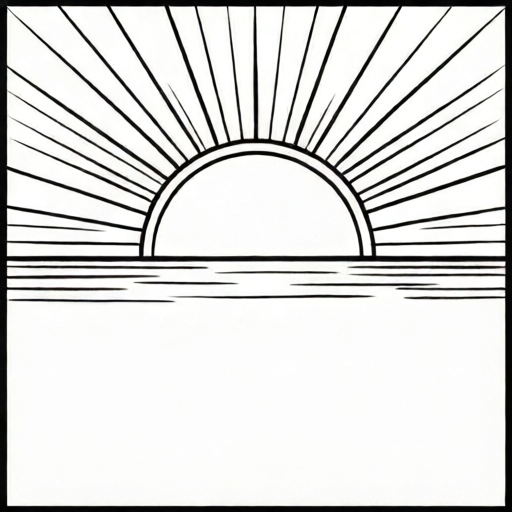
Use the stated measurements and conventions for each exercise.
Set the horizon and the sun position
Place the paper in landscape orientation. Draw a horizon line about one-third up from the bottom edge; for a 20 cm tall sheet, a hypothetical horizon at 7 cm from the bottom leaves 13 cm of sky. Mark the sun center on or just above the horizon, slightly off-center horizontally, for example 8 cm from the left edge on a 28 cm wide sheet.
Use a light pencil line for the horizon so it can be adjusted. The horizon must be straight and level; check it by comparing the distance from the top edge at both ends. The sun is a small circle or arc whose center sits low, because a sunrise sun is near the horizon.
- Draw a faint horizontal line at the chosen height.
- Mark the sun center on or just above that line.
- Draw a small circle around the center, keeping it low.
- Check that the horizon is level by measuring from the top edge at both ends.
Build layered sky bands
Divide the sky above the horizon into three or four horizontal bands. Bands closest to the horizon are lightest; bands higher up are darker. For a 13 cm sky, hypothetical band heights could be 3 cm, 3 cm, 3 cm, and 4 cm from horizon upward. Keep band boundaries parallel to the horizon.
Fill each band with a different tone or pattern: lightest near the horizon, medium in the middle, darkest at the top. You may use pencil shading, colored pencil, or simple hatching. The convention for x-height is baseline to midline; if you add labels, keep lowercase letters within that height so the plate reads consistently.
- Measure and mark band boundaries parallel to the horizon.
- Assign the lightest tone to the lowest band.
- Increase tone gradually in higher bands.
- Check that each boundary is parallel to the horizon.
Add sun rays and finish
Draw rays as straight lines radiating from the sun center outward into the sky bands. Use six to ten rays, spaced roughly evenly. Rays should stop before the top edge or continue to it consistently. Keep ray length varied but controlled; for example, alternate short and long rays.
Erase construction marks lightly, then strengthen the horizon, sun outline, and rays. The plate should read as a sunrise: low sun, light horizon band, darker upper bands, and clear rays. Valid alternatives include curved rays, dotted rays, or a partially hidden sun, provided the horizon and band order remain clear.
- Mark ray directions from the sun center.
- Draw rays with consistent spacing and controlled length.
- Erase faint construction lines.
- Strengthen final lines and check band order.
Worked example
On a 20 cm tall by 28 cm wide sheet, draw a sunrise with a horizon at 7 cm from the bottom, a sun center 8 cm from the left and on the horizon, three sky bands of 4 cm each above the horizon, and six straight rays. Describe the result.
Worked answer
The horizon is a level line 7 cm from the bottom. The sun center is at 8 cm from the left on that line, with a small circle. Above the horizon, three parallel bands of 4 cm each fill the 12 cm sky. The lowest band is lightest, the middle medium, and the top darkest. Six straight rays radiate from the sun center into the bands, spaced evenly. The plate reads as a sunrise because the sun is low, the horizon is clear, and the band order is light to dark upward.
Four practice exercises
Exercise 1
A 24 cm tall sheet has a horizon 8 cm from the bottom. How many centimeters of sky are above the horizon?
Show answer and check
16 cm
Why: Subtract the horizon height from the sheet height: 24 minus 8 equals 16.
Check: Measure the sky region on the sheet; it should match 16 cm.
Exercise 2
A sky is 12 cm tall and is divided into three equal bands. What is each band height, and which band is lightest?
Show answer and check
Each band is 4 cm; the lowest band is lightest.
Why: 12 divided by 3 equals 4. The convention places the lightest tone nearest the horizon.
Check: Measure each band; confirm the lowest band has the lightest tone.
Exercise 3
A sun center is 10 cm from the left edge on a 30 cm wide sheet. How far is it from the right edge?
Show answer and check
20 cm
Why: Subtract the left distance from the width: 30 minus 10 equals 20.
Check: Measure from the sun center to the right edge; it should be 20 cm.
Exercise 4
A plate has four sky bands of 3 cm, 3 cm, 4 cm, and 4 cm from horizon upward. What is the total sky height, and is the band order correct for a sunrise?
Show answer and check
Total sky height is 14 cm; the order is correct if the lowest band is lightest and tones darken upward.
Why: Add the band heights: 3 plus 3 plus 4 plus 4 equals 14. The sunrise convention requires the lightest band nearest the horizon.
Check: Measure the total sky height and compare band tones from bottom to top.
Common mistakes
- Placing the sun high in the sky. Lower the sun center to the horizon or just above it; a sunrise sun sits low.
- Making the band nearest the horizon darkest. Reverse the tones so the lowest band is lightest and upper bands are darker.
- Drawing rays that do not point away from the sun center. Start each ray at the sun center and extend outward; check direction with a straight edge.
- Letting band boundaries tilt. Measure equal distances from the horizon at both ends of each boundary.
Self-check rubric
- Horizon line is present, straight, and level.
- Sun center is on or just above the horizon.
- Three or four sky bands are present and parallel to the horizon.
- Band tones progress from lightest at the horizon to darkest at the top.
- Rays radiate outward from the sun center and are visually distinct.
- Valid alternatives such as curved rays or a partly hidden sun are accepted if the horizon and band order remain clear.
- Labels, if used, follow the baseline-to-midline x-height convention.
Questions and answers
How many sky bands should I use?
Three or four bands work well. Use three for a simple plate and four for more depth; keep the lowest band lightest.
Can the sun be partly below the horizon?
Yes. A partially hidden sun is a valid sunrise variant if the horizon line remains clear and the rays still radiate from the sun center.
Do rays have to be straight?
No. Curved or dotted rays are valid alternatives if they radiate outward from the sun center and remain visually distinct.
What does x-height mean here?
X-height is the distance from baseline to midline for lowercase letters. Use it only if you add labels; keep labels consistent with that convention.