Free original lessons
Draw a Wilted Flower: Drooping Stem, Curled Petals, Fallen Petal Practice
Learn a repeatable wilted flower drawing method: drooping stem, curled petals, fallen petals, plus a blank practice panel plan and self-check rubric.
Free lesson
Four exercises
Worked answers
Object Drawing Lessons
This lesson teaches a clear, checkable way to draw a wilted flower plate. The focus is the wilted flower only: a stem that bends under its own weight, petals that curl and narrow, and a few fallen petals near the base. Healthy flowers and other plant types are outside this task. Work on plain paper with a pencil and eraser. Use the convention below so your drawing can be checked fairly: x-height means the distance from the baseline to the midline of lowercase letters, and letter styles vary, so treat x-height as a measuring unit rather than a fixed size. All numerical values here are hypothetical examples for practice, not equipment standards. Measure your own paper and pencil if you want to scale the drawing.
Practice materials: Printable downloads are not available for this lesson yet. Use the instructions and four exercises below.
Reference illustration
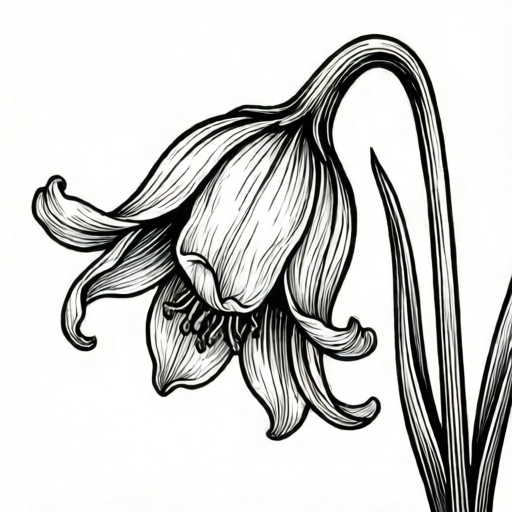
Use the stated measurements and conventions for each exercise.
Set the plate and the measuring convention
Place the paper in portrait orientation. Mark a light baseline near the lower third of the page and a midline above it. The distance between baseline and midline is your x-height unit. For this lesson, a hypothetical x-height of 10 mm is used in the arithmetic examples; if your paper is smaller, choose a smaller unit and keep all measurements in the same unit.
The wilted flower plate has three zones: the drooping stem zone above the baseline, the curled petal head at the top of the stem, and the fallen petal zone on the baseline. Keep the head inside the upper half of the page so the droop has room to curve.
- Draw a light baseline and a midline; label the gap as one x-height unit.
- Mark the stem base on the baseline and the head centre about 6 x-height units above it.
- Leave a clear fallen petal zone to one side of the stem base.
Build the drooping stem
A wilted stem is not a straight line. It leaves the base, rises a little, then bends over under the weight of the head. Draw the stem as a smooth curve made of two arcs: a short upward arc from the base, then a longer arc that leans to one side. Keep the stem width consistent; a wilted stem looks slightly thinner than a healthy one but should not taper to a point.
Check the droop by measuring the horizontal offset of the head from the stem base. In the hypothetical example, the head centre sits 3 x-height units to the right of the base. The stem curve should pass through the midpoint of that offset at about half the head height.
- Draw a light centre line from the base upward, then curve it to the chosen side.
- Draw two parallel edges around the centre line to give the stem width.
- Erase the centre line and smooth the bend so no sharp corner remains.
Draw curled petals and the fallen petal
Curled petals are drawn as narrow loops that turn back toward the stem. Start each petal at the head centre, sweep outward, then curl the tip inward. Vary the curl direction so the head looks limp rather than symmetrical. A useful check is that at least two petal tips point back toward the stem and at least one petal hangs downward.
Fallen petals sit on or just above the baseline. Draw two or three separate petals, each with a slight curl, spaced apart so they read as fallen rather than attached. Keep them smaller than the head petals. The blank practice panel planned for the printable should give one clear area for the stem, one for the head, and one for fallen petals.
- Draw four to six petal loops from the head centre, curling at least two tips inward.
- Add one downward-hanging petal to show weight.
- Draw two or three fallen petals near the baseline, each with a small curl.
- Darken the final lines and erase construction marks.
Worked example
Using a hypothetical x-height of 10 mm, plan a wilted flower plate where the head centre is 6 x-height units above the baseline and 3 x-height units to the right of the stem base. State the stem height, the head offset, and where two fallen petals sit.
Worked answer
Stem height is 6 x 10 mm = 60 mm above the baseline. Head offset is 3 x 10 mm = 30 mm to the right of the base. The stem curve passes through a midpoint about 30 mm above the base and 15 mm to the right. Two fallen petals sit on the baseline, one 20 mm right of the base and one 35 mm right, each with a small inward curl. All measurements use the same 10 mm unit.
Four practice exercises
Exercise 1
A practice plate uses a 12 mm x-height unit. The head centre is 5 units above the baseline and 2 units left of the stem base. Calculate the head height and horizontal offset in millimetres.
Show answer and check
Head height = 5 x 12 mm = 60 mm. Horizontal offset = 2 x 12 mm = 24 mm to the left.
Why: Multiply the number of units by the unit size. The left direction is stated so the offset is checkable.
Check: Re-multiply 5 by 12 and 2 by 12; confirm both answers use millimetres and the offset direction is left.
Exercise 2
A stem base is at 0 mm on the baseline and the head centre is 45 mm above it. The stem curve midpoint is halfway up. State the midpoint height and explain one check that the droop is smooth.
Show answer and check
Midpoint height = 45 mm / 2 = 22.5 mm above the baseline. Check smoothness by confirming the curve has no sharp corner at the midpoint and that the stem width stays consistent on both sides.
Why: Half of 45 mm is 22.5 mm. Smoothness is a visual check tied to the rubric, not a fixed numerical tolerance.
Check: Measure 22.5 mm from the baseline to the midpoint mark; then trace the stem edges to confirm no corner.
Exercise 3
A plate has three fallen petals on the baseline at 15 mm, 30 mm and 50 mm right of the stem base. The x-height unit is 10 mm. Convert each position to x-height units and state whether the spacing is even.
Show answer and check
Positions are 1.5, 3.0 and 5.0 x-height units. Spacing is 1.5 units between the first two and 2.0 units between the last two, so it is not even.
Why: Divide each millimetre value by 10 mm. Compare the gaps: 3.0 minus 1.5 equals 1.5; 5.0 minus 3.0 equals 2.0.
Check: Re-divide each value by 10 and subtract consecutive positions to confirm the two gaps differ.
Exercise 4
A head has five petals. Two tips curl inward, one hangs downward, and two point outward. Using the rubric, state whether the curl requirement is met and what one improvement would be.
Show answer and check
The curl requirement is met because at least two tips curl back toward the stem. One improvement is to curl one outward-pointing tip inward so the head reads more limp.
Why: The rubric requires at least two inward-curling tips and at least one downward petal; both are present. The improvement is optional but strengthens the wilted look.
Check: Count inward-curling tips and downward petals against the rubric; confirm the count is at least two and at least one.
Common mistakes
- Drawing the stem as a straight vertical line. Replace it with two arcs: a short rise from the base and a longer lean toward the head side.
- Making petals wide and flat like a healthy flower. Narrow each petal and curl at least two tips back toward the stem.
- Placing fallen petals touching the stem base. Move them one to two x-height units away so they read as separate fallen petals.
- Using different units for stem height and petal size. Choose one x-height unit and measure every part with that same unit.
Self-check rubric
- Stem shows a clear bend with no sharp corner and consistent width.
- Head centre is offset from the stem base by a measurable amount in the chosen unit.
- At least two petal tips curl back toward the stem.
- At least one petal hangs downward.
- Two or three fallen petals are separate from the stem and sit near the baseline.
- All measurements use one stated unit; valid alternative side choices are accepted.
Questions and answers
How many petals should the wilted flower have?
Four to six head petals plus two or three fallen petals is enough to read clearly. The exact number is a style choice; the rubric checks curl and droop, not a fixed count.
Can the stem droop to the left instead of the right?
Yes. Choose one side and keep the head offset consistent with that side. The worked example uses the right side only as a hypothetical case.
What does x-height mean here?
It is the distance from the baseline to the midline of lowercase letters. Letter styles vary, so use your own marked unit and keep all measurements in the same unit.
Do I need special paper or a printer?
No. Plain paper and a pencil are enough. The printable practice panel is planned, not yet built, so use the layout described in this lesson.