Free original lessons
Realistic Jellyfish Drawing: Bell Dome, Oral Arms, and Tentacles
Learn to draw a realistic jellyfish by building the bell dome, separating oral arms from trailing tentacles, and shading translucent forms with a clear convention.
Free lesson
Four exercises
Worked answers
Object Drawing Lessons
This lesson treats the jellyfish as a structural study rather than a cartoon. You will construct a bell dome with a measured midline, distinguish the ruffled oral arms beneath the bell from the longer trailing tentacles, and apply a simple shading convention for translucency. All measurements are hypothetical examples; measure your own paper and tools. The drawing convention is explicit: x-height runs from baseline to midline, and letter styles may vary, so valid alternatives are accepted when the stated relationships hold.
Practice materials: Printable downloads are not available for this lesson yet. Use the instructions and four exercises below.
Reference illustration
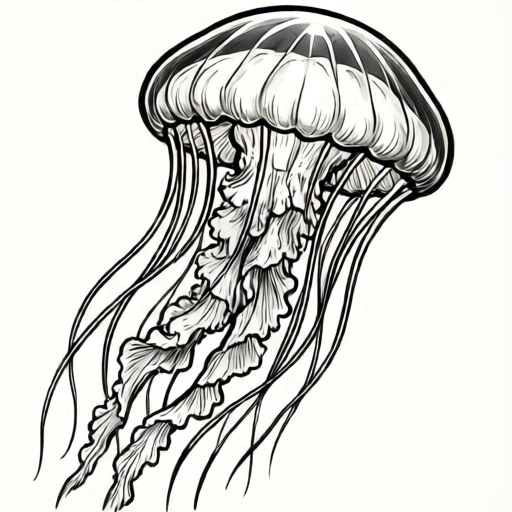
Use the stated measurements and conventions for each exercise.
Constructing the Bell Dome
Begin by drawing a light vertical axis and a horizontal baseline. Mark a midline at half the intended bell height; this is your x-height reference for proportion checks. The bell dome is a rounded cap, wider at the rim than at the top, with a slight inward curve near the margin.
Sketch the dome as two mirrored arcs meeting at the top, then flatten the rim slightly so it reads as a soft edge rather than a perfect circle. Keep construction lines faint so they can be erased or absorbed into shading.
- Draw a vertical axis and a horizontal baseline; mark the midline at half the bell height.
- Sketch two mirrored arcs from the top to the rim, checking symmetry against the axis.
- Flatten the rim with a gentle curve and add a faint inner rim line to suggest thickness.
- Measure the widest point and compare it to the bell height; adjust until the ratio matches your chosen example value.
Separating Oral Arms and Trailing Tentacles
Beneath the bell, oral arms are shorter, ruffled, and often clustered near the center. Trailing tentacles are longer, thinner, and spread outward from the rim. Draw oral arms first as wavy ribbons, then add tentacles as smooth tapering lines that curve with gravity and water drag.
Use a comparison diagram in your plan: one column for oral arms, one for tentacles, with length and thickness noted. This prevents the common error of making every appendage the same length and texture.
- Draw three to five wavy oral arms from the center underside, keeping them shorter than the bell height.
- Add trailing tentacles from the rim, varying length and curvature; avoid parallel identical lines.
- Check that oral arms overlap the bell edge slightly and tentacles fall behind or beside them.
- Label the two groups on your practice sheet before shading.
Shading for Translucency
Translucency is shown by soft gradients and visible interior lines rather than solid dark fills. Keep the bell lighter near the top and slightly darker at the rim, where thickness increases. Use light hatching that follows the dome curvature, and leave gaps so underlying oral arms remain visible.
For tentacles, vary line weight: thicker near the rim, thinner at the tips. A faint double line suggests a translucent core without turning the tentacle opaque.
- Apply light hatching along the dome curve, leaving the top nearly clear.
- Darken the rim slightly and add a soft shadow under the bell where oral arms attach.
- Draw tentacles with tapering line weight and occasional faint interior lines.
- Check that at least one oral arm remains visible through the bell shading.
Checking Proportion and Convention
Use the baseline-to-midline x-height as a repeatable check. Measure the bell height, the oral arm length, and the longest tentacle; record the ratios. Because letter styles vary, accept any consistent style as long as the measured relationships and labels are clear.
A simple arithmetic check: if the bell height is 6 units and the longest tentacle is 9 units, the tentacle-to-bell ratio is 1.5. Confirm your drawing matches your recorded ratio within a small tolerance you define.
- Measure bell height, oral arm length, and longest tentacle in the same units.
- Record ratios and compare them to your planned example values.
- Check that oral arms are shorter than the bell height and tentacles are longer than oral arms.
- Confirm labels and shading convention are consistent across the sheet.
Worked example
A jellyfish drawing has a bell height of 6 units, oral arms of 3 units, and a longest tentacle of 9 units. Check the ratios and state whether the oral arms and tentacles follow the lesson rules.
Worked answer
Oral arm to bell ratio is 3 divided by 6, or 0.5; tentacle to bell ratio is 9 divided by 6, or 1.5. The oral arms are shorter than the bell height, and the tentacles are longer than the oral arms, so the drawing follows the stated rules.
Four practice exercises
Exercise 1
A bell height is 8 units and the longest tentacle is 12 units. Calculate the tentacle-to-bell ratio and state whether it meets the rule that tentacles are longer than oral arms if oral arms are 4 units.
Show answer and check
The tentacle-to-bell ratio is 12 divided by 8, or 1.5. Oral arms are 4 units, which is shorter than the 12-unit tentacle, so the rule is met.
Why: Divide tentacle length by bell height; compare oral arm length to tentacle length.
Check: Recompute 12 divided by 8 and confirm 4 is less than 12.
Exercise 2
An oral arm is 5 units and the bell height is 10 units. Is the oral arm shorter than the bell height? Give the ratio.
Show answer and check
Yes, 5 is less than 10. The oral-arm-to-bell ratio is 5 divided by 10, or 0.5.
Why: Compare the two lengths directly and divide oral arm length by bell height.
Check: Confirm 5 is less than 10 and that 5 divided by 10 equals 0.5.
Exercise 3
A drawing plan uses a bell height of 7 units, oral arms of 3 units, and tentacles of 10 units. Check both rules: oral arms shorter than bell, and tentacles longer than oral arms.
Show answer and check
Oral arms are 3 units, shorter than the 7-unit bell. Tentacles are 10 units, longer than the 3-unit oral arms. Both rules are met.
Why: Compare oral arm length to bell height, then tentacle length to oral arm length.
Check: Verify 3 is less than 7 and 10 is greater than 3.
Exercise 4
A bell height is 9 units and the longest tentacle is 13.5 units. Calculate the tentacle-to-bell ratio and explain whether a 4-unit oral arm is acceptable.
Show answer and check
The ratio is 13.5 divided by 9, or 1.5. A 4-unit oral arm is shorter than the 9-unit bell and shorter than the 13.5-unit tentacle, so it is acceptable.
Why: Divide tentacle length by bell height; check oral arm against both bell and tentacle.
Check: Recompute 13.5 divided by 9 and confirm 4 is less than 9 and less than 13.5.
Common mistakes
- Making the bell a perfect circle instead of a soft dome with a flattened rim. Flatten the rim slightly and check symmetry against the vertical axis.
- Drawing oral arms and trailing tentacles as identical appendages. Keep oral arms shorter and ruffled; make tentacles longer, thinner, and smoother.
- Filling the bell with solid dark shading, losing translucency. Use light hatching with gaps and keep interior oral arms visible.
- Ignoring the x-height convention when checking proportions. Mark baseline and midline, then measure bell height and appendage lengths against them.
Self-check rubric
- Bell dome is a soft cap with a slightly flattened rim and clear symmetry check.
- Oral arms are shorter than the bell height and visibly ruffled.
- Trailing tentacles are longer than oral arms, thinner, and varied in curvature.
- Shading uses light hatching with gaps so translucency reads.
- Proportion ratios are recorded and checked in consistent units.
- Labels and convention are consistent; valid alternative styles are accepted when relationships hold.
Questions and answers
Do I need to draw every tentacle exactly the same length?
No. Vary length and curvature for realism, but keep oral arms shorter than the bell height and tentacles longer than oral arms.
What does x-height mean here?
It is the distance from baseline to midline, used as a repeatable proportion check. Letter styles may vary, so accept consistent alternatives.
Can I use solid shading anywhere?
Use it sparingly at the rim or where forms overlap; keep most of the bell light to suggest translucency.
How do I know my proportions are correct?
Measure bell height, oral arm length, and longest tentacle in the same units, then compare their ratios to your planned values.