Free original lessons
Draw an Anime Male: Stylized Head, Hair Mass, and Body Proportions
Learn to construct an anime male with a stylized head shape, clear hair mass, and consistent body proportions using simple measured guides and a repeatable check.
Free lesson
Four exercises
Worked answers
Object Drawing Lessons
This lesson teaches a construction method for an anime male figure using a stylized head and body ratio. You will define a head unit, place facial features on a midline, build hair as a mass rather than strands, and stack body proportions from that unit. The convention is explicit: x-height runs from the baseline to the midline of the head, and letter styles vary, so valid alternatives are allowed when the measured relationships hold. All measurements are hypothetical examples; measure your own paper and tools. The goal is a coherent, checkable drawing, not a single universal face.
Practice materials: Printable downloads are not available for this lesson yet. Use the instructions and four exercises below.
Reference illustration
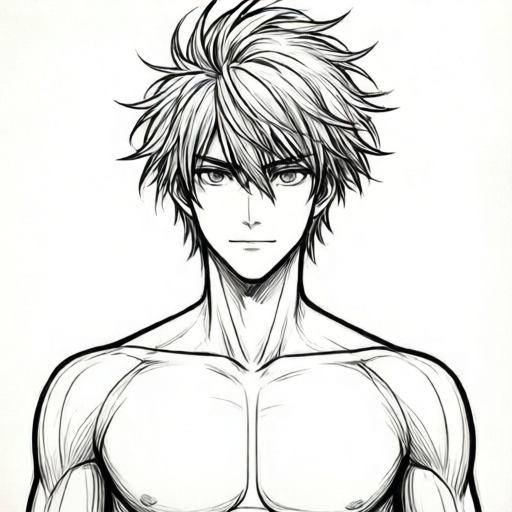
Use the stated measurements and conventions for each exercise.
Define the head unit and facial midline
Start by drawing a light vertical midline and a horizontal midline crossing it. The distance from the baseline (chin level) to the horizontal midline is the x-height. In this lesson, x-height is a construction unit, not a handwriting rule. Mark the top of the skull above the midline by roughly one x-height, then taper the jaw toward the baseline. The head shape is a rounded wedge: wider at the temples, narrower at the chin.
Place the eyes on or just below the horizontal midline. Eye width is about one x-height divided by three, with a gap of one eye width between them. Nose base sits about one-third of the way from the midline to the baseline; mouth sits about two-thirds down. Ear tops align near the horizontal midline, ear bottoms near the nose base. These are hypothetical proportions; adjust only if your measured head unit changes.
- Draw a vertical midline and a horizontal midline; label the baseline-to-midline distance as x.
- Mark the skull top about x above the midline and taper the jaw to the baseline.
- Place eyes on the midline with one-third-x widths and one-eye gap.
- Mark nose base at one-third down and mouth at two-thirds down from midline to baseline.
- Align ear tops with the midline and ear bottoms with the nose base.
Build hair as a mass, not strands
Treat hair as two or three overlapping masses: a crown mass covering the skull, a side mass framing the face, and an optional back mass. Draw the outer silhouette first, then add a few directional lines inside. Avoid drawing individual strands until the mass reads clearly. The hairline should sit above the eyes and follow the skull curve; bangs can cross the midline but must not hide the eye placement guide.
Use the x-height to check hair volume. The crown mass should rise about half an x above the skull top. Side masses should not extend past the jawline by more than half an x unless the design intentionally uses long hair. Because letter styles vary, hair shapes may differ, but the mass should still cover the skull and frame the face consistently.
- Draw the crown mass over the skull, rising about half an x above the top.
- Add side masses from the temples to the jawline.
- Draw the hairline above the eyes and check it follows the skull curve.
- Add a few directional lines inside each mass, not individual strands.
- Check that bangs do not obscure the eye midline guide.
Stack body proportions from the head unit
For a stylized anime male, use a head-to-body ratio of about seven heads. Measure the head height from skull top to baseline and call it H. Mark the chin, then stack H units downward: shoulders near 1.5 H, waist near 3 H, hips near 3.5 H, knees near 5 H, and feet near 7 H. These are hypothetical examples; measure your own drawing and keep units consistent.
Shoulder width is about two head widths for a stylized male, with the torso tapering to a waist about one and a half head widths. Arms hang to about mid-thigh, and hands reach roughly 3.5 H. Legs from hip to foot are about 3.5 H. Draw the torso as a simple tapered box, then add limbs as cylinders. Check that the head unit, shoulder width, and leg length agree before adding details.
- Measure head height H from skull top to baseline.
- Mark chin, shoulders at 1.5 H, waist at 3 H, hips at 3.5 H, knees at 5 H, feet at 7 H.
- Set shoulder width to about two head widths and taper to a waist of about one and a half head widths.
- Draw arms hanging to mid-thigh and legs from hip to foot at about 3.5 H.
- Check that all stacked units use the same H measurement.
Check the drawing against the convention
Use a simple checklist: eyes on the midline, nose at one-third, mouth at two-thirds, hair mass covering the skull, and body units stacked consistently. Because valid alternatives exist, do not penalize a different hair silhouette or eye shape if the measured relationships hold. The rubric rewards clear construction, consistent units, and readable mass, not a single universal face.
Measure with a ruler or marked strip. If the head height is 4 cm, then shoulders should be near 6 cm from the chin, waist near 12 cm, hips near 14 cm, knees near 20 cm, and feet near 28 cm. These numbers are hypothetical examples; substitute your own measured H and keep the arithmetic consistent.
- Check eye placement on the horizontal midline.
- Check nose and mouth at one-third and two-thirds down.
- Check hair mass covers the skull and frames the face.
- Check body units use the same H and stack to about seven heads.
- Record any deviation and adjust one unit at a time.
Worked example
A drawing has a measured head height H of 5 cm. Using the seven-head convention, find the shoulder, waist, hip, knee, and foot levels measured downward from the skull top, and state one check.
Worked answer
Shoulders at 1.5 H = 7.5 cm; waist at 3 H = 15 cm; hips at 3.5 H = 17.5 cm; knees at 5 H = 25 cm; feet at 7 H = 35 cm. Check: the foot level equals seven times the measured head height, and all units use the same 5 cm H.
Why: Multiply the measured head height by each unit multiplier. Keep units in centimeters and verify the final foot level equals 7 H.
Check: Re-measure H on the drawing, multiply by 7, and compare with the marked foot level; they should match within your measurement precision.
Four practice exercises
Exercise 1
A head unit H is 4 cm. Using the seven-head convention, calculate the shoulder, waist, hip, knee, and foot levels downward from the skull top.
Show answer and check
Shoulders 6 cm; waist 12 cm; hips 14 cm; knees 20 cm; feet 28 cm.
Why: Multiply H by 1.5, 3, 3.5, 5, and 7 respectively, keeping centimeters consistent.
Check: Verify that the foot level equals 7 times 4 cm, and that each level increases in the stated order.
Exercise 2
A drawing has eyes placed one-quarter of the way from the midline to the baseline. State whether this matches the lesson convention and give a correction.
Show answer and check
It does not match. Move the eyes to the horizontal midline or just below it, then recheck the nose at one-third and mouth at two-thirds.
Why: The convention places eyes on or just below the midline, not one-quarter down toward the baseline.
Check: Measure from midline to baseline and confirm the eye line is at or very near the midline.
Exercise 3
A hair drawing shows many separate strands but no clear outer silhouette. Describe a two-mass fix and one check.
Show answer and check
Draw a crown mass over the skull and a side mass from temple to jawline, then add a few directional lines inside. Check that the crown rises about half an x above the skull top and that bangs do not hide the eye midline.
Why: Mass first, strands second, keeps the silhouette readable and preserves facial guides.
Check: Trace the outer hair silhouette with a finger; it should form two or three clear masses around the skull.
Exercise 4
A figure has shoulder width of one head width and a waist of two head widths. Identify the proportion problem and give a corrected target.
Show answer and check
The shoulders are too narrow and the waist is too wide for the stylized male convention. Target shoulders near two head widths and a waist near one and a half head widths.
Why: The lesson uses a broader shoulder and tapered waist to read as a stylized male torso.
Check: Measure shoulder width and waist width in head widths and compare with the target values.
Common mistakes
- Drawing eyes above the horizontal midline to make the face look taller. Return the eyes to the midline or just below it, then adjust the skull top instead.
- Drawing hair as many separate strands before the mass is clear. Draw two or three overlapping masses first, then add a few directional lines inside.
- Stacking body units with different head heights. Measure one H from skull top to baseline and reuse that exact length for every unit.
- Making shoulders too narrow for a stylized male torso. Set shoulder width near two head widths, then taper to the waist.
Self-check rubric
- Head shape is a rounded wedge with a clear midline and baseline.
- Eyes sit on or just below the horizontal midline with consistent spacing.
- Nose and mouth follow the one-third and two-thirds placement.
- Hair is built as two or three overlapping masses that cover the skull and frame the face.
- Body units use one measured H and stack to the stated ratio.
- Shoulder width and waist taper are consistent with the chosen stylized male proportion.
- Valid alternatives in hair silhouette or eye shape are accepted when measured relationships hold.
Questions and answers
Is x-height the same as head height?
No. In this lesson, x-height is baseline to midline, while head height H is skull top to baseline. Use H for body stacking.
Can I use a different head-to-body ratio?
Yes, if you state the ratio and keep all units consistent. Seven heads is a hypothetical example for this stylized male construction.
Do I have to draw the same hair shape?
No. Hair silhouettes vary. The check is that the mass covers the skull, frames the face, and does not hide the eye midline guide.
How do I check my proportions without a ruler?
Mark the head height on a strip of paper and use that strip to stack shoulders, waist, hips, knees, and feet.