Free original lessons
Cadillac Drawing: Body Proportions and Wheel Placement
Learn to draw a Cadillac with believable body proportions and wheel placement using measured guides, a clear convention, and self-checking steps.
Free lesson
Four exercises
Worked answers
Object Drawing Lessons
This lesson teaches a repeatable method for drawing a Cadillac car body with convincing proportions and wheel placement. You will use a simple unit system based on the car's overall length, mark wheel centers and body landmarks, and then refine the silhouette. The approach works for a side view and can be adapted to a three-quarter view. All measurements are relative, so you can scale the drawing to any paper size. A convention is defined for judging proportions: use the wheel diameter as one unit, and compare all major distances to that unit. Lettering and handwriting are not part of the drawing score; any legible labels are acceptable. The goal is a clear, balanced car drawing, not a perfect replica of a specific model year.
Practice materials: Printable downloads are not available for this lesson yet. Use the instructions and four exercises below.
Reference illustration
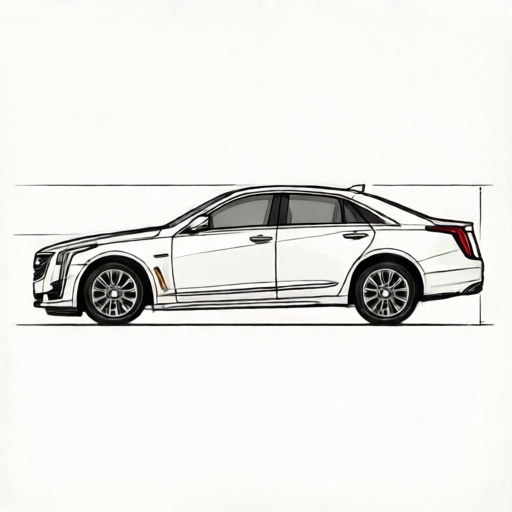
Use the stated measurements and conventions for each exercise.
Set a unit and mark the overall length
Choose a wheel diameter as your unit. On your paper, decide a wheel diameter that fits comfortably, for example 2 cm, and label it as a hypothetical example. Draw a light horizontal baseline for the ground. Mark the front and rear limits of the car body along the baseline. A typical Cadillac side-view length is about 5.5 to 6 wheel diameters, but treat this as a starting guide, not a rule. Measure your own chosen length and write it down.
Place the front and rear wheel centers on the baseline. The distance between wheel centers is the wheelbase. For a large sedan, a wheelbase of about 3.5 to 4 wheel diameters is a reasonable starting point. Mark the centers lightly, then draw vertical centerlines through them. These lines will anchor the wheel arches and the body mass.
- Draw a light ground line and mark a wheel diameter unit.
- Mark the front and rear body limits using about 5.5 to 6 units.
- Mark the front and rear wheel centers using a wheelbase of about 3.5 to 4 units.
- Draw vertical centerlines through both wheel centers.
Build the body mass around the wheels
The body sits between the wheels and extends beyond them. Draw a light rectangle from the front body limit to the rear body limit, with its bottom edge just above the wheel centers. The roof height is usually about 2.5 to 3 wheel diameters above the ground line for a sedan. Mark the beltline, the lower edge of the side windows, at roughly 1.5 to 1.8 units above the ground. These are starting proportions; adjust them to match the Cadillac style you want, such as a longer hood or a more upright cabin.
Place the wheel arches. Each arch should be centered on a wheel centerline and slightly wider than the wheel. Draw a light curve from the body bottom edge over each wheel. The front arch often sits slightly higher than the rear arch on a Cadillac, but keep both arches consistent with your chosen unit. Check that the body does not cut through the wheels; the wheels should sit inside their arches with a small gap.
- Draw a light body rectangle between the front and rear limits.
- Mark the roof height at about 2.5 to 3 units above the ground.
- Mark the beltline at about 1.5 to 1.8 units above the ground.
- Draw wheel arches centered on each wheel centerline.
- Check that each wheel sits inside its arch with a small gap.
Refine the Cadillac silhouette
Cadillac styling often includes a long hood, a crisp beltline, and a relatively upright cabin. Use your landmarks to shape the hood, windshield, roof, and trunk. The hood can run from the front body limit to the base of the windshield, roughly one-third of the body length. The cabin can occupy the middle third, and the trunk the rear third. These fractions are guides; adjust them to suit the angle and style you are drawing.
Draw the wheels as circles or ellipses using the wheel diameter unit. Add a smaller inner circle for the hub and a few spokes if desired. Keep the wheel centers on the baseline and the wheel bottoms touching the ground line. For a three-quarter view, perspective makes the near wheels appear larger and the far wheels smaller; use the wheel-diameter unit for the near wheel and scale the far wheel proportionally to its apparent depth, keeping all wheel bottoms on the ground line.
- Shape the hood, windshield, roof, and trunk using the beltline and roof height.
- Draw the wheels using the wheel diameter unit.
- Keep wheel bottoms on the ground line and centers on the baseline.
- Add simple hub and spoke details without changing the wheel size.
Check proportions and placement
Use a simple check: measure the wheel diameter on your drawing and compare it to the body length, wheelbase, roof height, and beltline. If any measurement is far from your planned values, adjust the light guide lines before darkening the final lines. A valid drawing can use different proportions, but the relationships should be intentional and consistent. The rubric rewards clear wheel placement, balanced body mass, and a recognizable Cadillac-like silhouette, not exact numerical matching.
For handwriting or labels, use any legible style. X-height is measured from the baseline to the midline of lowercase letters, and letter styles vary. Labels are optional and do not affect the drawing score. If you add a title or notes, keep them outside the car body so they do not interfere with the proportions.
- Measure the wheel diameter and compare it to body length and wheelbase.
- Check roof height and beltline against your planned units.
- Adjust light guides before finalizing lines.
- Keep any labels outside the car body and legible.
Worked example
A side-view Cadillac drawing uses a wheel diameter of 2 cm. The body length is 11 cm, the wheelbase is 7.5 cm, the roof height is 5.5 cm, and the beltline is 3.2 cm above the ground. Check the proportions in wheel-diameter units and state whether they are reasonable starting values.
Worked answer
Body length is 11 ÷ 2 = 5.5 units. Wheelbase is 7.5 ÷ 2 = 3.75 units. Roof height is 5.5 ÷ 2 = 2.75 units. Beltline is 3.2 ÷ 2 = 1.6 units. These values fall within the starting ranges: length about 5.5 to 6 units, wheelbase about 3.5 to 4 units, roof height about 2.5 to 3 units, and beltline about 1.5 to 1.8 units. The proportions are reasonable for a Cadillac-style sedan drawing.
Four practice exercises
Exercise 1
A side-view drawing uses a wheel diameter of 3 cm. The body length is 16.5 cm and the wheelbase is 10.5 cm. Convert both to wheel-diameter units and state whether they are within the starting ranges.
Show answer and check
Body length is 16.5 ÷ 3 = 5.5 units. Wheelbase is 10.5 ÷ 3 = 3.5 units. Both are within the starting ranges of about 5.5 to 6 units for length and about 3.5 to 4 units for wheelbase.
Why: Divide each measurement by the wheel diameter to express it in units. Compare the results to the lesson's starting ranges.
Check: Re-measure the wheel diameter and the two distances on the drawing. Confirm the divisions and that the results fall inside the stated ranges.
Exercise 2
A drawing has a wheel diameter of 2.5 cm and a roof height of 8 cm above the ground. Convert the roof height to units and decide whether it is too tall, too low, or within the starting range.
Show answer and check
Roof height is 8 ÷ 2.5 = 3.2 units. The starting range is about 2.5 to 3 units, so 3.2 units is slightly too tall and should be lowered or justified intentionally.
Why: Divide the roof height by the wheel diameter. Compare the result to the roof-height range in the lesson.
Check: Measure the roof height from the ground line to the roof top, divide by the wheel diameter, and confirm the result is above 3 units.
Exercise 3
A side-view Cadillac drawing has a wheelbase of 9 cm and a wheel diameter of 2.4 cm. The front wheel center is 4 cm from the front body limit. Convert the wheelbase and the front overhang to units and check whether the front overhang is plausible for a Cadillac-style sedan.
Show answer and check
Wheelbase is 9 ÷ 2.4 = 3.75 units. Front overhang is 4 ÷ 2.4 ≈ 1.67 units. A front overhang of about 1.5 to 2 units is plausible for a Cadillac-style sedan, so this is acceptable.
Why: Express both distances in wheel-diameter units. The wheelbase is within the starting range, and the front overhang is a reasonable fraction of the body length.
Check: Measure the wheelbase and front overhang, divide each by the wheel diameter, and confirm the wheelbase is about 3.5 to 4 units and the overhang is about 1.5 to 2 units.
Exercise 4
A drawing uses a wheel diameter of 2 cm. The beltline is 3.6 cm above the ground and the roof height is 5.8 cm above the ground. Convert both to units and state whether the cabin height between beltline and roof is reasonable.
Show answer and check
Beltline is 3.6 ÷ 2 = 1.8 units. Roof height is 5.8 ÷ 2 = 2.9 units. Cabin height is 2.9 − 1.8 = 1.1 units. This is reasonable because the beltline is within about 1.5 to 1.8 units and the roof is within about 2.5 to 3 units, leaving a cabin height of about 1 unit.
Why: Convert both heights to units, then subtract the beltline from the roof height to find the cabin height. Compare each value to the lesson's starting ranges.
Check: Measure the beltline and roof height from the ground line, divide by the wheel diameter, and confirm the beltline is about 1.5 to 1.8 units and the roof is about 2.5 to 3 units.
Common mistakes
- Drawing wheels too small or too large relative to the body. Set one wheel diameter unit first and use it for all wheel and body comparisons.
- Placing wheel centers too close together or too far apart. Mark the wheelbase as about 3.5 to 4 wheel diameters and check it before drawing arches.
- Letting the body cut through the wheels. Draw wheel arches centered on the wheel centerlines and leave a small gap around each wheel.
- Making the roof too tall or too flat for a Cadillac-like sedan. Use a roof height of about 2.5 to 3 wheel diameters as a starting guide, then adjust intentionally.
Self-check rubric
- Wheel placement: both wheels sit on the ground line with centers on the baseline and a small gap inside the arches.
- Body proportions: body length, wheelbase, roof height, and beltline are consistent with the chosen wheel-diameter unit.
- Cadillac silhouette: the drawing shows a long hood, crisp beltline, and upright cabin that read as a Cadillac-style sedan.
- Line quality: guide lines are light and final lines are clear; labels, if any, are legible and outside the car body.
- Valid alternatives: different proportions are acceptable if they are intentional, consistent, and clearly explained by the unit system.
Questions and answers
Do I need to copy a specific Cadillac model year?
No. The lesson focuses on body proportions and wheel placement. You can draw a generic Cadillac-style sedan or adapt the proportions to a model you like.
What if my paper is small?
Scale the wheel diameter unit to fit your paper. All other measurements are relative to that unit, so the drawing can be any size.
Can I use a three-quarter view instead of a side view?
Yes. Keep the same unit system; in a three-quarter view the near wheels will appear larger and the far wheels smaller due to perspective. Check that all wheels still touch the ground line.
How do I know if my proportions are acceptable?
Use the rubric: clear wheel placement, balanced body mass, consistent units, and a recognizable Cadillac-like silhouette. Exact numerical matching is not required.