Free original lessons
Draw a Walleye: Body Shape and Fin Placement Guide
Learn walleye-specific construction: elongated body, spiny dorsal, anal and pelvic fin positions, eye and marking placement, with a worked example and four practice tasks.
Free lesson
Four exercises
Worked answers
Object Drawing Lessons
A walleye is not a generic fish. Its body is elongated and slightly compressed, its back is darker than its belly, and its fin arrangement is distinctive: two dorsal fins (a spiny first dorsal and a soft-rayed second dorsal), an anal fin set far back, and pelvic fins placed forward under the belly. This guide teaches a repeatable construction order so your drawing reads as a walleye rather than a salmon, bass, or shark. Work in pencil first, keep proportions checkable, and use the convention below for any handwriting or labels. All measurements are hypothetical examples; measure your own paper and tools.
Practice materials: Printable downloads are not available for this lesson yet. Use the instructions and four exercises below.
Reference illustration
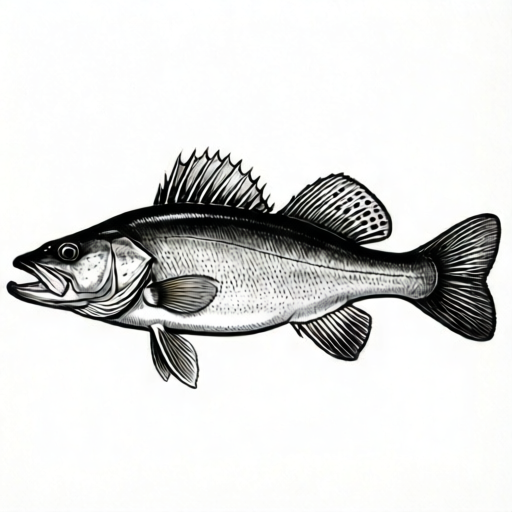
Use the stated measurements and conventions for each exercise.
Convention and proportion setup
Use a simple convention for labels and handwriting: x-height is measured from the baseline to the midline of lowercase letters, and letter styles may vary. This means two valid labels can look different but still be correct if their x-height is consistent and legible. For the fish itself, define a body-length unit L as the distance from the tip of the snout to the fork of the tail. On a hypothetical 20 cm drawing, L = 20 cm. Mark a horizontal midline and a vertical line at the eye.
Walleye proportions to aim for: body depth (top of back to belly) is roughly one-quarter to one-third of L; the head is about one-fifth of L; the eye sits high and slightly forward on the head. These are drawing targets, not manufacturing standards. Check them with a ruler on your own paper.
- Draw a horizontal midline and mark snout tip and tail fork so the distance equals your chosen L.
- Mark body depth as a fraction of L (for example, 0.28 L) above and below the midline at the deepest point, just behind the head.
- Place the eye center about 0.18 L from the snout tip and slightly above the midline.
- Lightly sketch the head wedge and the elongated body oval, then check depth and head length with a ruler.
Body outline and fin positions
The walleye body tapers from a deeper shoulder to a narrower caudal peduncle. The first dorsal fin is spiny and sits roughly above the pelvic fins; the second dorsal is soft-rayed and sits behind the first, closer to the tail. The anal fin is opposite the second dorsal and set far back. Pelvic fins are forward under the belly, and pectoral fins sit just behind the gill cover. Label each fin with a short line and a legible label using the x-height convention.
Marking placement: walleye markings are subtle. Suggest a darker back and a lighter belly with a soft transition, and add faint vertical bars or mottling only if your reference supports them. Do not invent bright stripes.
- Draw the spiny first dorsal as a low triangular fin with visible spine tips, starting about 0.35 L from the snout.
- Draw the soft second dorsal behind it, separated by a small gap, ending before the tail fork.
- Place the anal fin opposite the second dorsal, set far back near the caudal peduncle.
- Add pelvic fins forward under the belly and pectoral fins just behind the gill cover; label all fins.
Eye, mouth, and finishing checks
The walleye eye is large and reflective-looking; draw a clear circle with a pupil and a small highlight. The mouth is terminal to slightly superior, with the lower jaw projecting slightly. Keep the gill cover line curved and place the pectoral fin behind it. Finish by checking fin counts and positions against the construction marks rather than against a single ideal image.
Because letter styles vary, accept any legible label whose x-height is consistent. Because fish posture varies, accept small differences in fin angle if the positions and relative sizes match the walleye pattern.
- Draw the eye circle, pupil, and highlight; check eye diameter is about 0.06 L.
- Draw the mouth line with a slight lower-jaw projection and a curved gill cover.
- Erase construction lines, darken the body outline, and add soft back-to-belly shading.
- Verify each fin label and position using the checklist in the rubric.
Worked example
On a 20 cm body length L, place the eye center, first dorsal start, and anal fin using the guide fractions, and state the distances from the snout tip.
Worked answer
Eye center: 0.18 L = 3.6 cm from snout tip. First dorsal start: 0.35 L = 7.0 cm from snout tip. Anal fin: set far back, about 0.75 L = 15.0 cm from snout tip, opposite the second dorsal. Check that the second dorsal ends before the tail fork and that the anal fin sits near the caudal peduncle.
Four practice exercises
Exercise 1
A walleye drawing has L = 24 cm. Using the guide, calculate body depth at 0.28 L and eye distance at 0.18 L from the snout tip.
Show answer and check
Body depth = 0.28 × 24 = 6.72 cm total (about 3.36 cm above and below the midline). Eye distance = 0.18 × 24 = 4.32 cm from the snout tip.
Why: Multiply the fraction by L, keeping units in cm. Split depth above and below the midline for a balanced outline.
Check: Re-measure with a ruler on your paper; the two depth halves should sum to 6.72 cm within your drawing tolerance.
Exercise 2
Place the first dorsal start at 0.35 L and the anal fin at 0.75 L on an L = 30 cm drawing. State both distances from the snout tip and explain why the anal fin is not at 0.50 L.
Show answer and check
First dorsal start = 0.35 × 30 = 10.5 cm. Anal fin = 0.75 × 30 = 22.5 cm. The anal fin is far back because walleye anal fins sit near the caudal peduncle, opposite the second dorsal, not mid-belly.
Why: Use the fractions as position markers along the midline; the anal fin position is a walleye-specific feature.
Check: Confirm the anal fin is behind the midpoint and roughly opposite the second dorsal by measuring both distances.
Exercise 3
Sketch a walleye with L = 16 cm. Mark the eye at 0.18 L, the first dorsal at 0.35 L, and the second dorsal ending at 0.70 L. List the three distances in cm and check that the second dorsal ends before the tail fork.
Show answer and check
Eye = 2.88 cm; first dorsal = 5.6 cm; second dorsal end = 11.2 cm. The tail fork is at 16 cm, so the second dorsal ends 4.8 cm before the fork.
Why: Convert each fraction to cm and compare positions along the body length.
Check: Measure from the snout tip to each mark; the second dorsal end should be less than L.
Exercise 4
A learner draws one merged dorsal fin and puts the anal fin at mid-belly. Identify the two walleye-specific errors and state the corrected positions using L = 20 cm.
Show answer and check
Error 1: merged dorsal fin; correct by drawing a spiny first dorsal starting at 0.35 L = 7.0 cm and a separate soft second dorsal behind it. Error 2: anal fin at mid-belly; correct by moving it to about 0.75 L = 15.0 cm, far back near the caudal peduncle.
Why: Walleye fin arrangement requires two dorsals and a rear-set anal fin; the fractions give checkable corrected positions.
Check: Verify two separate dorsal fins with a gap and an anal fin behind the midpoint, using ruler measurements.
Common mistakes
- Drawing a deep, round body like a bass or sunfish. Reduce body depth to about one-quarter to one-third of L and elongate the oval toward the tail.
- Placing a single dorsal fin or merging the two dorsals. Draw a spiny first dorsal and a separate soft second dorsal with a small gap between them.
- Putting the anal fin near the middle of the belly. Move the anal fin far back, opposite the second dorsal and near the caudal peduncle.
- Using bright stripes or invented markings. Use subtle darker back, lighter belly, and faint bars only if your reference shows them.
Self-check rubric
- Body is elongated and slightly compressed, with depth between 0.25 L and 0.33 L.
- Head length is about 0.20 L and the eye is high and slightly forward.
- Two dorsal fins are present: spiny first dorsal and soft second dorsal, with a gap.
- Anal fin is set far back, opposite the second dorsal.
- Pelvic fins are forward under the belly; pectoral fins sit behind the gill cover.
- Labels are legible and follow the x-height convention; valid handwriting alternatives are accepted.
- Markings are subtle and reference-supported, not invented bright stripes.
Questions and answers
How many dorsal fins should I draw?
Two: a spiny first dorsal and a soft-rayed second dorsal, separated by a small gap.
Where do the pelvic fins go?
Forward under the belly, roughly below the first dorsal fin, not near the tail.
Can I label fins in my own handwriting?
Yes. Use the x-height convention: baseline to midline for lowercase letters, and keep labels legible and consistent.
Are the measurements exact?
No. The fractions are hypothetical drawing targets. Measure your own paper and adjust proportionally.