Free original lessons
Draw a Winged Cross: Symmetry and Feather Placement
Learn to compose a winged cross with balanced proportions, mirrored wings, and layered feathers using a simple grid and checkable steps.
Free lesson
Four exercises
Worked answers
Object Drawing Lessons
This lesson teaches a repeatable method for drawing a cross with wings. You will set cross proportions on a grid, mirror the wings for symmetry, and place feathers in clear layers. The approach uses simple measurements and visual checks so you can judge your own work. Letter styles and feather shapes vary, so the rubric rewards consistent choices rather than one exact outline. All measurements are hypothetical examples; measure your own paper and tools.
Practice materials: Printable downloads are not available for this lesson yet. Use the instructions and four exercises below.
Reference illustration
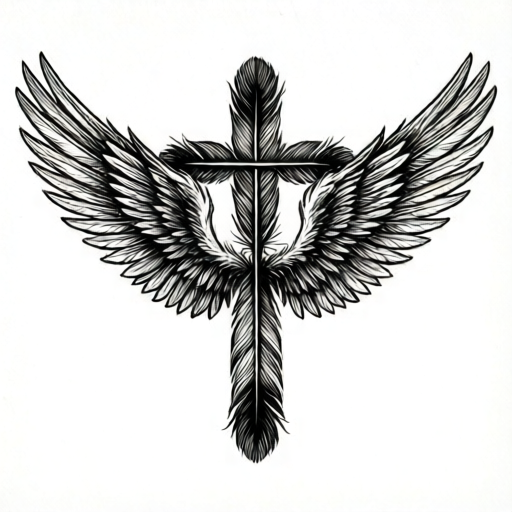
Use the stated measurements and conventions for each exercise.
Set the cross proportions on a grid
Begin with a light rectangular grid. For a hypothetical example, use a 12 by 16 unit grid on paper that is at least 15 by 20 cm. Mark a vertical center line and a horizontal center line. The cross will sit on the vertical center line.
Choose a vertical bar width and a horizontal bar width. A simple starting choice is a vertical bar 2 units wide and a horizontal bar 2 units wide. The vertical bar runs from 2 units below the top margin to 2 units above the bottom margin, so it is 12 units tall on the 16-unit grid. The horizontal bar crosses at the horizontal center line, which is 8 units from the top margin. Because the vertical bar starts 2 units below the top margin, the crossing point is 8 minus 2 equals 6 units down from the top of the vertical bar, and 12 minus 6 equals 6 units up from the bottom of the bar, so it is the midpoint of the vertical bar. These numbers are examples, not standards; adjust to your paper. Check this by measuring both segments from the crossing point to the bar ends.
- Draw the vertical center line and horizontal center line lightly.
- Mark the vertical bar as two parallel lines 2 units apart, centered on the vertical center line.
- Mark the horizontal bar as two parallel lines 2 units apart, centered on the horizontal center line.
- Check that the four arm lengths are equal in pairs: top and bottom arms equal, left and right arms equal.
- Erase construction lines only after the cross outline is confirmed.
Mirror the wings for symmetry
Symmetry here means the left and right wings are mirror images across the vertical center line. Decide a wing span and a wing height. For example, let each wing extend 5 units from the cross and rise 4 units above the horizontal bar. Mark matching points on both sides using the grid.
Draw the upper wing edge as a smooth curve from the cross outward and slightly upward, then return along the lower edge. Use the same number of grid points on each side. A mirror check is simple: fold the paper along the vertical center line or hold a straight edge at the center and compare distances.
- Mark the wing root where the wing meets the cross on each side.
- Mark the wing tip at equal distances from the center line on both sides.
- Draw the upper edge with the same curve on both sides.
- Draw the lower edge with the same curve on both sides.
- Compare three pairs of points: root, mid-wing, and tip. Each pair should be the same distance from the center line.
Place feathers in layers
Feather placement uses layers from the wing root outward. Draw three layers: a short inner layer near the cross, a medium middle layer, and a longer outer layer near the tip. Each feather is a simple tapered shape. Overlap feathers so the outer layer sits slightly over the middle layer at the edges.
Keep feather count equal on both wings. For a hypothetical example, use 4 inner feathers, 5 middle feathers, and 3 outer feathers per wing. Vary feather length gradually: inner feathers shortest, outer feathers longest. The convention is that feather tips point outward and slightly down, but you may choose a consistent alternative direction if you state it in your notes.
- Draw the inner layer first, starting at the wing root.
- Draw the middle layer overlapping the inner layer by about one third of a feather length.
- Draw the outer layer overlapping the middle layer similarly.
- Number the feathers on the left wing and match the same numbers on the right wing.
- Check that each numbered feather has a mirror partner at the same distance from the center line.
Refine and self-check
Refine line weight: keep the cross outline slightly stronger than feather lines so the composition reads clearly. Check that no feather crosses the vertical center line. Check that the wing roots do not cover the cross arms.
Use a simple arithmetic check: measure the distance from the center line to each wing tip in centimeters. The two distances should differ by no more than 0.5 cm on a 15 by 20 cm sheet. This tolerance is a hypothetical example; choose a tolerance that matches your tools and paper.
- Measure left and right wing tip distances from the center line.
- Measure top and bottom cross arm lengths.
- Confirm feather counts match on both wings.
- Confirm layer order is consistent from root to tip.
- Erase remaining construction marks and label your convention if you used an alternative feather direction.
Worked example
On a 12 by 16 unit grid, place a cross with a 2-unit vertical bar and a 2-unit horizontal bar. The vertical bar runs from 2 units below the top margin to 2 units above the bottom margin, and the horizontal bar crosses at the horizontal center line, 6 units down from the top of the vertical bar. Each wing extends 5 units from the cross and rises 4 units. Use 3 inner, 4 middle, and 2 outer feathers per wing. Describe the check for symmetry.
Worked answer
The vertical bar is centered on the vertical center line and spans from 2 units below the top to 2 units above the bottom, so it is 12 units tall. The horizontal bar is centered on the horizontal center line, which is 8 units from the top margin and 6 units down from the top of the vertical bar. Because the bar is 12 units tall, the crossing point is also 6 units up from the bottom of the bar, so it is the midpoint of the vertical bar. Wing roots are marked at the cross sides. Wing tips are marked 5 units from the center line on both sides and 4 units above the horizontal bar. Feathers are drawn in three layers with equal counts on both wings. Symmetry check: measure the left and right wing tip distances from the center line; they should match within 0.5 cm. Count feathers on each wing; counts should be 3, 4, and 2 in each layer.
Four practice exercises
Exercise 1
A cross has a vertical bar 2 units wide and a horizontal bar 2 units wide on a 12 by 16 grid. The vertical bar starts 2 units below the top margin. The horizontal bar crosses at the horizontal center line, 6 units down from the top of the vertical bar. How many units from the top margin is the horizontal bar?
Show answer and check
8 units from the top margin.
Why: The vertical bar starts 2 units below the top margin. The crossing is 6 units down the vertical bar. Add 2 plus 6 to get 8 units from the top margin, which matches the horizontal center line of the 16-unit grid. As a second check, the vertical bar ends 2 units above the bottom margin, so it is 12 units tall; the crossing is 6 units from the top and 6 units from the bottom of the bar, confirming it is the bar midpoint.
Check: Measure the distance from the top margin to the horizontal bar on your grid and compare it to 8 units, half of the 16-unit height. Also measure from the crossing point to the top and bottom ends of the vertical bar; both should be 6 units.
Exercise 2
Each wing extends 5 units from the cross. The left wing tip is measured 5.2 cm from the center line. The right wing tip is measured 4.9 cm from the center line. Using a hypothetical tolerance of 0.5 cm, do the wing tips pass the symmetry check?
Show answer and check
Yes, they pass.
Why: The difference is 5.2 minus 4.9 equals 0.3 cm. The tolerance is 0.5 cm. Since 0.3 is less than 0.5, the tips pass.
Check: Subtract the smaller distance from the larger distance and compare the result to 0.5 cm.
Exercise 3
A wing uses 4 inner feathers, 5 middle feathers, and 3 outer feathers. The other wing uses 4 inner, 4 middle, and 3 outer feathers. What is the total feather count difference between the wings?
Show answer and check
1 feather difference.
Why: First wing total is 4 plus 5 plus 3 equals 12. Second wing total is 4 plus 4 plus 3 equals 11. The difference is 12 minus 11 equals 1.
Check: Count each layer on both wings and add the counts. Compare the two totals.
Exercise 4
On a 12 by 16 grid, a wing root is 1 unit from the center line and the wing tip is 5 units from the center line. The wing rises 4 units above the horizontal bar. If you move the wing tip 1 unit farther out, what is the new distance from the center line, and does the wing span increase or decrease?
Show answer and check
The new distance is 6 units, and the wing span increases.
Why: The original tip distance is 5 units. Moving it 1 unit farther out gives 5 plus 1 equals 6 units. A larger distance from the center line means a longer wing span.
Check: Mark the new tip on the grid and measure from the center line. Confirm the distance is 6 units and compare it to the original 5 units.
Common mistakes
- Making the horizontal cross bar too high or too low. Mark the crossing point at a chosen fraction of the vertical bar, such as the midpoint (50 percent from the top), and measure both segments from the crossing point to the bar ends to confirm they match.
- Drawing wings with different spans. Mark wing tips at equal distances from the center line before drawing curves.
- Placing feathers without layers, so they look flat. Draw inner, middle, and outer layers in order and overlap each layer slightly.
- Letting feathers cross the center line. Keep the innermost feather root at least one unit from the center line and check each feather tip.
Self-check rubric
- Cross proportions: vertical and horizontal bars have consistent widths and paired arm lengths.
- Wing symmetry: left and right wing roots, mid-points, and tips are mirror images across the vertical center line.
- Feather placement: three layers are visible and ordered from root to tip.
- Feather counts: left and right wings have equal counts in each layer.
- Convention: any alternative feather direction is stated and applied consistently.
- Line clarity: cross outline is distinguishable from feather lines.
- Self-check: measurements and counts are recorded and within the chosen tolerance.
Questions and answers
Do the wings have to be perfectly symmetrical?
Aim for mirror symmetry across the vertical center line. Small differences are acceptable if the overall span and feather counts match.
How many feathers should each wing have?
There is no fixed number. Choose equal counts on both wings and keep layer order consistent. The example uses 4 inner, 5 middle, and 3 outer feathers.
Can I change the feather direction?
Yes, if you state your convention and apply it consistently to both wings. The rubric checks consistency, not one universal direction.
What paper size should I use?
Any size that fits your grid. The lesson uses a hypothetical 15 by 20 cm sheet and a 12 by 16 unit grid as an example.