Free original lessons
Draw Gremlin Characters with Feature Variations
Learn to construct original gremlin characters by varying head, ear, and body features, then combine them into unique drawings using a clear convention and rubric.
Free lesson
Four exercises
Worked answers
Object Drawing Lessons
This lesson teaches a repeatable method for drawing gremlin characters without copying any franchise design. You will build a simple construction plate: a head shape, ear options, and body options. Then you will combine features deliberately to create original gremlins. The convention is simple: x-height means the distance from baseline to midline in your own lettering, and you will use that measure to keep proportions consistent. Letter styles vary, so treat x-height as a personal unit, not a universal standard. All measurements are checkable with a ruler or by counting grid squares. Numerical values in examples are hypothetical and should be replaced by measurements of your actual paper and tools.
Practice materials: Printable downloads are not available for this lesson yet. Use the instructions and four exercises below.
Reference illustration
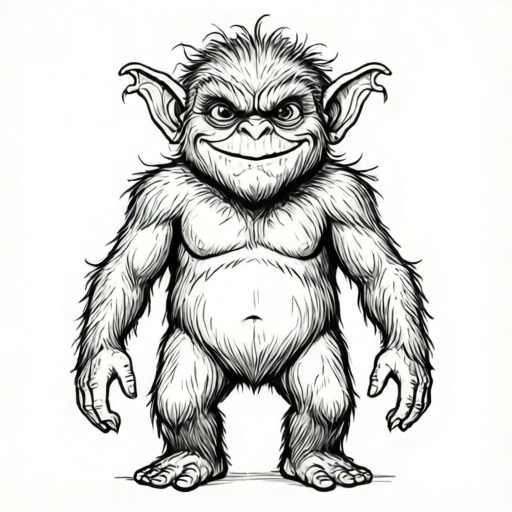
Use the stated measurements and conventions for each exercise.
Build a Construction Plate
Start with a rectangle of paper. Draw a baseline and a midline. The distance between them is your x-height unit. Use this unit to size the head: for example, a head might be two x-heights tall and one and a half wide. These numbers are hypothetical; measure your own paper and choose values that fit.
On the plate, draw three head shapes: round, wedge, and pear. Draw three ear types: pointed, frilled, and drooping. Draw three body types: stocky, lanky, and hunched. Label each with a letter and number so you can combine them later.
- Draw a baseline and midline; measure the x-height with a ruler.
- Sketch three head shapes within a two-by-one-and-a-half x-height box.
- Add three ear types to each head, keeping ear length about one x-height.
- Draw three body types below, each about four x-heights tall.
- Label all features clearly for later combination.
Combine Features into Original Gremlins
Choose one head, one ear, and one body from your plate. Combine them on a fresh sheet. Keep the x-height unit consistent so the character reads as one creature. Vary at least two features from any previous drawing to ensure originality.
Use simple checkable arithmetic: if the head is two x-heights tall and the body is four, the total height is six x-heights. Measure your drawing to confirm. Adjust proportions by adding or subtracting half an x-height.
- Select a head, ear, and body combination.
- Draw the head at two x-heights tall.
- Attach ears at one x-height long.
- Draw the body at four x-heights tall.
- Check total height and adjust by half x-height increments.
Add Feature Variations Deliberately
Variation should be intentional, not random. Change one feature at a time: swap pointed ears for frilled ears, or change a stocky body to lanky. Keep a written log of which features you used so you can avoid repeating the same combination.
Use the rubric to judge whether variations are clear and consistent. A valid alternative is any combination that follows the construction rules and remains recognizable as a gremlin character.
- List the features you will vary.
- Draw the base character.
- Change one feature and redraw.
- Compare the two drawings using the rubric.
- Record the combination used.
Worked example
Combine a round head, frilled ears, and a stocky body. The head is two x-heights tall, ears are one x-height long, and the body is four x-heights tall. What is the total height?
Worked answer
Total height is six x-heights (2 + 4). Ears add one x-height to the sides but do not change total height. Measure your drawing to confirm six x-heights from baseline to top of head.
Four practice exercises
Exercise 1
Draw a gremlin with a wedge head, pointed ears, and a lanky body. Head is two x-heights tall, body is five x-heights tall. State the total height.
Show answer and check
Total height is seven x-heights (2 + 5). Ears are one x-height long and do not change total height.
Why: Add head and body heights; ears are lateral additions. Use the same x-height unit for both parts.
Check: Measure from baseline to top of head; confirm seven x-heights. Check ear length is one x-height.
Exercise 2
Draw a gremlin with a pear head, drooping ears, and a hunched body. Head is two and a half x-heights tall, body is three and a half x-heights tall. State the total height.
Show answer and check
Total height is six x-heights (2.5 + 3.5).
Why: Add the two heights. Half x-height increments are allowed if measured consistently.
Check: Measure total height and confirm six x-heights. Check that drooping ears are one x-height long.
Exercise 3
Draw two gremlins: first with round head, frilled ears, stocky body; second with wedge head, pointed ears, lanky body. List two features that differ.
Show answer and check
Head shape and body type differ; ear type also differs. Any two of these are correct.
Why: Compare the feature lists. At least two features must differ to meet the variation rule.
Check: Use the rubric to confirm at least two differences and consistent x-height.
Exercise 4
A drawing has a head three x-heights tall and a body four x-heights tall, but the ears are two x-heights long. Is the total height seven or nine x-heights? Explain.
Show answer and check
Total height is seven x-heights. Ears are lateral and do not add to total height unless they extend above the head.
Why: Total height is head plus body. Ear length is measured separately.
Check: Measure baseline to top of head; confirm seven x-heights. Check ear length separately.
Common mistakes
- Mixing x-height units between head and body. Measure the x-height once and use the same unit for all parts.
- Changing too many features at once. Vary one feature per drawing to keep comparisons clear.
- Copying a known franchise gremlin. Use only your own plate combinations and avoid recognizable franchise details.
- Ignoring the rubric when judging originality. Check each rubric item after every drawing.
Self-check rubric
- Uses a consistent x-height unit throughout the drawing.
- Combines one head, one ear, and one body from the plate.
- Varies at least two features from any previous drawing.
- Avoids franchise-specific details.
- Total height matches the sum of head and body x-heights.
- Features are clearly labeled or logged.
Questions and answers
What is x-height in this lesson?
It is the distance from your baseline to your midline in your own lettering. It is a personal unit, not a universal standard.
Can I use different letter styles?
Yes. Letter styles vary, so measure your own x-height and keep it consistent within a drawing.
Are the numerical examples fixed rules?
No. They are hypothetical examples. Measure your actual paper and tools and choose values that fit.
How do I know my gremlin is original?
Use the rubric: check that at least two features differ from any previous drawing and that no franchise-specific details are copied.