Free original lessons
Winged Heart Drawing: Symmetric Feather Construction
Learn to draw a winged heart with paired, symmetric feather rows using a clear axis, attachment points, and a mirror guide for both wings.
Free lesson
Four exercises
Worked answers
Object Drawing Lessons
This lesson teaches a repeatable method for drawing a winged heart with symmetric wing feather construction. You will set a vertical heart axis, mark paired wing attachment points, and build feather rows outward from each side so the left and right wings match in shape and spacing. The approach uses simple checkable measurements and a mirror-symmetry guide rather than relying on freehand guesswork. All measurements are hypothetical examples; measure your own paper and tools before drawing. The convention for judging symmetry is defined in the rubric, and valid stylistic alternatives are allowed where the overall balance is preserved.
Practice materials: Printable downloads are not available for this lesson yet. Use the instructions and four exercises below.
Reference illustration
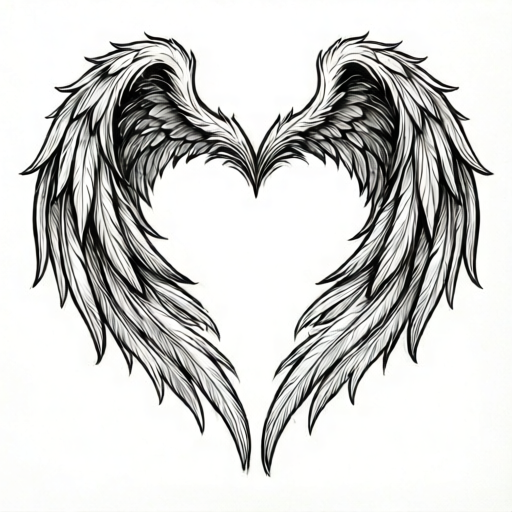
Use the stated measurements and conventions for each exercise.
Set the heart axis and outline
Begin with a light vertical axis line down the center of your page. This axis is the mirror line for the whole drawing. Mark a top point and a bottom point on the axis to set the heart height. Choose a width that is roughly three-quarters of the height; for example, if the heart is 12 cm tall, make it about 9 cm wide. These numbers are hypothetical examples, so adjust to your paper.
Draw the heart outline symmetrically about the axis. A reliable method is to mark the widest left and right points at the same height, then draw two curved lobes from the top point down to the widest points, and two curves from the widest points to the bottom point. Check symmetry by folding the paper along the axis or by measuring the distance from the axis to matching points on each side.
- Draw a light vertical axis and mark top and bottom points.
- Mark matching widest points left and right at equal distances from the axis.
- Draw the two upper lobes and two lower curves, checking equal distances.
- Erase construction marks only after the outline is confirmed symmetric.
Place paired wing attachment points
Wings attach where the heart's upper lobes meet the sides. Mark one attachment point on the left side and a matching point on the right at the same height and equal distance from the axis. Then mark a second pair slightly lower for the inner feather row. Keep all pairs level; use a horizontal guide line or measure from the top point.
The attachment points control the wing angle. For a balanced look, place the upper attachment pair about one-third of the heart height below the top point, and the lower pair about half the heart height below the top. These are hypothetical proportions; measure your own drawing to keep pairs equal.
- Mark the upper attachment pair at equal heights and distances from the axis.
- Mark the lower attachment pair below the first, also equal on both sides.
- Draw a light horizontal guide through each pair to confirm level placement.
- Label left and right pairs so you can mirror each feather row.
Build feather rows outward and mirror them
Feathers are drawn as overlapping tapered shapes. Start at the upper attachment point on the left and draw the first feather angling slightly upward and outward. Each subsequent feather in the row starts a little farther from the heart and overlaps the previous one. Keep feather lengths increasing gradually toward the wing tip, then decreasing for the outer row.
After completing the left wing, mirror each feather to the right side using the axis. Measure the distance from the axis to each feather tip on the left, then mark the same distance on the right at the same height. Draw the right feathers to match the left in length, angle, and overlap. A mirror-symmetry guide, such as a light grid or folded paper, helps confirm matching pairs.
- Draw the left inner feather row from the upper attachment point outward.
- Add the left outer row, increasing then decreasing feather length.
- Measure each left feather tip's distance from the axis and height.
- Mark matching points on the right and draw mirrored feathers.
- Check that every feather has a partner at the same height and equal distance from the axis.
Refine overlap and line weight
Once both wings are drawn, refine the overlaps so feathers read as layered. Keep the heart outline slightly stronger than the feather lines, and avoid heavy lines where feathers cross. If a feather looks too long or short, adjust its partner on the other side by the same amount to preserve symmetry.
Use the rubric convention: symmetry is judged by matching feather pairs at equal heights and equal distances from the axis, not by identical stylistic details. Slight variations in curve shape are acceptable if the overall balance and feather count match.
- Strengthen the heart outline and lighten feather construction lines.
- Adjust any mismatched feather pair by equal amounts on both sides.
- Confirm feather count and row order match left and right.
- Erase remaining guides and review against the rubric.
Worked example
A heart is 12 cm tall and 9 cm wide on a page. The upper wing attachment pair is 4 cm below the top point, and the lower pair is 6 cm below the top. The left inner row has five feathers. The first left feather tip is 3 cm from the axis at a height 4 cm below the top. Where should the matching right feather tip be placed?
Worked answer
The matching right feather tip should be 3 cm from the axis on the right side, at the same height of 4 cm below the top point. This mirrors the left tip and preserves symmetry.
Four practice exercises
Exercise 1
A heart is 10 cm tall. The upper attachment pair is 3 cm below the top and the lower pair is 5 cm below the top. Mark where the left and right upper attachment points should be if each is 2 cm from the axis.
Show answer and check
Left upper attachment: 2 cm left of the axis, 3 cm below the top. Right upper attachment: 2 cm right of the axis, 3 cm below the top.
Why: Attachment pairs must be level and equal distance from the axis. The given height and distance define both points.
Check: Measure each point from the axis and from the top point; both should read 2 cm and 3 cm respectively.
Exercise 2
The left inner feather row has four feathers. Their tips are 2 cm, 3 cm, 4 cm, and 5 cm from the axis at heights 3 cm, 4 cm, 5 cm, and 6 cm below the top. List the matching right tip distances and heights.
Show answer and check
Right tips: 2 cm, 3 cm, 4 cm, and 5 cm from the axis at heights 3 cm, 4 cm, 5 cm, and 6 cm below the top.
Why: Mirror symmetry requires each right tip to match its left partner in distance from the axis and height.
Check: Pair each left tip with a right tip and confirm equal distance and height for all four pairs.
Exercise 3
A drawing shows five left feathers but only four right feathers. The left tips are at 2, 3, 4, 5, and 6 cm from the axis. What is the simplest correction to restore symmetry?
Show answer and check
Add one right feather to match the missing left partner, placing its tip at the same distance from the axis and height as the unmatched left feather.
Why: Feather counts must match. The unmatched left feather identifies the missing right partner's position.
Check: Recount feathers on both sides and confirm every left tip has a right partner at equal distance and height.
Exercise 4
The heart is 12 cm tall and 9 cm wide. The upper attachment pair is 4 cm below the top. A left feather tip is 3 cm from the axis at 4 cm below the top. The right feather tip is drawn 4 cm from the axis at 4 cm below the top. Is the pair symmetric, and what change fixes it?
Show answer and check
No. The right tip should be 3 cm from the axis, not 4 cm, at the same height. Move the right tip 1 cm closer to the axis.
Why: Symmetric pairs require equal distances from the axis at the same height. The heights match but the distances do not.
Check: Measure both tips from the axis at the same height; the distances should be equal.
Common mistakes
- Drawing wings at different heights on each side. Mark attachment pairs with a horizontal guide and measure from the top point before drawing feathers.
- Making feather rows too crowded or too sparse. Decide a feather count per row before drawing, then keep the same count on both sides.
- Letting feather tips drift away from the mirror axis. Measure each left tip's distance from the axis and mark the matching right point before drawing.
- Using heavy lines that hide overlaps. Keep feather lines light and strengthen only the heart outline and final feather edges.
Self-check rubric
- Heart outline is symmetric about the vertical axis within the chosen measurement check.
- Upper and lower wing attachment pairs are level and at equal distances from the axis.
- Left and right wings have the same feather count and row order.
- Each feather has a partner at the same height and equal distance from the axis.
- Feather overlaps read as layered, with the heart outline stronger than feather lines.
- Valid stylistic alternatives are accepted if balance, count, and pairing are preserved.
Questions and answers
Do both wings need identical feather shapes?
No. The convention requires matching feather pairs at equal heights and distances from the axis, with the same count and row order. Small curve differences are acceptable if balance is preserved.
How many feathers should each wing have?
Choose a count that fits your wing size, such as five inner and four outer feathers per wing as a hypothetical example. Keep the same count on both sides.
Can I use a ruler for every feather?
Use a ruler for attachment points and tip distances, then draw feather curves freehand. Measure again to check symmetry.
What if my paper is not square?
Measure your actual paper and set the axis in the center of the area you will use. Adjust heart height and width to fit, keeping the width about three-quarters of the height as a starting proportion.