Free original lessons
Cartoon Angel Drawing: Wings, Halo, and Robe Shapes
Learn to draw a simplified cartoon angel using circles, triangles, ovals, and layered wing shapes. Includes construction steps, common fixes, and four practice tasks.
Free lesson
Four exercises
Worked answers
Object Drawing Lessons
This guide teaches a repeatable way to draw a cartoon angel from basic shapes. You will build the figure in layers: head circle, robe triangle, halo oval, then wings as overlapping curved shapes. The goal is clear cartoon simplification, not realistic anatomy or portraiture. Work on plain paper with a pencil and eraser. Keep shapes large and loose at first, then refine outlines. A useful convention for this task: treat the head as a circle, the robe as a downward triangle with a curved hem, the halo as a flattened oval above the head, and each wing as two or three layered leaf-like shapes. Letter styles and facial features may vary; the rubric rewards clear shape logic and balanced placement rather than one exact face. Measure your own paper and tools if you set sizes; any numbers below are hypothetical examples, not standards.
Practice materials: Printable downloads are not available for this lesson yet. Use the instructions and four exercises below.
Reference illustration
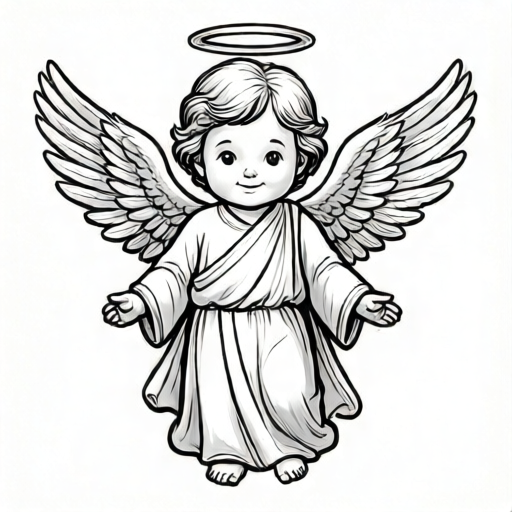
Use the stated measurements and conventions for each exercise.
Build the angel from simple shapes
Start with placement. Draw a light vertical line for the body axis. Place a circle for the head near the top, leaving room above for the halo. Below the head, draw a downward triangle for the robe, with the wide side at the shoulders and the point near the hem. The triangle can be rounded at the corners to feel softer.
Add the halo as a flattened oval centered above the head. Keep a small gap between halo and head so the halo reads as separate. For the wings, draw two mirrored stacks of curved shapes behind the shoulders. Each wing can be two or three overlapping leaf shapes that get smaller toward the tip.
Refine with simple face marks: two dot eyes, a small curved mouth, and optional hair or sleeve lines. Keep the robe fold pattern simple, such as two curved lines from shoulder to hem. Erase construction lines only after the final outlines are clear.
- Draw a light vertical axis and a head circle near the top.
- Add a flattened oval halo above the head with a small gap.
- Draw a downward triangle robe from the shoulders to the hem.
- Sketch two mirrored wings as layered curved shapes behind the shoulders.
- Add simple face marks and one or two robe fold lines.
- Darken final outlines and erase construction lines.
Control wing spread and robe folds
Wing spread changes the silhouette. For a closed look, keep wing tips close to the robe and angle them downward. For an open look, extend the wing tips outward and slightly upward, but keep both wings mirrored. The layered shapes should overlap so the wing reads as one form, not separate leaves.
Robe folds should follow the triangle. Draw folds as gentle curves that start near the shoulders and end near the hem. Avoid many parallel lines; two or three folds are enough for a cartoon. If the robe looks stiff, curve the hem slightly and round the triangle corners.
Balance matters more than exact symmetry. Check that the halo sits above the head center, the wings attach at the same height, and the robe point is near the body axis. Small differences are acceptable in cartoon style.
- Choose a wing spread: closed, medium, or open.
- Draw the first wing as two or three overlapping curved shapes.
- Mirror the second wing at the same shoulder height.
- Add two or three curved robe folds from shoulder toward hem.
- Curve the hem slightly and round the robe corners.
- Check halo centering and wing attachment height.
Refine outlines and check the drawing
Once the shapes are placed, darken the final outlines. Keep the halo outline clean and separate from the head. Wing layers can share edges, but each layer should be visible. The robe outline should be the strongest line because it defines the body.
Use a simple check: cover the face and ask whether the head, halo, robe, and wings still read as an angel. If the wings disappear into the robe, increase the gap or change the wing angle. If the halo touches the head, lift it slightly.
For a practice box, redraw the angel with a different wing spread and a different fold pattern. Keep the same basic shapes so the comparison is fair. Label any chosen sizes as your own examples, such as a head circle about one-third of the paper width.
- Darken final outlines from top to bottom.
- Keep halo and head outlines separate.
- Make wing layers visible with shared but clear edges.
- Strengthen the robe outline as the main body shape.
- Check the silhouette by covering the face.
- Redraw in a practice box with a new wing spread and fold pattern.
Worked example
Draw a cartoon angel with a closed wing spread and two robe folds. Use a head circle, a downward triangle robe, a flattened oval halo, and two layered wing shapes per side.
Worked answer
A completed cartoon angel: head circle near the top, flattened oval halo above with a small gap, downward triangle robe with rounded corners and a slightly curved hem, two mirrored wings each made of two overlapping curved shapes angled downward, two curved robe folds from shoulder to hem, and simple dot eyes with a small curved mouth. Final outlines are darkened and construction lines erased.
Why: The closed wing spread keeps the silhouette compact. Two wing layers per side are enough to show feathers without clutter. Two robe folds follow the triangle and suggest fabric. The halo gap keeps the ring separate from the head.
Check: Cover the face: the head, halo, robe, and wings should still read as an angel. Confirm the halo does not touch the head, both wings attach at the same height, and the robe has exactly two fold lines.
Four practice exercises
Exercise 1
Draw a cartoon angel with an open wing spread. Use a head circle, a flattened oval halo with a gap, a downward triangle robe, and three layered wing shapes per side. Add one robe fold.
Show answer and check
A cartoon angel with wings extended outward and slightly upward, each wing made of three overlapping curved shapes, a halo above the head with a gap, a triangle robe with rounded corners, and one curved fold from shoulder to hem.
Why: An open spread changes the silhouette by extending the wing tips outward. Three layers per side show more feather detail while keeping the cartoon simple. One fold keeps the robe from looking cluttered.
Check: Check that both wings have three visible layers, the wing tips are mirrored, the halo has a gap, and the robe has exactly one fold line.
Exercise 2
Draw a cartoon angel with a closed wing spread and a rounded bell-shaped robe instead of a sharp triangle. Keep the halo as a flattened oval above the head. Use two wing layers per side and no robe folds.
Show answer and check
A cartoon angel with wings angled downward and close to the body, each wing made of two overlapping curved shapes, a bell-shaped robe with a curved hem, a halo above the head with a gap, and no fold lines.
Why: A bell-shaped robe is a valid alternative to a triangle because it still has a wide shoulder area and a hem. Closed wings keep the silhouette compact. No folds keeps the robe smooth and simple.
Check: Confirm the robe is wider at the shoulders than at the hem, both wings have two layers, the halo is separate from the head, and there are no fold lines.
Exercise 3
Draw a cartoon angel with a medium wing spread. Use a head circle, a halo oval, a triangle robe, and two wing layers per side. Add two robe folds that curve from the shoulders toward the hem. Include simple dot eyes and a small mouth.
Show answer and check
A cartoon angel with wings angled outward at a medium spread, two layers per wing, a triangle robe with two curved folds, a halo above the head with a gap, dot eyes, and a small curved mouth.
Why: Medium spread balances open and closed silhouettes. Two folds follow the robe shape without clutter. Simple face marks keep the cartoon readable.
Check: Check that the wing angle is between closed and fully open, both wings have two layers, the robe has two folds, and the face marks are simple and clear.
Exercise 4
Redraw the same cartoon angel in a practice box with a different wing spread and a different fold pattern. Keep the head circle, halo oval, and robe triangle. Use three wing layers per side and three robe folds. Describe how the new version differs from the first.
Show answer and check
A second cartoon angel in a practice box with a changed wing spread, such as from closed to open, and a changed fold pattern, such as folds starting closer to the center. The head, halo, and robe shapes remain the same. The description notes the new wing angle and fold placement.
Why: Keeping the basic shapes constant makes the comparison fair. Changing only wing spread and fold pattern shows how those variables affect the silhouette and fabric feel.
Check: Confirm the practice box contains a second angel with the same head, halo, and robe shapes, three wing layers per side, three robe folds, and a written note describing the differences.
Common mistakes
- The halo touches or overlaps the head circle. Lift the halo and leave a small gap so it reads as a separate ring above the head.
- Wings are drawn as one solid blob with no layers. Split each wing into two or three overlapping curved shapes that get smaller toward the tip.
- The robe triangle is too narrow and looks like a stick. Widen the shoulder side of the triangle and round the corners so the robe has body.
- Wing tips are not mirrored and the figure looks lopsided. Mark the shoulder height on both sides and draw the second wing to match the first wing's angle and layer count.
- Too many robe fold lines make the robe look cluttered. Use two or three gentle curves from shoulder to hem and erase the rest.
Self-check rubric
- Head is a clear rounded shape placed near the top with room above for the halo.
- Halo is a flattened oval above the head with a visible gap.
- Robe reads as a downward triangle or bell with a wide shoulder area and a hem.
- Wings are mirrored layered shapes attached at the same shoulder height.
- Wing spread is consistent on both sides.
- Robe folds are limited to two or three gentle curves.
- Final outlines are clear and construction lines are erased or faint.
- Cartoon simplification is maintained; realistic anatomy is not required.
- Valid alternatives are accepted for face marks, hair, sleeve lines, and exact wing layer count if the shape logic remains clear.
Questions and answers
Do I need to draw a perfect circle for the head?
No. A slightly oval or uneven circle is fine for cartoon style. The rubric checks that the head is a clear rounded shape, not that it is geometrically perfect.
How many wing layers should I use?
Two or three layers per wing is enough. More layers can work if they stay visible, but the cartoon reads best when the wing shape is simple.
Can the robe be a different shape?
Yes, as long as it reads as a robe. A rounded triangle or a bell shape is acceptable. The key is a wide shoulder area and a hem that suggests fabric.
What if my angel's face looks different from the example?
That is allowed. The convention fixes the basic shapes, not the face. Dot eyes, a small mouth, or simple hair marks are all valid cartoon choices.
How do I know the drawing is balanced?
Check that the halo is above the head center, wings attach at the same height, and the robe point is near the body axis. Small differences are acceptable.