Free original lessons
Draw a Cacao Tree: Trunk Pods and Broad Leaves
Learn to sketch a cacao tree with trunk-borne pods, broad leaves, and clear branching. Includes a convention, rubric, worked example, and four practice tasks.
Free lesson
Four exercises
Worked answers
Object Drawing Lessons
The cacao tree is distinctive because its large pods grow directly from the trunk and older branches, not from the tips of twigs. This lesson teaches a simple drawing convention: a vertical trunk with a few ascending branches, broad oval leaves, and ridged pods attached at the trunk and branch junctions. You will use light construction lines, then refine outlines. All measurements are hypothetical examples; measure your own paper and tools. The goal is a clear, recognizable tree form, not botanical perfection.
Practice materials: Printable downloads are not available for this lesson yet. Use the instructions and four exercises below.
Reference illustration
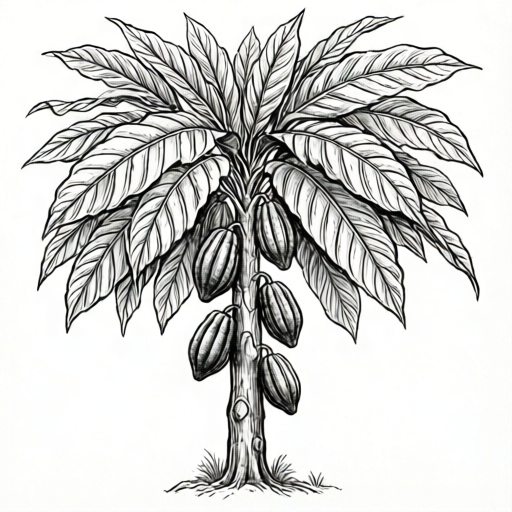
Use the stated measurements and conventions for each exercise.
Establish the trunk and branch framework
Begin with a light vertical line for the trunk, about one third of the page height. Mark a ground line and a canopy line. The trunk should taper slightly toward the top. Add three to five main branches that ascend at roughly 30 to 45 degrees from the trunk, alternating sides. Keep branch junctions visible because pods will attach near them.
Use a simple convention: solid outline for the final tree, dashed light lines for construction. Label nothing on the final drawing unless the task asks for labels. The trunk is the anchor; every pod and leaf should connect logically to it or to a branch.
- Draw a light vertical trunk line from ground to canopy.
- Mark three to five branch start points along the upper half of the trunk.
- Draw branches as gentle curves ascending outward, alternating sides.
- Check that branch junctions are clear and not hidden by leaves.
Attach pods to trunk and branches
Cacao pods are large, oval to football-shaped, and grow on short stalks from the trunk and older branches. Draw pods at different angles: one hanging downward, one angled outward, one nearly horizontal. Each pod should have a short stalk connecting it to the trunk or branch. Add three to five shallow ridge lines running lengthwise along each pod. Ridges are optional but help identify the fruit.
Keep pod size consistent: a hypothetical example is a pod about one fifth of the trunk height. Vary angle, not size, to show natural growth. Avoid attaching pods to thin twigs or leaf tips.
- Choose three attachment points on the trunk or main branches.
- Draw a short stalk at each point, then an oval pod outline.
- Add two to four lengthwise ridge lines inside each pod.
- Vary pod angles: downward, outward, and horizontal.
Add broad leaves and canopy
Cacao leaves are broad, oval, and pointed, often drooping. Draw leaves in clusters at branch ends and along upper branches. Use a simple leaf shape: an oval with a pointed tip and a central vein. Leaves should overlap slightly but not hide the trunk or pod attachment points. Keep leaf size proportional: a hypothetical example is a leaf about half the length of a pod.
The canopy should look open enough to see the branch structure. Draw leaves with light outlines first, then darken the ones in front. This creates depth without shading.
- Draw leaf clusters at branch ends and along upper branches.
- Use oval shapes with pointed tips and a central vein.
- Overlap leaves slightly, keeping trunk and pods visible.
- Darken front leaves to suggest depth.
Refine and check the drawing
Erase or lighten construction lines. Darken the final trunk, branches, pods, and leaves. Check that every pod connects to the trunk or a main branch, that leaves are broad and pointed, and that the trunk tapers upward. Use the rubric to evaluate clarity, attachment logic, and proportion. Valid alternatives include different branch counts, pod angles, and leaf arrangements, as long as the tree form and pod attachment remain clear.
- Lighten construction lines and darken final outlines.
- Verify pod stalks connect to trunk or main branches.
- Check leaf shape: broad, oval, pointed.
- Confirm trunk taper and open canopy.
Worked example
Draw a cacao tree with a tapered trunk, three main branches, three pods attached to the trunk, and broad leaves at branch ends. Use light construction lines and dark final outlines.
Worked answer
A completed drawing shows a vertical trunk tapering upward, three ascending branches alternating sides, three oval pods with short stalks attached to the trunk at different heights and angles, and broad pointed leaves clustered at branch ends. Construction lines are light or erased; final outlines are dark. Pods have two to four lengthwise ridge lines. The canopy is open enough to see branch junctions.
Four practice exercises
Exercise 1
Draw a cacao tree with a trunk, two main branches, and two pods attached to the trunk. Use broad leaves at branch ends. Keep the canopy open.
Show answer and check
A drawing with a tapered vertical trunk, two ascending branches, two oval pods on short stalks attached to the trunk at different heights, and broad pointed leaves at branch ends. Branch junctions are visible.
Why: Two branches and two pods meet the minimum structure. Attaching pods to the trunk follows the cacao growth pattern. Open canopy keeps junctions visible.
Check: Verify each pod has a short stalk to the trunk, leaves are broad and pointed, and branch junctions are not hidden.
Exercise 2
Draw three pods at different angles on a single trunk section: one downward, one outward, one horizontal. Add ridge lines. No leaves required.
Show answer and check
A trunk section with three oval pods on short stalks: one hanging down, one angled outward, one nearly horizontal. Each pod has two to four lengthwise ridge lines.
Why: Varying angle shows natural growth. Ridge lines identify the fruit. Short stalks connect pods to the trunk.
Check: Check that each pod connects to the trunk, angles differ, and ridge lines run lengthwise.
Exercise 3
Draw a cacao tree with four main branches and five pods. Place at least two pods on branches and three on the trunk. Add leaf clusters at branch ends.
Show answer and check
A tree with a tapered trunk, four ascending branches, five oval pods on short stalks (three on trunk, two on branches), and broad pointed leaves clustered at branch ends. Canopy is open.
Why: Mixing pod placement on trunk and branches shows the full pattern. Four branches provide enough support points. Leaf clusters complete the canopy.
Check: Count pods and confirm attachment points. Verify leaves are broad and pointed, and branch junctions remain visible.
Exercise 4
Draw a cacao tree using only outlines and no shading. Include a trunk, three branches, four pods, and broad leaves. Label nothing. Use light construction lines that are erased or faint.
Show answer and check
An outline drawing with a tapered trunk, three branches, four oval pods on short stalks at varied angles, and broad pointed leaves. Construction lines are faint or erased; no labels or shading.
Why: Outline-only drawing tests clarity of form. Four pods and three branches meet the structure. Faint construction lines show process without clutter.
Check: Confirm no shading or labels, pods attach to trunk or branches, leaves are broad and pointed, and construction lines are faint or erased.
Common mistakes
- Drawing pods on thin twigs or leaf tips. Attach pods only to the trunk or older branches with short stalks.
- Making leaves narrow or needle-like. Use broad oval shapes with pointed tips and a central vein.
- Hiding all branch junctions with leaves. Keep canopy open enough to see where branches meet the trunk.
- Drawing all pods at the same angle. Vary pod angles: downward, outward, and horizontal.
Self-check rubric
- Trunk is vertical and tapers slightly upward.
- Three to five main branches ascend at clear angles.
- Pods attach to trunk or older branches with short stalks.
- Pods vary in angle and have optional ridge lines.
- Leaves are broad, oval, and pointed with a central vein.
- Canopy is open enough to see branch junctions.
- Construction lines are light or erased; final outlines are dark.
- Valid alternatives in branch count, pod angle, and leaf arrangement are accepted if the tree form and attachment logic remain clear.
Questions and answers
Do cacao pods grow on branches or only the trunk?
They grow on the trunk and older branches, not on thin twigs or leaf tips. Draw short stalks connecting each pod to a sturdy support.
How many pods should I draw?
Three to five pods are enough to show the pattern. Place them at different heights and angles on the trunk and main branches.
What shape are cacao leaves?
Broad, oval, and pointed, often drooping. Use a central vein and keep leaves proportional to the pods.
Can I use different branch counts?
Yes. Three to five main branches work well. The rubric allows valid alternatives as long as the tree form and pod attachment are clear.