Free original lessons
Draw a Dachshund: Elongated Body and Drooping Ears
Learn to draw a side-profile dachshund with a long torso, short legs, and long drooping ears using simple proportion checks and a clear convention.
Free lesson
Four exercises
Worked answers
Object Drawing Lessons
This lesson teaches a side-profile dachshund drawing built on three defining shapes: an elongated torso, short leg tubes, and long drooping ears. You will use a simple convention: the torso length is measured from chest to rump, and leg height is measured from the ground to the belly line. Ear length is measured from the top of the head to the lowest ear tip. All numerical values here are hypothetical examples for practice, not standards. Draw lightly, check proportions with a ruler or marked strip of paper, then refine outlines.
Practice materials: Printable downloads are not available for this lesson yet. Use the instructions and four exercises below.
Reference illustration
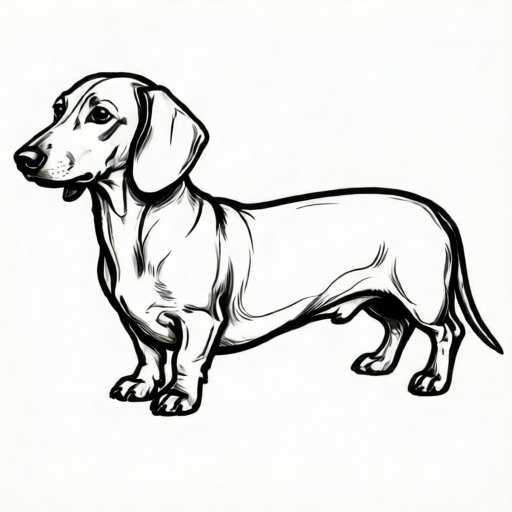
Use the stated measurements and conventions for each exercise.
Set the proportion convention
Use one unit for all measurements. A convenient hypothetical example is a torso length of 8 units, leg height of 2 units, and ear length of 3 units. These are chosen values for practice, not breed standards. The key relationship is that the torso is much longer than the leg height, and the ears hang well below the jaw line.
Measure the actual paper or drawing space you have. If your paper is 20 cm wide, choose a torso length that fits with room for the head and tail. For example, a 10 cm torso, 2.5 cm legs, and 3.5 cm ears would fit a 20 cm wide sheet with margins. Label your chosen values as hypothetical examples on your practice sheet.
- Draw a horizontal belly line and mark chest and rump points.
- Measure torso length between those points and record it.
- Measure leg height from the ground line to the belly line.
- Measure ear length from the top of the head to the lowest ear tip.
- Compare the three measurements and adjust before adding detail.
Build the elongated torso and short legs
Start with a long rounded rectangle for the torso. The top line is the back; the bottom line is the belly. Keep the back gently curved, not perfectly straight. The chest end is slightly deeper than the rump end. This gives the dachshund its characteristic long, low body.
Add four short leg tubes. In side profile, show two front legs and two back legs, with the far legs slightly offset or partially hidden. Each leg is a narrow tube from the belly line to the ground line. Keep leg height short relative to torso length. Paws are small rounded shapes at the ground line.
- Draw the torso as a long rounded shape with a gentle back curve.
- Mark the belly line and ground line.
- Draw near front leg and near back leg as short tubes.
- Add far legs with slight offset to show depth.
- Check that leg height is much shorter than torso length.
Shape the head and long drooping ears
The head is a rounded wedge at the chest end of the torso. The muzzle is moderately long and slightly tapered. Place the eye above the muzzle line. The ear starts near the top of the head and hangs down in a long, soft curve. Ear length should reach below the jaw and often toward the chest.
Draw the near ear as a long drooping shape with a gentle fold. The far ear can be partially visible behind the head. Keep the ear width moderate; the length is the defining feature. Avoid pointed or upright ears, which would suggest a different breed.
- Draw a rounded wedge for the head at the chest end.
- Add a tapered muzzle and place the eye above it.
- Draw the near ear from the top of the head, curving down past the jaw.
- Add the far ear partially behind the head.
- Check ear length against your recorded measurement.
Refine, check, and finish
Refine outlines by smoothing the torso, legs, and ears. Keep the body low and long. Add a tail that follows the back line and tapers. A simple collar or ground line can help show scale, but keep details minimal so proportions remain clear.
Use a check method: measure torso length, leg height, and ear length on your drawing with the same unit. Compare ratios. For the hypothetical example, torso should be about four times leg height and ear length about one and a half times leg height. Adjust any shape that breaks these relationships.
- Smooth outlines and erase construction marks.
- Add tail and minimal details.
- Re-measure torso, legs, and ears with the same unit.
- Compare ratios and adjust as needed.
- Label your chosen hypothetical values on the practice sheet.
Worked example
A practice sheet uses a hypothetical torso length of 12 cm, leg height of 3 cm, and ear length of 4.5 cm. Check the ratios and state whether the drawing follows the convention.
Worked answer
Torso to leg ratio is 12 divided by 3, which equals 4. Ear to leg ratio is 4.5 divided by 3, which equals 1.5. The torso is four times the leg height and the ear is one and a half times the leg height. This follows the convention of a long torso, short legs, and long drooping ears.
Four practice exercises
Exercise 1
A side-profile sketch has a torso length of 10 cm, leg height of 2 cm, and ear length of 3 cm. State the torso-to-leg ratio and ear-to-leg ratio, and say whether the proportions fit the dachshund convention.
Show answer and check
Torso-to-leg ratio is 10 divided by 2, which equals 5. Ear-to-leg ratio is 3 divided by 2, which equals 1.5. The torso is five times the leg height and the ear is one and a half times the leg height, so the proportions fit the long-body, short-leg, long-ear convention.
Why: Use the same unit for all measurements. Divide torso by leg height and ear length by leg height. A large torso-to-leg ratio and an ear-to-leg ratio greater than 1 indicate the correct relationship.
Check: Re-measure each feature with the same ruler or marked strip. Confirm the divisions and that the ear tip hangs below the jaw line in the sketch.
Exercise 2
You have a 15 cm wide practice area. Choose hypothetical values for torso length, leg height, and ear length that fit with 1 cm margins on each side, and check the ratios.
Show answer and check
One valid choice is torso length 11 cm, leg height 2.5 cm, and ear length 3.5 cm. The torso plus margins uses 13 cm, leaving 2 cm for head and tail space. Torso-to-leg ratio is 11 divided by 2.5, which equals 4.4. Ear-to-leg ratio is 3.5 divided by 2.5, which equals 1.4. These values fit the convention.
Why: The torso must fit within the practice area after margins. Choose a torso length less than the available width. Then choose leg height much smaller than torso length and ear length greater than leg height.
Check: Add torso length and margins to confirm it fits the 15 cm width. Recalculate both ratios with the same unit and confirm the ear tip would hang below the jaw in a side-profile sketch.
Exercise 3
A drawing shows a torso of 9 cm, legs of 4 cm, and ears of 2 cm. Identify the proportion problems and give corrected hypothetical values that keep the torso at 9 cm.
Show answer and check
The legs are too long relative to the torso, and the ears are too short. A corrected set keeping the torso at 9 cm could be leg height 2 cm and ear length 3 cm. Torso-to-leg ratio becomes 9 divided by 2, which equals 4.5. Ear-to-leg ratio becomes 3 divided by 2, which equals 1.5. This restores short legs and long drooping ears.
Why: Compare each feature to the torso. Leg height should be a small fraction of torso length, and ear length should exceed leg height. Adjust legs and ears while keeping the torso fixed.
Check: Measure the corrected drawing with one unit. Confirm leg height is much less than torso length and ear length is greater than leg height, and that the ear reaches below the jaw.
Exercise 4
Describe how to redraw a side-profile dachshund from a practice outline using a torso of 8 units, legs of 2 units, and ears of 3 units. Include the order of construction and one check.
Show answer and check
Draw a horizontal belly line and mark chest and rump 8 units apart. Draw the back with a gentle curve and the belly line below it. Add near front and back legs as 2-unit tubes to the ground line, then far legs with slight offset. Draw a rounded wedge head at the chest end, a tapered muzzle, and an eye above the muzzle. Draw the near ear from head top curving down 3 units past the jaw, and add the far ear partially behind. Check that torso is four times leg height and ear is one and a half times leg height.
Why: Construction order moves from the largest proportion (torso) to smaller features (legs, head, ears). Using one unit keeps the ratios checkable. The check confirms the defining dachshund relationships.
Check: Measure torso, leg height, and ear length on the redrawn outline with the same unit. Confirm the ratios and that the ear tip hangs below the jaw line.
Common mistakes
- Making the torso too short, so the dog looks like a generic dog. Re-measure torso length and extend it until it is clearly much longer than leg height.
- Drawing legs too long, which raises the body and loses the low profile. Shorten leg tubes so leg height is a small fraction of torso length.
- Drawing ears too short or upright. Lengthen the ear curve so it hangs below the jaw, and keep the ear soft and drooping.
- Using different units for torso, legs, and ears. Choose one unit and measure all three features with it before comparing.
Self-check rubric
- Torso length is clearly much greater than leg height, using one consistent unit.
- Legs are short tubes from belly line to ground line, with far legs offset or partially hidden.
- Ears are long and drooping, measured from head top to lowest tip, reaching below the jaw.
- Head is a rounded wedge with a tapered muzzle and eye above the muzzle line.
- Outline is smooth and construction marks are removed.
- Chosen numerical values are labeled as hypothetical examples, not standards.
- Valid alternatives in ear width, fold, tail shape, and minor outline style are accepted if the length and droop convention is met.
Questions and answers
Do I need exact breed measurements?
No. Use one unit and consistent ratios. The numerical values in this lesson are hypothetical examples for practice, not standards.
Can the ear shape vary?
Yes. The convention defines ear length from head top to lowest tip. Width and fold can vary as long as the ear is long and drooping.
How many legs should be visible in side profile?
Show two near legs clearly and two far legs partially or offset. The key is short leg height relative to torso length.
How do I check my drawing?
Measure torso, leg height, and ear length with the same unit. Compare ratios and adjust any feature that breaks the long-body, short-leg, long-ear relationship.