Free original lessons
Draw an Alicorn: Horn, Wing, and Body Proportion Construction
Learn to construct an alicorn with clear guides for horn placement, shoulder wing attachment, and head-to-body proportions using simple checkable steps.
Free lesson
Four exercises
Worked answers
Object Drawing Lessons
This lesson teaches a repeatable construction method for an alicorn: a horse-like body with a single forehead horn and a pair of shoulder-mounted wings. You will use a head-to-body proportion grid, a horn spiral guide, and a wing attachment diagram. The goal is structural clarity, not a single universal style. All measurements are hypothetical examples; measure your own paper and tools. Work lightly in pencil, then refine. The convention for line placement is explicit: the body midline is the vertical center of the torso; the shoulder point is where the front leg meets the torso; the horn base sits on the forehead midline above the eyes. Letter styles and finish vary, so the rubric rewards consistent construction and valid alternatives, not identical copies.
Practice materials: Printable downloads are not available for this lesson yet. Use the instructions and four exercises below.
Reference illustration
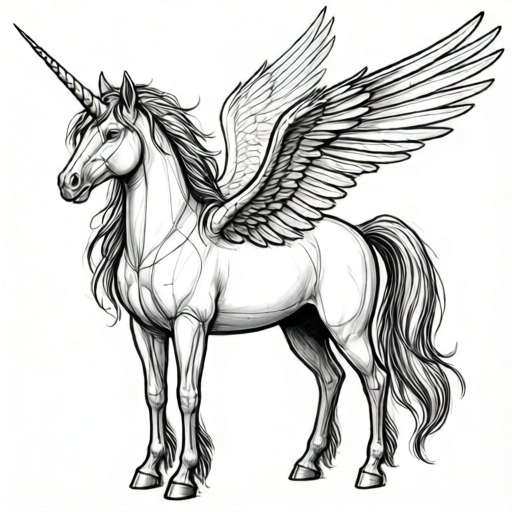
Use the stated measurements and conventions for each exercise.
Set the body proportion grid
Begin with a head-to-body ratio. A practical starting ratio is 1 head unit to 3.5 body units for a stylized adult alicorn. Mark a head unit as the vertical distance from the top of the skull to the chin. Use the same unit for the torso length from chest to rump. Draw a light horizontal baseline and a vertical midline. Place the chest and rump marks along the baseline, then add the torso as an oval that spans 3.5 head units. This grid keeps the horn and wing from crowding the body.
Check the grid by counting units: head = 1, neck = 0.7, torso = 3.5, legs = 2.2. These are hypothetical examples, not standards. If your paper is small, scale every unit by the same factor so the ratio stays consistent.
- Draw a light baseline and a vertical midline.
- Mark one head unit from skull top to chin.
- Mark 3.5 head units along the baseline for torso length.
- Draw the torso oval between chest and rump marks.
- Add neck and leg guides using the same unit.
Place the horn on the forehead
The horn base sits on the forehead midline, above the eye line and below the ears. Use the head unit to locate it: divide the head unit into thirds vertically; the horn base is near the upper third, centered on the midline. Draw a short base ellipse, then a spiral guide. A simple spiral guide uses three decreasing arcs: a wide base arc, a middle arc, and a small tip arc. Keep the spiral centered on the forehead midline so the horn reads as a single structure.
Valid alternatives include a straight tapered horn or a curved horn, as long as the base remains on the forehead midline and the horn does not overlap the eyes. The spiral guide is a construction aid, not a required final texture.
- Mark the eye line and the upper third of the head unit.
- Draw a small base ellipse on the forehead midline.
- Add three decreasing arcs for the spiral guide.
- Taper the horn toward the tip.
- Check that the horn base is above the eyes and centered.
Attach the wing at the shoulder
The wing attaches at the shoulder point, where the front leg meets the torso. Draw a shoulder circle about 0.4 head units across. The wing root sits inside this circle, slightly above the leg joint. From the root, draw a leading edge that sweeps back and up, then a trailing edge that returns to the root. For a folded wing, keep the wing close to the torso and angle the tip downward. For a spread wing, extend the leading edge outward and upward, then add feather groups as simple overlapping shapes.
Use the wing-fold versus wing-spread panel idea: draw two small thumbnails beside the main frame, one folded and one spread, both rooted at the same shoulder circle. This confirms the attachment point does not move between variants.
- Mark the shoulder point and draw a 0.4-head-unit circle.
- Place the wing root inside the circle, above the leg joint.
- Draw the leading edge from root to tip.
- Draw the trailing edge back to the root.
- Add feather groups as overlapping shapes.
- Repeat as a folded and spread thumbnail at the same root.
Refine and check the construction
Refine by darkening the final outlines and erasing construction guides. Check three anchors: horn base on the forehead midline, wing root inside the shoulder circle, and torso length equal to 3.5 head units. If any anchor is off, adjust the guide before adding detail. Keep units consistent: if one head unit is 3 cm, then the torso is 10.5 cm and the shoulder circle is 1.2 cm. These numbers are hypothetical examples; measure your own drawing.
The rubric allows valid alternatives: a straight horn, a curved horn, a folded wing, or a spread wing all pass if the anchors are correct and the proportions are consistent.
- Darken final outlines.
- Erase construction guides.
- Measure the three anchors.
- Adjust any off-anchor guide.
- Add final detail only after anchors pass.
Worked example
A learner draws an alicorn on paper where one head unit is 4 cm. The torso measures 12 cm, the horn base sits 1 cm above the eye line on the forehead midline, and the wing root is 1 cm outside the shoulder circle. Identify the errors and give corrected measurements using the 1 to 3.5 ratio and a 0.4-head-unit shoulder circle.
Worked answer
The torso should be 3.5 times 4 cm = 14 cm, so 12 cm is 2 cm short. The shoulder circle should be 0.4 times 4 cm = 1.6 cm across, so a wing root 1 cm outside the circle is misplaced; move it inside the circle above the leg joint. The horn base at 1 cm above the eye line is acceptable if it remains on the forehead midline and below the ears; check that it is centered. Corrected values: torso 14 cm, shoulder circle 1.6 cm, wing root inside the circle, horn base centered on the forehead midline.
Four practice exercises
Exercise 1
On a blank frame, draw a body proportion grid where one head unit is 3 cm. Mark the torso length, neck length, and leg length using the ratios 1 to 3.5, 0.7, and 2.2. Describe where the shoulder circle goes and its diameter.
Show answer and check
Torso = 10.5 cm, neck = 2.1 cm, legs = 6.6 cm. The shoulder circle sits where the front leg meets the torso, diameter = 1.2 cm.
Why: Multiply each ratio by the 3 cm head unit: 3.5 times 3 = 10.5; 0.7 times 3 = 2.1; 2.2 times 3 = 6.6; 0.4 times 3 = 1.2.
Check: Re-measure each segment with the same ruler and confirm the torso is exactly 3.5 times the head unit.
Exercise 2
A drawing has a head unit of 5 cm and a torso of 15 cm. Is the torso proportion correct for the 1 to 3.5 ratio? If not, state the correct torso length and the difference.
Show answer and check
No. Correct torso = 17.5 cm; the drawing is 2.5 cm short.
Why: 3.5 times 5 = 17.5 cm. 17.5 minus 15 = 2.5 cm.
Check: Divide the torso by the head unit: 15 divided by 5 = 3.0, which is less than 3.5.
Exercise 3
Describe how to place a horn base and a wing root on an alicorn whose head unit is 4 cm. Give the horn base location relative to the eye line and the shoulder circle diameter, then state one valid alternative horn style.
Show answer and check
Horn base on the forehead midline in the upper third of the head unit, above the eye line and below the ears. Shoulder circle diameter = 1.6 cm, with the wing root inside it above the leg joint. A straight tapered horn is a valid alternative.
Why: The upper third of 4 cm is about 1.3 cm from the skull top; the shoulder circle is 0.4 times 4 = 1.6 cm. The horn style may vary if the base anchor is correct.
Check: Confirm the horn base is centered on the midline and above the eye line, and the wing root is inside the 1.6 cm circle.
Exercise 4
A learner draws a spread wing rooted 2 cm outside a shoulder circle that is 1.2 cm across. The head unit is 3 cm. State the error, the correct root location, and whether a folded wing would also be valid at that same root.
Show answer and check
The wing root is outside the shoulder circle. Correct root: inside the 1.2 cm circle above the leg joint. Yes, a folded wing is also valid at the same root.
Why: The shoulder circle is 0.4 times 3 = 1.2 cm. The root must be inside it regardless of wing variant. Folded and spread wings share the same attachment point.
Check: Measure the distance from the root to the circle center; it must be less than 0.6 cm, the circle radius.
Common mistakes
- Placing the horn between the ears or on the nose. Return to the forehead midline and the upper third of the head unit; the horn base must sit above the eye line and below the ears.
- Attaching the wing to the middle of the back. Move the wing root into the shoulder circle where the front leg meets the torso; keep the root above the leg joint.
- Changing the head unit midway through the drawing. Re-measure one head unit and scale all other units by the same factor so the 1 to 3.5 ratio stays consistent.
- Letting the horn spiral overlap the eyes. Shorten the base ellipse and raise the spiral guide so the horn stays on the forehead midline above the eye line.
Self-check rubric
- Horn base is centered on the forehead midline above the eye line and below the ears.
- Wing root sits inside the shoulder circle where the front leg meets the torso.
- Torso length equals 3.5 head units using one consistent head unit.
- Neck and leg guides use the same head unit as the torso.
- Construction guides are light and final outlines are clear.
- Valid alternatives such as straight or curved horns and folded or spread wings are accepted when anchors are correct.
Questions and answers
Do I have to use a spiral horn?
No. A straight or curved tapered horn is valid if the base stays on the forehead midline above the eyes. The spiral is a construction guide, not a required style.
Can the wing be folded or spread?
Yes. Both variants are valid. Keep the wing root inside the same shoulder circle so the attachment point does not move.
What if my paper is a different size?
Scale every unit by the same factor. If one head unit is 2 cm instead of 3 cm, the torso becomes 7 cm and the shoulder circle becomes 0.8 cm.
How do I know the proportions are correct?
Count units: head 1, neck 0.7, torso 3.5, legs 2.2. Measure the torso and compare it to 3.5 head units. Adjust before adding detail.