Free original lessons
Oleander Drawing: Clustered Flowers and Narrow Leaves
Learn to draw oleander with grouped five-petal flowers and narrow leaves spaced along stems, using a simple convention and checkable steps.
Free lesson
Four exercises
Worked answers
Object Drawing Lessons
Oleander is recognizable by two features: flower clusters made of small five-petal blooms, and long narrow leaves arranged along woody stems. This lesson teaches a drawing convention, not a single correct picture. You will place cluster centers, build petals around them, attach narrow leaves in pairs or near-pairs along stems, and check proportions with simple arithmetic. All measurements are hypothetical examples; measure your own paper and tools. The planned printable resources are described at the end but are not yet built.
Practice materials: Printable downloads are not available for this lesson yet. Use the instructions and four exercises below.
Reference illustration
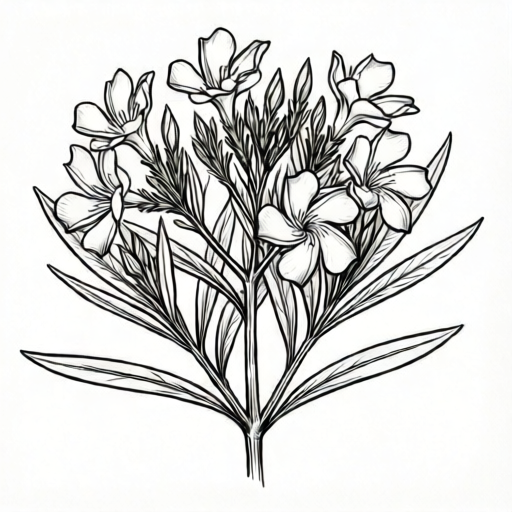
Use the stated measurements and conventions for each exercise.
Setting a drawing convention
Choose a convention before drawing: a flower is a small circle center with five petal shapes around it, and a leaf is a narrow pointed oval whose width is about one-fifth of its length. Decide a base unit, such as 1 cm, and keep flower diameters near one unit and leaf lengths near three to five units.
Valid alternatives are allowed. Petals may be rounded, slightly pointed, or uneven; leaves may curve gently. The rubric rewards consistent grouping and spacing, not identical shapes.
- Mark a base unit on scrap paper, for example 1 cm, and label it as a hypothetical example.
- Draw one practice flower: center circle about half a unit wide, five petals around it.
- Draw one practice leaf: length four units, width about four-fifths of a unit, pointed at both ends.
- Check that the leaf width is roughly one-fifth of its length before continuing.
Building a flower cluster
A cluster is a group of five-petal flowers whose centers sit close together, often with outer flowers slightly lower or higher. Start with three to seven center dots inside an imaginary oval, then draw petals around each center. Overlap is normal; keep petal tips visible enough to count.
Spacing check: if cluster centers are about one unit apart, the cluster reads as a group rather than separate flowers. Adjust by moving centers closer or farther before adding petals.
- Draw an imaginary oval about six units wide and four units tall for the cluster area.
- Place five center dots inside the oval, keeping neighboring dots about one unit apart.
- Around each dot, draw five petals of similar size, allowing slight variation.
- Count petals on two flowers to confirm five each; redraw any flower with fewer than four visible petals.
Arranging narrow leaves along stems
Oleander leaves are narrow and long. Attach them along a stem in pairs or near-pairs, alternating direction slightly. A simple spacing rule: leaf attachment points are about two units apart along the stem, and each leaf points outward at roughly 30 to 45 degrees from the stem. Draw the stem first as a gentle curve. Mark attachment points, then draw leaves from each point. Keep leaf length between three and five units so the plant does not look sparse or overcrowded.
- Draw a curved stem about twelve units long.
- Mark six attachment points, about two units apart.
- At each point, draw one narrow leaf on each side, or alternate sides if pairs feel crowded.
- Check that no two leaves on the same side are closer than one unit at their bases.
Combining cluster and leaves
Place one or two clusters near the top of the stem and leaves along the middle and lower stem. A balanced layout keeps the cluster from covering all leaf attachment points. Leave a small gap between the lowest flower and the highest leaf pair.
Final check: measure the cluster width and the stem length. If the cluster is wider than one-third of the stem length, reduce cluster size or lengthen the stem.
- Draw the main stem and one side stem.
- Add a cluster at the top of each stem.
- Add leaf pairs along both stems, keeping spacing consistent.
- Measure and adjust so clusters and leaves do not overlap excessively.
Worked example
Draw a single oleander stem with one flower cluster and four leaf pairs. Use a base unit of 1 cm as a hypothetical example. The stem is 12 cm long, the cluster oval is 4 cm wide and 3 cm tall, and leaf attachment points are 2 cm apart.
Worked answer
A completed drawing shows a gently curved 12 cm stem, a cluster of five small five-petal flowers inside a 4 cm by 3 cm oval near the top, and four leaf pairs attached at 2 cm intervals along the middle and lower stem. Each leaf is about 4 cm long and 0.8 cm wide, pointed at both ends. A 1 cm gap separates the lowest flower from the highest leaf pair.
Why: The cluster width is 4 cm and the stem is 12 cm, so the cluster equals one-third of the stem length and the one-third check passes. The leaf ratio is 0.8 to 4, which is one-fifth, matching the convention. Attachment points 2 cm apart keep leaves from crowding. If a cluster were wider than one-third of its stem, the correction would be to reduce the cluster width or lengthen the stem until the ratio is at most one-third.
Check: Measure stem length and cluster width; divide cluster width by stem length. If the result is greater than one-third, adjust. Count petals on two flowers and confirm five each. Measure one leaf length and width and confirm the width is about one-fifth of the length.
Four practice exercises
Exercise 1
Draw one flower cluster with five flowers. Use a base unit of 1 cm as a hypothetical example. Place centers about 1 cm apart inside an oval 5 cm wide and 3 cm tall. Draw five petals around each center.
Show answer and check
A cluster of five five-petal flowers with centers grouped inside the oval and neighboring centers about 1 cm apart.
Why: Five centers inside a 5 cm by 3 cm oval can be spaced about 1 cm apart without leaving the oval. Five petals per flower makes counting easy.
Check: Count the flowers and petals. Measure two neighboring center distances and confirm they are near 1 cm. Confirm all centers lie inside the oval.
Exercise 2
Draw a stem 10 cm long with four leaf pairs. Use attachment points 2 cm apart starting 2 cm from the bottom. Each leaf is 4 cm long and 0.8 cm wide.
Show answer and check
A 10 cm stem with four pairs of narrow leaves attached at 2 cm, 4 cm, 6 cm, and 8 cm from the bottom.
Why: Four attachment points spaced 2 cm apart fit along a 10 cm stem with room at top and bottom. Leaf width 0.8 cm and length 4 cm gives a one-fifth ratio.
Check: Measure stem length and attachment spacing. Measure one leaf and divide width by length; confirm the result is about 0.2.
Exercise 3
A drawing has a cluster 7 cm wide on a stem 15 cm long. Using the one-third check, is the cluster too wide? Show the arithmetic.
Show answer and check
Yes, the cluster is too wide. One-third of 15 cm is 5 cm, and 7 cm is greater than 5 cm.
Why: Divide cluster width by stem length: 7 divided by 15 is about 0.47, which is greater than 0.33. Reduce the cluster to 5 cm or less, or lengthen the stem to at least 21 cm.
Check: Compute stem length divided by three and compare with cluster width. Alternatively compute cluster width divided by stem length and compare with one-third.
Exercise 4
Draw a complete oleander with two stems, one cluster per stem, and three leaf pairs per stem. Use a base unit of 1 cm as a hypothetical example. Keep clusters 4 cm wide and stems 12 cm long. Check the one-third rule for each stem.
Show answer and check
Two 12 cm stems, each with a 4 cm cluster and three leaf pairs spaced about 2 cm apart. Each cluster is one-third of its stem length, so the check passes.
Why: One-third of 12 cm is 4 cm, so a 4 cm cluster meets the limit exactly. Three leaf pairs per stem with 2 cm spacing fit along the middle and lower stem.
Check: For each stem, divide cluster width by stem length and confirm the result is at most one-third. Count leaf pairs and measure spacing on one stem.
Common mistakes
- Drawing flowers as single large blooms instead of small five-petal flowers grouped together. Draw three to seven small centers first, then add five petals around each center.
- Making leaves wide and short, so they look like general leaves rather than narrow oleander leaves. Set leaf length at four units and width at about four-fifths of a unit, then check the ratio.
- Clustering leaf attachment points too tightly so leaves overlap into a solid mass. Space attachment points about two units apart and alternate sides if needed.
- Letting the flower cluster cover the stem and hide leaf arrangement. Place clusters near stem tips and leave a gap before the highest leaf pair.
Self-check rubric
- Flower cluster contains at least three small flowers, most with five visible petals.
- Cluster centers are grouped within a defined oval area rather than scattered.
- Leaves are narrow: width is roughly one-fifth of length.
- Leaf attachment points are spaced consistently along the stem.
- Cluster and leaves do not overlap so much that leaf arrangement is hidden.
- Valid alternatives such as slightly uneven petals or alternating single leaves are accepted if spacing and grouping remain clear.
Questions and answers
Must every flower have exactly five petals?
The convention uses five petals for counting and checking, but slight variation is acceptable if most flowers read as five-petal shapes.
Can leaves be drawn singly instead of in pairs?
Yes. Pairs or near-pairs are a useful spacing guide, but alternating single leaves along the stem is a valid alternative if spacing stays consistent.
How large should the drawing be?
Choose a base unit that fits your paper. The numerical values here are hypothetical examples; measure your own paper and keep the ratios consistent.
What if my cluster looks uneven?
Uneven clusters can be valid. Check that centers are grouped within an oval and that petal counts are mostly five; adjust spacing rather than forcing identical flowers.