Free original lessons
Draw the Eiffel Tower with Grid Squares and Proportion Guides
Learn to draw the Eiffel Tower using a grid-square outline, tier proportions, and leg splay. Includes worked example, practice tasks, and a validation plan.
Free lesson
Four exercises
Worked answers
Object Drawing Lessons
This lesson teaches a reliable method for drawing the Eiffel Tower by combining a grid-square outline with simple proportion guides. You will map the tower onto a square grid, set the three visible tiers with measured ratios, and adjust the leg splay so the silhouette reads correctly. The approach suits pencil and paper and uses only checkable arithmetic. All measurements are relative to the tower's total drawn height, so you can scale the drawing to any paper size. A worked example demonstrates the full sequence, followed by four self-contained practice tasks, a rubric, and a plan for future printable resources.
Practice materials: Printable downloads are not available for this lesson yet. Use the instructions and four exercises below.
Reference illustration
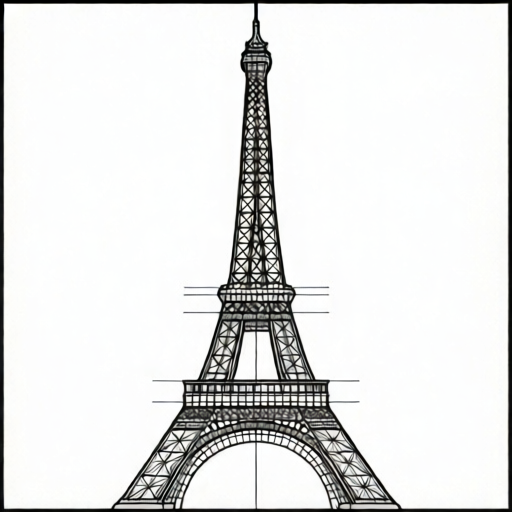
Use the stated measurements and conventions for each exercise.
Set up the grid and overall envelope
Begin by choosing a total drawn height H for the tower, measured from the ground line to the tip. A convenient hypothetical example is H = 20 grid squares, where each square is 1 unit. Draw a square grid on your paper with light pencil lines. Mark the vertical centre line. The tower's widest point at ground level is the base width W. For this method, set W = 0.45H as a starting guide; with H = 20, W = 9 squares. This is a chosen proportion, not a universal rule, and you may adjust it after checking the silhouette.
Draw the ground line and the tip point on the centre line. Mark the base width symmetrically about the centre line. Lightly sketch a rectangle that encloses the tower from ground to tip and from left base edge to right base edge. This envelope keeps the drawing within planned bounds and makes later proportion checks easy.
- Choose H in grid squares and label it on the margin.
- Draw a light square grid and a vertical centre line.
- Mark the ground line and the tip on the centre line.
- Set W = 0.45H, mark half-width each side of centre, and sketch the envelope rectangle.
Place the three tiers with proportion guides
The tower's visible form is divided into three stacked tiers. Using H as the reference, place horizontal guide lines at these fractions of H measured upward from the ground line: first tier top at 0.30H, second tier top at 0.60H, and third tier top at 0.85H. The remaining 0.15H is the upper taper to the tip. These fractions are a teaching convention chosen for clear spacing; they are not engineering data. With H = 20, the guides fall at 6, 12, and 17 squares above the ground line.
At each tier top, mark a width. A workable starting set is: first tier width 0.30H, second tier width 0.18H, and third tier width 0.08H. With H = 20 these are 6, 3.6, and 1.6 squares. Round to the nearest half square for drawing: 6, 3.5, and 1.5. Keep all widths centred on the centre line. These values create a stepped taper that you can refine after comparing the outline to the grid.
- Measure upward from the ground line and draw horizontal guides at 0.30H, 0.60H, and 0.85H.
- Mark each tier width centred on the centre line: 0.30H, 0.18H, and 0.08H.
- Connect the tier edges with light straight lines to form the stepped outline.
- Check that every guide line and width is a simple multiple or fraction of H.
Shape the leg splay and silhouette
The legs splay outward from the first tier down to the ground. Treat the splay as the horizontal offset between the first-tier edge and the base edge on each side. With the starting values above, the offset is (W minus first-tier width) divided by 2. For H = 20, W = 9 and first-tier width = 6, so the offset is 1.5 squares per side. Draw the leg outer edges as gentle curves from the first-tier corners to the base corners, bowing outward slightly near the ground.
A small panel showing how splay angle changes the silhouette helps you compare options. If the offset is too small, the tower looks column-like; if too large, it looks unstable. Test two or three offsets on tracing paper and choose the one that best matches your reference or memory. Because letter styles and drawing conventions vary, accept any splay that keeps the base wider than the first tier and the curves smooth.
- Compute the splay offset as (W minus first-tier width) divided by 2.
- Draw gentle outer curves from first-tier corners to base corners.
- Compare at least two offset values and keep the clearer silhouette.
- Erase construction lines only after the outline passes the proportion checks.
Worked example
Draw the Eiffel Tower on a grid with H = 16 squares. Use tier tops at 0.30H, 0.60H, and 0.85H; tier widths 0.30H, 0.18H, and 0.08H; and base width W = 0.45H. Compute all values in squares and describe the outline.
Worked answer
H = 16. Tier tops: 0.30 times 16 = 4.8, round to 5; 0.60 times 16 = 9.6, round to 9.5; 0.85 times 16 = 13.6, round to 13.5. Tier widths: 0.30 times 16 = 4.8, round to 5; 0.18 times 16 = 2.88, round to 3; 0.08 times 16 = 1.28, round to 1.5. Base width W = 0.45 times 16 = 7.2, round to 7. Splay offset per side = (7 minus 5) divided by 2 = 1 square. Draw the envelope 7 squares wide and 16 squares tall, place guides at 5, 9.5, and 13.5 squares above ground, centre widths 5, 3, and 1.5, and curve the outer legs outward by 1 square per side.
Four practice exercises
Exercise 1
Using H = 12 squares, tier tops at 0.30H, 0.60H, and 0.85H, tier widths 0.30H, 0.18H, and 0.08H, and W = 0.45H, compute all values in squares, rounding to the nearest half square. Describe the splay offset.
Show answer and check
Tier tops: 3.6 rounds to 3.5; 7.2 rounds to 7; 10.2 rounds to 10. Tier widths: 3.6 rounds to 3.5; 2.16 rounds to 2; 0.96 rounds to 1. W = 5.4 rounds to 5.5. Splay offset per side = (5.5 minus 3.5) divided by 2 = 1 square.
Why: Multiply each fraction by H, round to the nearest half square, then subtract the first-tier width from W and divide by two for the per-side offset.
Check: Recompute each product and confirm the base is wider than the first tier by twice the offset.
Exercise 2
A drawing uses H = 24 squares and W = 10 squares. The first-tier width is 7 squares. Compute the splay offset per side and state whether the base is wider than the first tier.
Show answer and check
Offset = (10 minus 7) divided by 2 = 1.5 squares per side. The base is wider than the first tier by 3 squares total, so the splay is valid.
Why: The offset is half the difference between base width and first-tier width. A positive offset means the legs splay outward.
Check: Add twice the offset to the first-tier width and confirm it equals W.
Exercise 3
On a grid with H = 20 squares, a student places tier guides at 5, 11, and 16 squares above ground. Compare these to the target fractions 0.30H, 0.60H, and 0.85H and state the differences in squares.
Show answer and check
Targets: 6, 12, and 17 squares. Differences: 5 is 1 square low; 11 is 1 square low; 16 is 1 square low. All three guides are one square below target.
Why: Multiply each fraction by 20 to get the target heights, then subtract the student's values.
Check: Recompute 0.30 times 20, 0.60 times 20, and 0.85 times 20, and confirm each difference is 1 square.
Exercise 4
A student draws a tower with H = 18 squares, first-tier width 5 squares, and base width 5 squares. Identify the proportion error and give a corrected base width using W = 0.45H rounded to the nearest half square.
Show answer and check
The error is zero splay: base width equals first-tier width, so the legs do not splay. Corrected W = 0.45 times 18 = 8.1, rounds to 8 squares. The new offset per side is (8 minus 5) divided by 2 = 1.5 squares.
Why: A valid splay requires the base to be wider than the first tier. Recompute W from the fraction and then find the offset.
Check: Confirm the corrected base is wider than the first tier and that twice the offset plus first-tier width equals W.
Common mistakes
- Making the base width equal to the first-tier width, so the legs do not splay. Recompute the offset as (W minus first-tier width) divided by 2 and redraw the outer leg curves.
- Placing tier guides by eye without measuring from the ground line. Measure each guide upward from the ground line as a fraction of H and label it lightly.
- Letting tier widths drift off the centre line. Mark half-widths on both sides of the centre line and check symmetry with a ruler.
- Using inconsistent units between the grid and the ruler. State one unit, such as one grid square, and convert all measurements to that unit before drawing.
Self-check rubric
- Grid is square and light, with a clear centre line and ground line.
- Envelope height H and base width W are labelled and consistent in one unit.
- Tier guide heights match the chosen fractions of H within half a square.
- Tier widths are centred and match the chosen fractions within half a square.
- Leg splay offset is computed and drawn symmetrically on both sides.
- Silhouette reads as the Eiffel Tower and construction lines are clean or erased.
- Valid alternatives are accepted when proportions are internally consistent and checked.
Questions and answers
Do I need a specific paper size?
No. Choose H in grid squares and scale the drawing to your paper. The fractions stay the same.
Are the tier fractions official Eiffel Tower measurements?
No. They are teaching conventions chosen for clear spacing and easy arithmetic, not engineering data.
Can I change the base width?
Yes. Adjust W and recompute the splay offset, then check that the base remains wider than the first tier.
How do I know the drawing is accurate enough?
Use the rubric: check grid alignment, tier fractions, symmetry, splay, and clean construction lines.