Free original lessons
Draw the Star of David: Overlapping Triangle Construction
Learn to draw the Star of David by constructing two overlapping equilateral triangles with precise alignment, symmetry checks, and a worked example.
Free lesson
Four exercises
Worked answers
Object Drawing Lessons
The Star of David is built from two identical equilateral triangles, one rotated 180 degrees and overlaid so their centers coincide. This lesson teaches a reliable construction using a baseline, a midline, and simple symmetry checks. You will learn to set the triangle size, align the second triangle, and verify the six points. The method works with any drawing tool; no special equipment is assumed. All measurements are hypothetical examples you can adapt to your paper and tools.
Practice materials: Printable downloads are not available for this lesson yet. Use the instructions and four exercises below.
Reference illustration
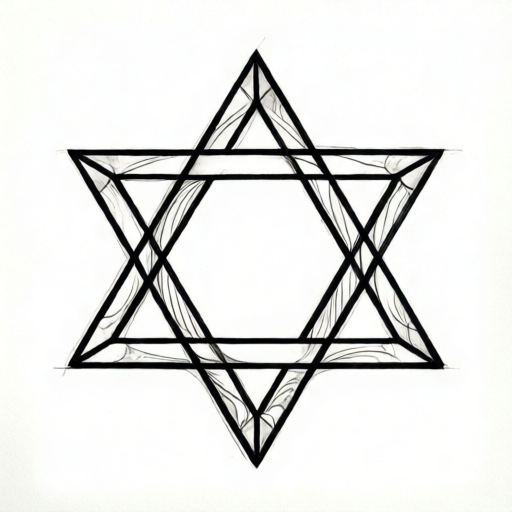
Use the stated measurements and conventions for each exercise.
Setting Up the Construction Frame
Begin with a horizontal baseline and vertical centerline through point C. For an equilateral triangle of side s, the altitude is h=s√3/2, but the distance from its centroid C to any vertex is the circumradius r=s/√3. In a Star of David made from two congruent triangles centered at C, the top and bottom apexes are each r from C, so the full point-to-point height is 2r. With s=6 cm, h≈5.20 cm, r≈3.46 cm, and the star height is about 6.93 cm. Keep these three measurements distinct. All values are hypothetical drawing examples; measure your own paper.
Mark the center where the lines cross. The first triangle has one vertex at (0,+r) and a base parallel to the baseline at y=−r/2. The second triangle is the same size, rotated 180 degrees, with a vertex at (0,−r) and its base at y=+r/2.
- Draw a horizontal baseline and a vertical midline crossing at the center point.
- Mark the first triangle base parallel to the baseline at y=−r/2; place its endpoints at x=−s/2 and x=+s/2.
- Mark the top triangle apex r=s/√3 above C and the inverted triangle apex r below C.
- For side 6 cm, use r≈3.46 cm from C to each vertex; the triangle altitude h≈5.20 cm is a separate base-to-apex measurement.
Constructing the Second Triangle
The second triangle is identical in size but rotated 180 degrees about the center. Its bottom vertex lies on the midline at y=−r, the same distance from C as the first triangle’s top vertex at y=+r. Its base is parallel to the baseline at y=+r/2, with endpoints x=−s/2 and x=+s/2. This placement is the point reflection of the first triangle through the center: each vertex of the second triangle is directly opposite the corresponding vertex of the first, at an equal distance from the center.
- Mark the second triangle's bottom vertex on the midline below the center at the same distance as the first triangle's top vertex above the center.
- Mark the second triangle’s base endpoints on the horizontal line y=+r/2 above the center, each at half the side length from the midline, directly opposite the first triangle’s base endpoints.
- Connect the three vertices to complete the second equilateral triangle.
- Verify that both triangles share the same center and that each vertex of the second triangle is directly opposite a vertex of the first at an equal distance from the center.
Symmetry and Proportion Checks
A correct Star of David has six outer points and six inner crossing points where the sides of the two triangles intersect, forming the vertices of an inner hexagon. The center is not one of these crossings; it is the shared center of both triangles. The outer points should lie on a circle centered at the shared center point. Use a ruler to measure from the center to each outer point; the distances should be equal within your drawing accuracy.
Check rotational symmetry by rotating the paper 180 degrees; the star should look the same. Also check that the two triangles are congruent: their side lengths and altitudes should match. If one triangle is larger, the star will look unbalanced. Adjust by remeasuring the side length and altitude before redrawing.
- Measure the distance from the center to each of the six outer points and compare.
- Rotate the paper 180 degrees and confirm the star aligns with itself.
- Compare the side lengths of both triangles with a ruler.
- Check that the six inner intersection points (where the sides of the two triangles cross) are equally spaced around the center.
Worked example
Construct a Star of David with a hypothetical triangle side length of 6 cm. Show the key measurements and symmetry check.
Worked answer
For side s=6 cm, the altitude is h=6√3/2≈5.20 cm and the circumradius is r=6/√3≈3.46 cm. Put the top apex at (0,+3.46 cm), the bottom apex at (0,−3.46 cm), and the other four vertices at x=±3 cm and y=±1.73 cm: the top triangle's base vertices use y=−1.73 cm, and the inverted triangle's use y=+1.73 cm. Connect each triangle's three vertices. The full vertical apex-to-apex height is 2r≈6.93 cm. Check that all six points are about 3.46 cm from C and the two triangles have equal 6 cm sides.
Four practice exercises
Exercise 1
A student draws two centered equilateral triangles with side length 4 cm. The top apex is 3.5 cm above center C. Where should the bottom apex be for symmetry, and what is the correct center-to-apex distance for side 4 cm? Distinguish it from the triangle altitude.
Show answer and check
Mirror the second triangle's bottom apex 3.5 cm below C to match the student's first apex, but that is not the ideal centered placement. For side 4 cm, r=4/√3≈2.31 cm; place the top and bottom apexes about 2.31 cm above and below C. The triangle altitude from its base to its apex is a different measure: 4√3/2≈3.46 cm.
Why: The two triangle apexes are symmetric about C, so a 3.5 cm top offset would mirror to 3.5 cm below. However, the Star of David is centered at the triangles' common centroid; the vertex radius is s/√3, not the triangle altitude. For s=4 cm, r≈2.31 cm, while h≈3.46 cm.
Check: Compute r=4/√3≈2.31 cm and verify the top and bottom apexes are at +r and −r from C. Separately compute h=4√3/2≈3.46 cm; do not use h as the center-to-apex distance.
Exercise 2
For two centered equilateral triangles with side length 8.66 cm, a student measures the six outer-point distances from center C as 5.0, 5.1, 4.9, 5.0, 5.2, and 5.0 cm. Using a chosen tolerance of ±0.2 cm, do the measurements pass the radius check?
Show answer and check
Yes. The ideal circumradius is 8.66/√3≈5.00 cm. The measured distances differ from 5.00 cm by 0, 0.1, 0.1, 0, 0.2, and 0 cm, all within the stated ±0.2 cm tolerance.
Why: The centered outer vertices lie at the circumradius s/√3. Here the chosen side gives a radius of about 5.00 cm, and the largest absolute measurement deviation is 0.20 cm. The tolerance is explicitly an exercise choice.
Check: Compute 8.66/√3≈5.00 cm and compare each reading with 5.00 cm; confirm every absolute deviation is no more than 0.2 cm.
Exercise 3
A student's first triangle has side length 5 cm and altitude 4.3 cm. The second triangle has side length 5 cm but altitude 4.0 cm. What is the likely mistake, and how can it be fixed?
Show answer and check
The second triangle's altitude is incorrect. For a 5 cm side the altitude should be about 4.33 cm (5 times 0.866 is about 4.33); the first triangle's 4.3 cm is acceptable rounding, but 4.0 cm is too short. Redraw the second triangle with altitude about 4.33 cm.
Why: For an equilateral triangle, altitude is determined by side length: altitude equals side length times about 0.866. With a 5 cm side, the altitude should be about 4.33 cm. A 4.0 cm altitude with a 5 cm side indicates a construction error in the second triangle.
Check: Measure all three sides of the second triangle; they should be equal, and its altitude should match the first triangle's altitude (both about 4.33 cm for a 5 cm side).
Exercise 4
Describe how to check that the second triangle is rotated exactly 180 degrees from the first, using only a ruler and the drawn lines.
Show answer and check
Check that the top vertex of the first triangle and the bottom vertex of the second triangle lie on the same vertical midline, with the center point exactly between them. Also check that the bases are parallel and on opposite sides of the center.
Why: A 180-degree rotation maps the top vertex to the bottom vertex along the same line through the center, and maps the base to a parallel line on the opposite side.
Check: Measure the distance from the center to the top vertex and to the bottom vertex; they should be equal, and both vertices should be on the midline.
Common mistakes
- Drawing the second triangle at a different size from the first. Measure the first triangle's side length and altitude, then use the same values for the second triangle. Mark all vertices before connecting.
- Placing the second triangle's center away from the first triangle's center. Use the crossing point of the baseline and midline as the shared center. Mark the second triangle's vertices relative to that same center.
- Rotating the second triangle by an angle other than 180 degrees. The second triangle's bottom vertex should lie directly below the center on the midline, and its base should be horizontal above the center. Check that the top and bottom vertices are on the same vertical line.
- Assuming the star's points must be perfectly sharp or identical in style. Line weight and point sharpness may vary slightly. Use the symmetry checks to confirm that both overlapping triangles remain congruent.
Self-check rubric
- Both triangles are equilateral within drawing accuracy (side lengths equal).
- The two triangles share the same center point.
- The second triangle is rotated 180 degrees relative to the first.
- Six outer points are present and roughly equally spaced around the center.
- Symmetry check shows equal distances from center to outer points.
- Line style and point sharpness may vary; structural symmetry is the primary criterion.
Questions and answers
Do I need a compass or protractor?
No. A ruler is enough for the side and center measurements. For a centered Star of David, use the circumradius s/√3 to place the vertices; the triangle altitude s√3/2 is a separate base-to-apex measure.
How do I know the triangles are equilateral?
Measure all three sides of each triangle. They should be equal within your drawing accuracy. Also check that each angle is about 60 degrees if you have a protractor.
Can the star be drawn at any size?
Yes. Choose a side length that fits your paper, then use the same side length, altitude, and circumradius relations for both triangles. Keep altitude and center-to-vertex distance distinct.
What if my star looks slightly uneven?
Check the center alignment and the distance from the center to each outer point. Small differences in line weight or point sharpness are acceptable under the convention; structural symmetry is the main goal.