Free original lessons
Draw Anger: Brow, Mouth and Posture Variations
Learn to draw anger expressions by varying brow tension, mouth shape and posture lean. Includes a worked example, four practice tasks and a clear rubric.
Free lesson
Four exercises
Worked answers
Object Drawing Lessons
Anger is readable in drawing when three features change together: the brow, the mouth and the posture. This lesson teaches a simple convention for each feature, then shows how to vary intensity and style without losing the emotion. You will use a defined brow angle, a set of mouth shapes and a posture lean, and you will check your work with measurable comparisons. The goal is not one universal angry face but a controlled set of variations that a viewer can read as anger. All practice tasks are self-contained; where a diagram would help, the text describes it precisely.
Practice materials: Printable downloads are not available for this lesson yet. Use the instructions and four exercises below.
Reference illustration
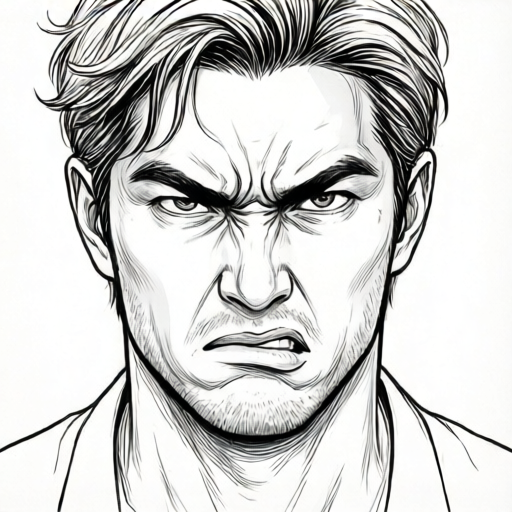
Use the stated measurements and conventions for each exercise.
The three-feature anger convention
Use a fixed convention so variations stay comparable. Brow: draw the inner ends lower than the outer ends, with the gap between the brows narrowed. The brow line is a straight or slightly curved segment; the angle is measured from horizontal. Mouth: choose one of three shapes — a pressed line, a downturned open shape, or a squared shout shape. Posture: lean the head and shoulders forward from vertical by a stated angle.
Keep the head outline the same across variants so only the three features change. Mark a baseline under the chin and a midline through the eyes; x-height is baseline to midline for any lettering you add, and letter styles may vary. Label each feature change next to the drawing so the variation is explicit.
- Draw a neutral head outline with a baseline and an eye midline.
- Set the brow angle: inner ends lower, gap narrowed; record the angle from horizontal.
- Choose a mouth shape and draw it centered on the midline.
- Lean the posture forward by a stated angle from vertical.
- Label each change and compare with the neutral version.
Scaling brow tension from mild to intense
Brow tension scales by two numbers: the angle of the inner brow below horizontal and the gap between the inner brow ends. A mild anger uses a small angle and a modest gap reduction; intense anger uses a larger angle and a very narrow gap. Keep the outer brow ends fixed so the change is measurable.
A small panel can show three brow states side by side: mild, moderate and intense. For each, record the angle and the gap in the same units. This makes the progression checkable rather than a matter of taste.
- Fix the outer brow points on the head outline.
- Draw the mild brow: small angle, gap reduced by one quarter.
- Draw the moderate brow: larger angle, gap reduced by half.
- Draw the intense brow: largest angle, gap reduced to a narrow slit.
- Measure each angle and gap and write the values beside the panel.
Mouth and posture variation
Mouth shape carries the vocal quality of anger. A pressed line reads as controlled anger; a downturned open shape reads as frustration; a squared shout shape reads as explosive anger. Posture lean adds force: a forward lean of the head and shoulders suggests confrontation, while an upright posture with tense brows suggests suppressed anger.
Vary one feature at a time to keep the comparison fair. If you change the mouth, keep the brow and lean fixed; if you change the lean, keep the brow and mouth fixed. Record the chosen values so another person can redraw the same variant.
- Choose a mouth shape and draw it with a clear outline.
- Set the posture lean angle from vertical and draw the shoulder line.
- Keep the other two features fixed and label the changed feature.
- Compare the variant with the neutral drawing and note the difference.
Checking your anger drawing
Check readability by asking a viewer to point to the brow, mouth and posture and say whether each reads as anger. Check consistency by measuring the brow angle and gap, the mouth width, and the lean angle in the same units. Check variation by confirming that each variant changes only the labeled feature.
Use simple arithmetic: if the neutral gap is 20 units and the intense gap is 5 units, the reduction is 15 units, or 75 percent. If the lean is 10 degrees from vertical, state that value rather than guessing. Any numerical values here are hypothetical examples; measure your own drawing.
- Measure brow angle and gap; record values.
- Measure mouth width and lean angle; record values.
- Ask a viewer to identify the emotion and the three features.
- Confirm each variant changes only its labeled feature.
Worked example
Draw a moderate anger expression using the convention. Use a brow angle of 15 degrees below horizontal, a gap reduced by half from a neutral gap of 20 units to 10 units, a pressed-line mouth 30 units wide, and a forward lean of 10 degrees from vertical. Label each feature and state the measured values.
Worked answer
The drawing shows a head outline with a baseline and eye midline. The inner brow ends are 15 degrees below horizontal and the gap is 10 units, half the neutral 20 units. The mouth is a pressed line 30 units wide centered on the midline. The shoulder line leans forward 10 degrees from vertical. Labels mark brow angle, gap, mouth width and lean. A viewer identifies anger from the lowered inner brows, pressed mouth and forward lean. Check: 20 minus 10 equals 10 units, a 50 percent gap reduction; the stated angle and lean match the drawn lines.
Four practice exercises
Exercise 1
Draw a mild anger expression. Use a brow angle of 8 degrees below horizontal, a gap reduced by one quarter from a neutral gap of 20 units, a downturned open mouth 25 units wide, and a forward lean of 5 degrees from vertical. Label each feature and state the measured values.
Show answer and check
The drawing shows inner brow ends 8 degrees below horizontal and a gap of 15 units, which is 20 minus 5 units, a one-quarter reduction. The mouth is a downturned open shape 25 units wide. The shoulder line leans 5 degrees from vertical. Labels state the angle, gap, mouth width and lean.
Why: The brow angle and gap follow the mild setting; the mouth shape is downturned open; the lean is small. Keeping the head outline fixed makes the comparison fair.
Check: Measure the brow angle and gap; confirm 20 minus 15 equals 5 units, a 25 percent reduction. Confirm the mouth width and lean match the labels.
Exercise 2
Draw an intense anger expression. Use a brow angle of 25 degrees below horizontal, a gap of 5 units from a neutral gap of 20 units, a squared shout mouth 35 units wide, and a forward lean of 15 degrees from vertical. Label each feature and state the measured values.
Show answer and check
The drawing shows inner brow ends 25 degrees below horizontal and a gap of 5 units, a reduction of 15 units or 75 percent from neutral. The mouth is a squared shout shape 35 units wide. The shoulder line leans 15 degrees from vertical. Labels state all values.
Why: Intense anger uses the largest brow angle and narrowest gap, the squared mouth and the largest lean. The values are stated so the drawing can be redrawn.
Check: Measure the brow angle and gap; confirm 20 minus 5 equals 15 units, a 75 percent reduction. Confirm the mouth width and lean match the labels.
Exercise 3
Draw two variants that differ only in mouth shape. Keep the brow at 15 degrees below horizontal with a gap of 10 units and the lean at 10 degrees from vertical. Variant A uses a pressed line 30 units wide; Variant B uses a downturned open mouth 30 units wide. Label the changed feature in each.
Show answer and check
Both drawings share the same brow angle, gap and lean. Variant A has a pressed line 30 units wide; Variant B has a downturned open mouth 30 units wide. Labels mark the mouth as the only changed feature in each variant.
Why: Holding brow and lean fixed isolates the mouth change, so the comparison is controlled. The shared values make the difference checkable.
Check: Compare the two drawings: brow angle, gap and lean must match; only the mouth outline differs. Confirm both mouth widths are 30 units.
Exercise 4
Draw a suppressed anger expression. Use a brow angle of 20 degrees below horizontal with a gap of 8 units, a pressed-line mouth 28 units wide, and an upright posture with zero lean from vertical. Label each feature and explain why the posture differs from the other variants.
Show answer and check
The drawing shows inner brow ends 20 degrees below horizontal and a gap of 8 units, a reduction of 12 units or 60 percent from neutral. The mouth is a pressed line 28 units wide. The shoulder line is upright at zero lean. The label explains that suppressed anger keeps the posture upright while the brow and mouth carry the tension.
Why: Suppressed anger is shown by tense brow and pressed mouth with no forward lean, which distinguishes it from confrontational variants. The values are stated for measurement.
Check: Measure the brow angle and gap; confirm 20 minus 8 equals 12 units, a 60 percent reduction. Confirm the lean is zero and the mouth width is 28 units.
Common mistakes
- Changing brow, mouth and posture all at once so the comparison is unclear. Vary one feature per variant and keep the other two fixed.
- Drawing the inner brow ends higher than the outer ends, which reads as sadness or worry. Lower the inner ends below horizontal and narrow the gap.
- Using a smile-shaped mouth with angry brows, which mixes signals. Choose a pressed, downturned or squared mouth shape and label it.
- Leaning the whole figure without stating an angle, so the posture cue is unmeasurable. State the lean angle from vertical and draw the shoulder line to match.
Self-check rubric
- Brow: inner ends lower than outer ends, gap narrowed, angle stated in degrees.
- Mouth: one clear shape from the convention, width stated in the same unit.
- Posture: shoulder line leaned forward by a stated angle from vertical.
- Variation: each variant changes only its labeled feature.
- Labels: feature changes and measured values written beside the drawing.
- Readability: a viewer identifies anger and points to all three features.
- Valid alternatives: brow curve, mouth outline and lean style may differ if the stated values match.
Questions and answers
Do I need to draw a full figure?
No. The lesson uses a head outline and a shoulder line only; full figure drawing is outside this task.
Is there one correct angry face?
No. The convention defines measurable features, but valid alternatives exist in brow curve, mouth outline and lean style.
How do I measure the brow angle?
Measure from horizontal to the brow line at the inner end, using a protractor or a printed angle guide.
What units should I use?
Use one unit for all lengths, such as millimeters on paper, and degrees for angles. State the unit beside each value.