Free original lessons
Hairstyle Ideas Drawing: Compare Partings, Lengths and Texture Strokes
Plan and sketch hairstyle variations on blank head outlines by comparing parting positions, length guides and simple texture strokes for loose, tied and layered looks.
Free lesson
Four exercises
Worked answers
Object Drawing Lessons
This lesson teaches a repeatable way to generate hairstyle ideas drawing on head outlines. You will place a parting, mark a length guide, and choose a texture stroke convention so variations can be compared fairly. The focus is shape variation, not strand-by-strand rendering or dreadlock construction. Work on paper with a pencil and eraser. Use the same head outline for each variation so differences come from the hair design, not from a changing head shape. A printable resource is planned but not yet built; the instructions below are self-contained.
Practice materials: Printable downloads are not available for this lesson yet. Use the instructions and four exercises below.
Reference illustration
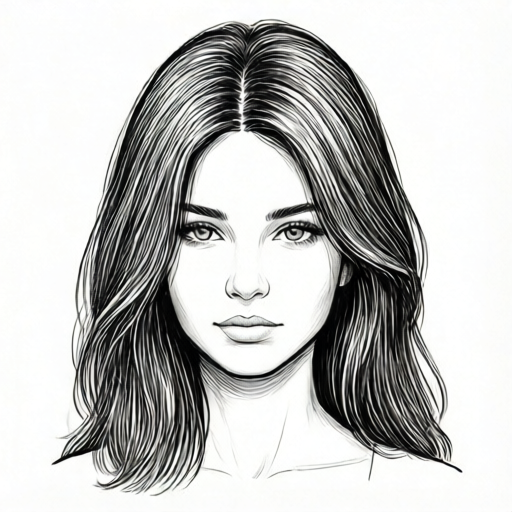
Use the stated measurements and conventions for each exercise.
Set up a fair comparison
Draw or trace three identical head outlines in a row. Mark the crown point, the midline from forehead to crown, and the baseline where hair ends. Label each column: loose, tied, layered. Keep the head outline identical so your comparison is honest.
Define a texture stroke convention before drawing. For example: short curved strokes mean soft waves, straight short strokes mean sleek, and clustered zigzag strokes mean volume. Write the convention beside the row so anyone reading the sheet can decode it. This convention is yours; valid alternatives are allowed as long as they are stated.
- Trace three identical head outlines and label the columns loose, tied, layered.
- Mark crown, midline and a length guide line on each outline.
- Write your texture stroke convention in a small key beside the row.
Place the parting and length guide
The parting is a line on the scalp. Choose one of three positions: center, side, or off-center. Draw it from the hairline to the crown. The parting changes how hair falls, so draw the fall direction as two or three broad shapes rather than many strands.
The length guide is a horizontal line showing where hair ends. Use consistent units: measure from the crown to the guide in centimeters on your actual paper. For example, a hypothetical short guide might be 4 cm below the crown, medium 8 cm, long 12 cm. These numbers are examples only; measure your own paper and label your chosen values.
- Draw the parting from hairline to crown on each outline.
- Add two or three broad fall shapes from the parting.
- Mark the length guide and label its distance from the crown in centimeters.
Sketch loose, tied and layered variations
For the loose variation, let the fall shapes spread outward and end at the length guide. Use your soft-wave stroke convention. For the tied variation, gather the fall shapes into a single mass at the back or side and draw a simple tie mark; keep the length guide visible below the tie. For the layered variation, draw two length guides, a shorter upper guide and a longer lower guide, and show stepped edges between them.
Compare the three columns side by side. Ask: does the parting match the fall direction? Is the length guide respected? Are texture strokes consistent with the key? Adjust with an eraser before finalizing.
- Draw the loose variation with outward fall shapes ending at the guide.
- Draw the tied variation with a gathered mass and a tie mark.
- Draw the layered variation with two guides and stepped edges.
- Check parting, length and texture consistency across all three.
Review and refine
Use a simple checklist: identical head outlines, labeled parting, labeled length guide in centimeters, stated texture convention, and three distinct silhouettes. If two columns look too similar, change one variable only, such as moving the parting from center to side, and redraw.
Keep strokes broad. This lesson excludes strand-by-strand rendering and dreadlock construction; those are separate skills. Your goal is comparable shape variation.
- Apply the checklist to your row.
- Change one variable where two columns are too similar.
- Redraw the affected column and recheck.
Worked example
On one head outline, place a side parting, mark a medium length guide 8 cm below the crown (hypothetical example), and sketch a loose variation using short curved strokes for soft waves. State the convention.
Worked answer
The parting runs from the hairline to the crown on the left side. Two broad fall shapes sweep right and end at the 8 cm guide. Short curved strokes fill the fall shapes. Key: short curved stroke equals soft wave. The head outline is unchanged from the template.
Four practice exercises
Exercise 1
Draw one head outline with a center parting and a short length guide 4 cm below the crown (hypothetical example). Sketch a tied variation with a single gathered mass and a tie mark. State your texture convention.
Show answer and check
Center parting from hairline to crown; fall shapes gather to a single mass at the back; tie mark drawn; length guide at 4 cm labeled; convention stated in a key.
Why: A center parting splits fall shapes evenly; gathering them tests whether the tie mark and guide remain readable.
Check: Verify the parting reaches the crown, the guide is labeled 4 cm, the tie mark is present, and the key matches the strokes used.
Exercise 2
Draw two identical head outlines side by side. On the left use an off-center parting with a long guide 12 cm below the crown (hypothetical example). On the right use the same parting but a layered variation with an upper guide at 6 cm and a lower guide at 12 cm. Label both.
Show answer and check
Left: off-center parting, fall shapes to 12 cm. Right: same parting, stepped edges between 6 cm and 12 cm guides. Both labeled.
Why: Changing only the layering while keeping the parting fixed isolates the effect of length guides.
Check: Confirm the partings match, both guides are labeled, and stepped edges appear only on the right.
Exercise 3
Sketch a loose variation with a side parting and a medium guide 8 cm below the crown (hypothetical example). Use clustered zigzag strokes for volume and write the key. Then list one change that would make it a tied variation without altering the head outline.
Show answer and check
Side parting, fall shapes to 8 cm, zigzag strokes for volume, key written. Change: gather the fall shapes into one mass and add a tie mark.
Why: The change tests understanding that tying alters gathering, not the head outline or parting.
Check: Check the guide label, the key, and that the listed change mentions gathering and a tie mark.
Exercise 4
Create a comparison row of three identical outlines: loose with center parting, tied with center parting, layered with center parting. Use one stated convention. Measure and label each length guide in centimeters on your paper.
Show answer and check
Three identical outlines, center parting on each, distinct silhouettes for loose, tied and layered, one convention key, each guide measured and labeled.
Why: Holding the parting constant forces the comparison to rely on gathering and layering.
Check: Use the rubric: identical outlines, labeled partings, measured guides, stated convention, three distinct silhouettes.
Common mistakes
- Drawing different head outlines in each column. Trace one outline three times or use a folded template so the head shape is identical.
- Leaving the parting unlabeled or inconsistent with the fall direction. Draw the parting first, then make fall shapes start from it; label the parting position.
- Using texture strokes without a stated convention. Write a small key beside the row and use only strokes defined in it.
- Treating the length guide as a fixed universal number. Measure your actual paper and label your chosen centimeter values as examples.
Self-check rubric
- Three identical head outlines are used and labeled loose, tied, layered.
- Each outline has a labeled parting position and a length guide measured in centimeters.
- A texture stroke convention is stated beside the row and applied consistently.
- The three silhouettes are visibly distinct in parting, length or gathering.
- Valid alternative conventions are accepted if stated and consistent.
Questions and answers
Do I need the printable resource to do this lesson?
No. The lesson is self-contained; draw or trace three identical head outlines on paper. The printable is planned but not yet built.
Can I use different texture strokes than the examples?
Yes, as long as you state your convention in a key beside the row and apply it consistently.
How do I know my length guide is correct?
There is no universal value. Measure from the crown to the guide on your paper in centimeters and label it; consistency across columns matters more than the number.
Does this lesson cover dreadlocks or strand-by-strand rendering?
No. Those are outside this boundary. Focus on broad shape variation and simple texture strokes.