Free original lessons
Pencil Flower Drawing: Line Weight, Graphite Shading, and Petal Layering
Learn to draw a flower in pencil using varied line weight, graphite shading, and clear petal layering. Includes a worked example, four practice tasks, and a rubric.
Free lesson
Four exercises
Worked answers
Object Drawing Lessons
This lesson teaches pencil flower rendering with three controllable variables: line weight, graphite shading, and petal layering. You will use a simple convention: x-height is measured from baseline to midline of lowercase letters, and letter styles vary, so treat it as a guide rather than a fixed rule. All numerical values are hypothetical examples; measure your own paper and pencil. The goal is a readable flower form with deliberate edges and tonal separation, not botanical labeling or color.
Practice materials: Printable downloads are not available for this lesson yet. Use the instructions and four exercises below.
Reference illustration
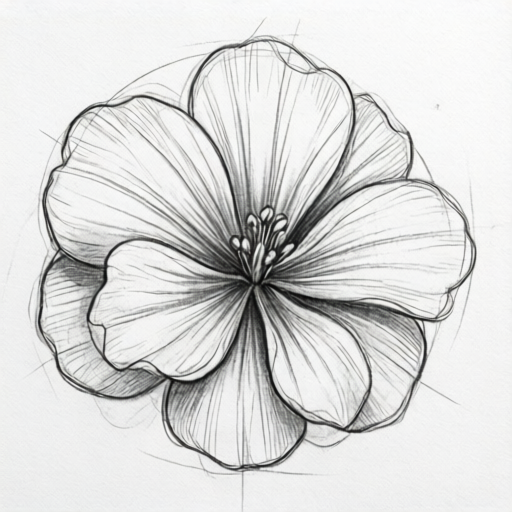
Use the stated measurements and conventions for each exercise.
Line Weight Control
Line weight is the visual thickness of a pencil mark. It changes with pressure, pencil grade, and sharpness. Use a light pressure for construction lines and a firmer pressure for final contours. Keep the pencil at a consistent angle to avoid sudden width jumps.
A practical convention: draw a line-weight strip with five short parallel strokes, each slightly darker or thicker than the last. Label them 1 to 5. Use 1 for hidden construction, 3 for petal edges, and 5 for the stem or outer contour. These numbers are hypothetical; adjust to your pencil and paper.
- Sharpen the pencil and test on scrap paper.
- Draw five 3 cm horizontal strokes with increasing pressure.
- Mark the lightest as 1 and the darkest as 5.
- Choose 3 as your standard petal edge weight.
- Redraw one petal edge at weight 3 and compare.
Graphite Shading Panel
Graphite shading creates value without color. Build a panel of five squares, each filled with a different tone: white paper, light gray, mid gray, dark gray, and near-black. Use gentle overlapping strokes and blend only if needed. Keep the direction consistent within each square.
Shade petals by following their curvature. A petal that curves away from the light gets a darker band near its base or edge. Leave a thin white gap between overlapping petals to separate them. Avoid smudging with your hand; rest on scrap paper.
- Draw five 2 cm squares in a row.
- Fill each square with one tone from light to dark.
- Label the tones 1 to 5.
- Choose tone 2 for lit petals and tone 4 for shadowed petals.
- Test a petal with tone 2, then add tone 4 at the base.
Petal Layering Order
Petal layering means deciding which petals sit in front. Draw back petals first with lighter lines, then front petals with firmer lines. Overlap edges should show a small gap or a darker line to read as separation.
Use a simple order: back ring, middle ring, front ring, then center. Keep construction lines light so they can be erased. When a front petal crosses a back petal, darken only the front petal's edge.
- Lightly draw the back ring of petals.
- Add the middle ring, overlapping the back ring.
- Draw the front ring with weight 3 edges.
- Add the center with small marks.
- Erase construction lines and reinforce front edges.
Putting It Together
Combine the three skills on one flower. Start with a light construction circle and a center point. Add petals in rings, then shade with two tones. Check that the darkest line is on the front contour and the lightest on construction marks.
Keep the drawing simple: five to eight petals is enough. The stem can be a single weight-5 line. A leaf may be added with a weight-3 edge and tone-3 shading.
- Draw a light circle for the flower head.
- Add back, middle, and front petals in order.
- Shade lit areas with tone 2 and shadow areas with tone 4.
- Add stem at weight 5 and one leaf at weight 3.
- Erase construction lines and review against the rubric.
Worked example
Draw a six-petal flower with a light construction circle, back and front petal rings, two shading tones, and a stem. Use weight 1 for construction, weight 3 for petal edges, and weight 5 for the stem.
Worked answer
A completed pencil flower with a faint circle, three back petals drawn first, three front petals overlapping with weight-3 edges, tone-2 shading on lit petals, tone-4 shading at bases, and a single weight-5 stem. Construction lines are erased or left very light.
Four practice exercises
Exercise 1
Draw a line-weight strip with five strokes labeled 1 to 5. Then draw one petal edge at weight 3 and one stem at weight 5.
Show answer and check
A strip of five strokes increasing in darkness or thickness, a petal edge matching the middle stroke, and a stem matching the darkest stroke.
Why: The strip calibrates pressure to visible weight. Matching the petal to stroke 3 and the stem to stroke 5 shows deliberate control.
Check: Compare the petal edge to stroke 3 and the stem to stroke 5. They should look similar in thickness or darkness.
Exercise 2
Create a five-square graphite shading panel from light to dark. Shade one petal with tone 2 and add tone 4 at its base.
Show answer and check
Five squares with distinct tones, a petal mostly tone 2, and a darker tone-4 band near the base.
Why: The panel establishes a value scale. Using two separated tones creates readable shadow without color.
Check: Check that the petal's base is visibly darker than its tip and that both tones appear in the panel.
Exercise 3
Draw a flower with three back petals and three front petals. Use weight 1 for construction, weight 3 for front petal edges, and leave a small gap where petals overlap.
Show answer and check
A flower with faint construction marks, three back petals, three front petals with firmer edges, and visible gaps at overlaps.
Why: Drawing back petals first and leaving gaps makes layering read clearly without extra shading.
Check: Trace each front petal edge: it should be darker than the back petals, and overlaps should show a gap or darker line.
Exercise 4
Draw a complete flower with a stem and one leaf. Use weight 3 for petal and leaf edges, weight 5 for the stem, tone 2 for lit areas, and tone 4 for shadow. Erase construction lines.
Show answer and check
A complete pencil flower with a weight-5 stem, weight-3 petal and leaf edges, two shading tones, and no visible heavy construction lines.
Why: This combines line weight, shading, and layering in one small composition. Erasing construction lines tests clean finish.
Check: Use the rubric: check line weight hierarchy, two tones, petal order, readable form, and clean construction.
Common mistakes
- Using the same line weight for construction and final edges. Keep construction at weight 1 and final petal edges at weight 3.
- Shading every petal with the same tone. Use tone 2 for lit petals and tone 4 near bases or overlaps.
- Drawing front petals before back petals. Draw back ring first, then middle, then front.
- Smudging graphite with the hand. Rest on scrap paper and shade in small overlapping strokes.
Self-check rubric
- Line weight: construction lines are lighter than final petal edges; stem is darkest.
- Shading: at least two distinct graphite tones separate lit and shadowed areas.
- Layering: back petals are drawn before front petals and overlaps read clearly.
- Form: flower head is readable with five to eight petals and a simple stem.
- Cleanliness: construction lines are erased or very light; no heavy smudging.
Questions and answers
Do I need a specific pencil grade?
No. Use any graphite pencil. Test pressure on scrap paper to find your weights.
How many petals should I draw?
Five to eight petals keeps the layering readable for this lesson.
Can I blend the graphite?
Yes, but keep the five-tone panel distinct. Blending should not erase the tone differences.
What does x-height mean here?
It is baseline to midline of lowercase letters. Letter styles vary, so use it only as a rough size guide.