Free original lessons
Draw September Birth Flowers: Aster and Morning Glory Form Construction
Learn to construct aster petal layers and morning glory trumpet forms with clear guides, practice exercises, and a fair rubric for line drawings.
Free lesson
Four exercises
Worked answers
Object Drawing Lessons
This lesson teaches the structural drawing of two September birth flowers: the aster and the morning glory. You will build each flower from simple geometric guides rather than copying a finished picture. The aster is treated as a radial burst of narrow petals in overlapping layers around a central disk. The morning glory is treated as a trumpet: a flaring circular face joined to a narrowing tube. All measurements are hypothetical examples; measure your own paper and tools. The convention for line drawings is that x-height is measured from baseline to midline, and letter styles may vary. No colored rendering or bouquet composition is included.
Practice materials: Printable downloads are not available for this lesson yet. Use the instructions and four exercises below.
Reference illustration
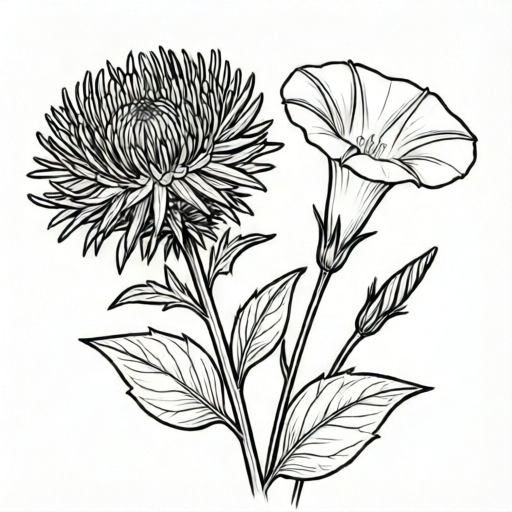
Use the stated measurements and conventions for each exercise.
Aster: radial petal layers
Begin with a light circle for the flower head. Mark the center point. Draw a smaller inner circle for the disk. The space between the inner and outer circles is the petal zone. Divide the outer circle into evenly spaced guide marks; for a hypothetical example, use 16 marks. These marks are starting points, not fixed petal counts.
Draw the first layer of narrow petals from the inner circle outward, letting each petal taper to a point. Overlap adjacent petals slightly. Add a second layer offset between the first-layer petals, and a third layer if space allows. Keep petal lengths varied but balanced. The disk remains a textured circle; indicate texture with short radial ticks rather than solid fill.
- Draw a light outer circle and mark its center.
- Draw a smaller inner circle for the disk.
- Place evenly spaced guide marks around the outer circle.
- Draw the first petal layer from inner circle to outer guide marks.
- Offset and draw a second layer between first-layer petals.
- Add short radial ticks inside the disk for texture.
Morning glory: trumpet form
The morning glory is built as a trumpet. Start with a large circle for the flaring face. Mark its center. Draw a smaller concentric circle inside the face to represent the throat opening. From the throat, draw two curved side lines that narrow into a tube. The tube should taper gently and end at a small calyx shape.
Divide the face into five equal sectors using light guide lines. The trumpet face has five radial creases that meet at the throat. Draw these creases as soft curves from the throat circle to the outer edge. Add a gentle wavy rim between creases. The tube connects behind the face; show it with two curved side lines that narrow toward the calyx.
- Draw a large circle for the trumpet face and mark its center.
- Draw a smaller concentric throat circle.
- Divide the face into five equal sectors with light guides.
- Draw five soft creases from throat to outer edge.
- Add a wavy rim between creases.
- Draw two narrowing side lines for the tube and a small calyx at the end.
Proportion and line convention
Use a consistent line convention: construction lines are light and may be erased; final lines are darker and continuous. For the aster, the disk diameter is a hypothetical one-third of the outer circle diameter. For the morning glory, the throat circle diameter is a hypothetical one-half of the face diameter. These ratios are examples, not standards.
X-height is measured from baseline to midline. When labeling parts on your drawing, use lowercase letters with a consistent x-height; letter styles may vary. Check that your labels do not overlap the flower forms. Measure your actual paper and pencil to set guide sizes; do not assume printer tolerances.
- Choose a light line for guides and a darker line for final contours.
- Measure your paper and set a hypothetical outer circle diameter.
- Mark the disk or throat ratio as a light guide.
- Label parts with lowercase letters at a consistent x-height.
- Erase construction lines only after final contours are stable.
Worked example
Construct an aster with an outer circle diameter of 8 cm and a disk diameter of 3 cm. Place 12 guide marks. Describe the first two petal layers and one check.
Worked answer
Draw an 8 cm outer circle and a 3 cm concentric disk. Mark 12 evenly spaced points on the outer circle. Draw 12 narrow petals from the disk edge to the marks. Draw a second layer of 12 petals offset halfway between the first-layer petals. Check that every petal starts at the disk edge and that adjacent petals overlap slightly without crossing the disk center.
Why: The disk is about one-third of the outer diameter, which is a hypothetical ratio. Twelve guide marks give a balanced radial layout. Offsetting the second layer creates the layered aster form.
Check: Measure the outer circle and disk with a ruler. Count that each layer has 12 petals. Verify that no petal enters the disk area and that the second layer is offset.
Four practice exercises
Exercise 1
Construct an aster with an outer circle diameter of 10 cm and a disk diameter of 4 cm. Use 16 guide marks. Draw two offset petal layers and add disk texture ticks.
Show answer and check
A 10 cm outer circle, a 4 cm concentric disk, 16 evenly spaced guide marks, 16 first-layer petals from disk to marks, 16 second-layer petals offset between the first, and short radial ticks inside the disk.
Why: The disk is 4 cm of a 10 cm outer diameter, a hypothetical two-fifths ratio. Sixteen marks give even spacing. Offsetting the second layer creates overlap.
Check: Measure both circles. Count 16 petals in each layer. Confirm the second layer is offset and that ticks stay inside the disk.
Exercise 2
Construct a morning glory with a face diameter of 9 cm and a throat diameter of 4.5 cm. Divide the face into five sectors and draw five creases plus a wavy rim. Add a narrowing tube and calyx.
Show answer and check
A 9 cm face circle, a 4.5 cm concentric throat circle, five equal sectors, five soft creases from throat to edge, a wavy rim between creases, two narrowing side lines for the tube, and a small calyx at the tube end.
Why: The throat is half the face diameter, a hypothetical ratio. Five sectors match the five creases. The tube narrows behind the face.
Check: Measure face and throat. Count five creases meeting at the throat. Verify the tube narrows and ends at a calyx.
Exercise 3
Draw an aster with an outer circle of 7 cm and a disk of 2 cm. Use 10 guide marks. Then draw a morning glory face of 6 cm with a throat of 3 cm and five creases. Label the disk, throat, and calyx with lowercase letters at consistent x-height.
Show answer and check
Aster: 7 cm outer circle, 2 cm disk, 10 marks, two offset petal layers, disk ticks. Morning glory: 6 cm face, 3 cm throat, five creases, wavy rim, narrowing tube, calyx. Labels use lowercase letters with baseline-to-midline x-height.
Why: The two flowers are constructed separately with hypothetical ratios. Labels follow the stated x-height convention and may use any letter style.
Check: Measure circles and count petals and creases. Check that labels sit on a baseline with consistent x-height and do not overlap forms.
Exercise 4
Construct an aster with an outer circle of 12 cm and a disk of 4 cm using 20 guide marks and three petal layers. Construct a morning glory with a face of 8 cm, throat of 4 cm, five creases, and a tube that narrows to 1 cm at the calyx. Describe one valid alternative choice.
Show answer and check
Aster: 12 cm outer circle, 4 cm disk, 20 marks, three petal layers with petals offset between adjacent layers (20 petals in the first layer, with subsequent layers offset between the previous layer's petals), disk ticks. Morning glory: 8 cm face, 4 cm throat, five creases, wavy rim, tube narrowing from throat to 1 cm at calyx. A valid alternative is using a different letter style for labels while keeping x-height consistent, or varying petal lengths slightly while preserving radial balance.
Why: The disk is one-third of the outer diameter and the throat is half the face diameter, both hypothetical. Three layers require offsetting each layer. The tube narrows to a measured 1 cm end.
Check: Measure all circles and the tube end. Count 20 petals per layer and five creases. Confirm offsets and that the alternative choice does not break the x-height convention or radial balance.
Common mistakes
- Drawing aster petals as a single ring with equal lengths. Offset at least two layers and vary petal lengths slightly while keeping radial balance.
- Making the morning glory face flat with no tube. Draw two narrowing side lines behind the face and end them at a small calyx.
- Using heavy construction lines that cannot be erased. Keep guides light and reserve darker lines for final contours.
- Labeling with inconsistent letter heights. Set a baseline and midline, then keep lowercase x-height consistent across labels.
Self-check rubric
- Aster shows a distinct disk and at least two offset petal layers.
- Morning glory shows a flaring face, a throat circle, five creases, and a narrowing tube ending in a calyx.
- Construction lines are light and final contours are darker and continuous.
- Labels use lowercase letters with consistent x-height from baseline to midline; letter style may vary.
- Proportions are internally consistent and any numerical values are labeled as hypothetical examples.
Questions and answers
Do I need to count aster petals exactly?
No. Guide marks are starting points. The goal is overlapping radial layers, not a fixed petal count.
Must the morning glory have exactly five creases?
Five creases are a useful convention for the trumpet face. You may adjust the wavy rim, but keep creases meeting at the throat.
Can I use a different letter style for labels?
Yes. The convention fixes x-height from baseline to midline, not a single letter style. Keep heights consistent.
Are the numerical ratios required?
No. They are hypothetical examples. Measure your own paper and choose ratios that fit your drawing.