Free original lessons
Old Man Face Drawing: Proportions and Age Cues
Learn to draw an old man's face using feature proportion guides, wrinkle placement, and age cue steps with a practice frame and rubric.
Free lesson
Four exercises
Worked answers
Object Drawing Lessons
Drawing an old man's face well depends on two things working together: believable feature proportions and deliberate age cues. This guide gives you a repeatable construction method, a convention for measuring facial features, and a set of checkable steps. You will use a simple proportion system based on the face frame, then layer age cues such as creases, sagging tissue, and texture. All measurements are relative to your own drawing, so the method works at any size. The practice tasks are self-contained and use plain arithmetic with consistent units. A worked example shows the full process before you try the four exercises.
Practice materials: Printable downloads are not available for this lesson yet. Use the instructions and four exercises below.
Reference illustration
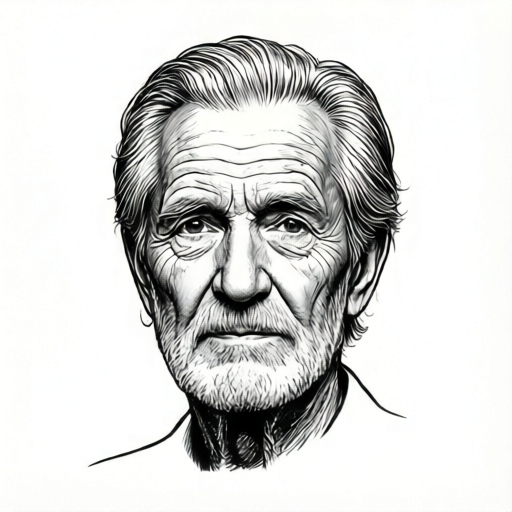
Use the stated measurements and conventions for each exercise.
Set a proportion convention before drawing
Use a face frame: a rectangle whose height is the distance from the top of the head to the chin, and whose width is the widest part of the face at cheek level. Divide the height into thirds: hairline to brow, brow to base of nose, base of nose to chin. These thirds are a convention, not a universal rule; real faces vary. Mark the midline vertically. Eye level sits near the brow-to-nose midpoint in this convention. Nose base sits at the lower third line. Mouth sits about one-third of the way from nose base to chin. Ear top aligns near brow level and ear bottom near nose base.
For an old man, adjust proportions slightly: the lower face may appear longer as tissue sags, the nose may look larger relative to the eyes, and the ears may seem longer. Keep the thirds visible as guides, then shift features by small amounts. Label any numerical values you choose as hypothetical examples for your own drawing size. For instance, if your frame is 12 cm tall, each third is 4 cm; eye level is about 2 cm below the brow line. These numbers are examples only; measure your actual paper and pencil marks.
- Draw the face frame and mark the midline.
- Mark the three horizontal third lines: hairline, brow, nose base, chin.
- Place eye level near the midpoint between brow and nose base.
- Place mouth about one-third from nose base to chin.
- Mark ear top near brow and ear bottom near nose base.
Place age cues in a deliberate order
Age cues are not random wrinkles. They follow tissue movement and gravity. Start with structural cues: a slightly lowered brow, heavier upper eyelids, and a nose that appears longer because the tip drops. Then add creases where skin folds: forehead horizontal lines, crow's feet at eye corners, nasolabial folds from nose sides to mouth corners, and marionette lines from mouth corners downward. Finally add texture: fine lines on cheeks, thinning lips, and visible tendons or hollows at the temples. Keep line weight lighter for fine texture and darker for deep folds.
Use a convention for line placement: draw each crease as a short curve that follows the underlying form, not as a straight scratch. Forehead lines curve gently around the brow. Crow's feet radiate from the outer eye corner. Nasolabial folds start beside the nose and curve toward the mouth corner. Check that creases do not cross the eye or lip outlines awkwardly. Valid alternatives include fewer, deeper creases or more, finer lines; both can read as age if the structural cues are present.
- Lower the brow slightly and thicken the upper eyelid line.
- Add forehead lines that curve around the brow form.
- Draw crow's feet radiating from the outer eye corners.
- Add nasolabial folds from nose sides to mouth corners.
- Add marionette lines and fine cheek texture last.
Check proportions and age cues together
After construction, check that the face still reads as one person. The eyes should sit on the eye-level line, the nose base on the lower third line, and the mouth near the one-third mark below the nose. If you moved features for age, note the shift and keep it consistent on both sides. Check that age cues support the structure: deep nasolabial folds should connect to a slightly dropped nose tip, and crow's feet should match the eye shape. Use a simple arithmetic check: if your frame height is 15 cm, each third is 5 cm; eye level is about 2.5 cm below the brow line. These values are hypothetical examples; measure your own frame.
A useful check is the mirror test: view the drawing from a short distance. If the face looks young, add structural cues before adding more wrinkles. If it looks like a mask, reduce line weight and vary crease length. The rubric below allows valid alternatives, so do not aim for a single universal answer.
- Verify eye level, nose base, and mouth against the third lines.
- Check that left and right feature shifts match.
- Confirm each deep crease follows a structural cue.
- Reduce line weight where texture looks too heavy.
- Record any measurement you used and label it as an example.
Worked example
A face frame is 18 cm tall. Using the thirds convention, find the brow line, nose base line, and chin line. Then place eye level at the midpoint between brow and nose base, and mouth at one-third from nose base to chin. State the values as hypothetical examples.
Worked answer
Each third is 18 ÷ 3 = 6 cm. From the top: hairline at 0 cm, brow at 6 cm, nose base at 12 cm, chin at 18 cm. Eye level is the midpoint of 6 cm and 12 cm, so (6 + 12) ÷ 2 = 9 cm from the top. Mouth is one-third from nose base to chin: 12 + (18 − 12) ÷ 3 = 12 + 2 = 14 cm from the top. These are hypothetical examples for an 18 cm frame; measure your own frame.
Four practice exercises
Exercise 1
A face frame is 21 cm tall. Using the thirds convention, calculate the brow line, nose base line, and chin line from the top. Then calculate eye level as the midpoint between brow and nose base. Label values as hypothetical examples.
Show answer and check
Each third is 21 ÷ 3 = 7 cm. Brow at 7 cm, nose base at 14 cm, chin at 21 cm. Eye level is (7 + 14) ÷ 2 = 10.5 cm from the top. These are hypothetical examples for a 21 cm frame.
Why: Divide the total height into three equal parts, then average the brow and nose base positions for eye level.
Check: Add the three thirds: 7 + 7 + 7 = 21 cm. Confirm eye level lies between 7 cm and 14 cm.
Exercise 2
A face frame is 15 cm tall. Place the mouth at one-third of the distance from nose base to chin. Calculate the mouth position from the top and state the units. Label values as hypothetical examples.
Show answer and check
Each third is 15 ÷ 3 = 5 cm. Nose base is at 10 cm, chin at 15 cm. The nose-to-chin distance is 5 cm; one-third is 5 ÷ 3 ≈ 1.67 cm. Mouth is at 10 + 1.67 = 11.67 cm from the top. These are hypothetical examples for a 15 cm frame.
Why: Find the nose base and chin lines, subtract to get the lower distance, divide by three, and add to the nose base position.
Check: Confirm 11.67 cm is between 10 cm and 15 cm, and that the remaining distance to the chin is about 3.33 cm.
Exercise 3
Describe where to place three age cues on a constructed old man face: one structural cue, one deep crease, and one fine texture cue. Explain how each follows facial form.
Show answer and check
Structural cue: lower the brow slightly and thicken the upper eyelid line. Deep crease: draw a nasolabial fold from beside the nose curving toward the mouth corner. Fine texture: add short, light lines on the cheek that follow the cheek's curve. Each cue follows the underlying form rather than crossing it at random.
Why: Age cues should support structure first, then add folds and texture in order of depth.
Check: Check that the deep crease connects to a structural change and that the fine lines are lighter than the deep crease.
Exercise 4
A drawing has eye level at 9 cm, nose base at 12 cm, and chin at 18 cm from the top. The mouth is placed at 14 cm. Check whether the mouth is about one-third from nose base to chin. Show the arithmetic.
Show answer and check
Nose-to-chin distance is 18 − 12 = 6 cm. One-third is 6 ÷ 3 = 2 cm. Nose base plus one-third is 12 + 2 = 14 cm. The mouth at 14 cm matches the one-third placement. Units are cm; values are hypothetical examples.
Why: Subtract nose base from chin, divide by three, and add to nose base to find the expected mouth position.
Check: Confirm 14 cm lies between 12 cm and 18 cm and that the remaining distance to the chin is 4 cm, which is two-thirds of 6 cm.
Common mistakes
- Adding many wrinkles without changing the underlying structure. Lower the brow, thicken eyelids, and drop the nose tip slightly before adding creases.
- Placing the eyes too high or too low after adjusting for age. Keep the eye-level line visible and shift features by small, measured amounts.
- Drawing creases as straight scratches that ignore facial form. Curve each crease around the brow, eye, or cheek form and vary its length.
- Making both sides of the face identical when age cues are asymmetric. Allow small differences in crease depth and length, but keep the proportion guides consistent.
Self-check rubric
- Feature proportions follow a visible convention: thirds, midline, eye level, nose base, mouth placement.
- Age cues include structural changes before surface wrinkles.
- Creases follow facial form and vary in weight and length.
- Left and right features remain consistent with the proportion guides.
- Any numerical values are labeled as hypothetical examples and match the drawing size.
- Valid alternatives are accepted: fewer deep creases or more fine lines, provided structure reads as age.
Questions and answers
Do I need exact measurements to draw an old man's face?
No. Use relative thirds and midpoints. If you choose numbers, label them as hypothetical examples for your drawing size and measure your actual paper.
How many wrinkles should I draw?
There is no fixed number. Use structural cues first, then add creases where skin folds. Fewer deep creases or more fine lines can both work if the structure reads as age.
Can I use a different proportion system?
Yes. The thirds and midpoints here are a convention. Any consistent system that you can check works, as long as you keep the feature relationships clear.
What if my old man looks like a young face with lines?
Add structural age cues: lowered brow, heavier eyelids, dropped nose tip, and sagging lower face. Then reduce fine lines until the structure dominates.