Free original lessons
Pencil Beach Scene: Shoreline, Waves, and Dune Grass
Learn to compose a pencil beach drawing with a curved shoreline, layered wave bands, dune grass strokes, and a well-placed horizon using simple checks.
Free lesson
Four exercises
Worked answers
Object Drawing Lessons
This lesson teaches a repeatable pencil approach to a beach scene: place the horizon, curve the shoreline, build wave bands, add dune grass, and shade sand and water with light pressure. You will use a defined drawing convention so that valid alternatives are accepted, and you will check proportions with simple arithmetic rather than relying on a single correct picture.
Practice materials: Printable downloads are not available for this lesson yet. Use the instructions and four exercises below.
Reference illustration
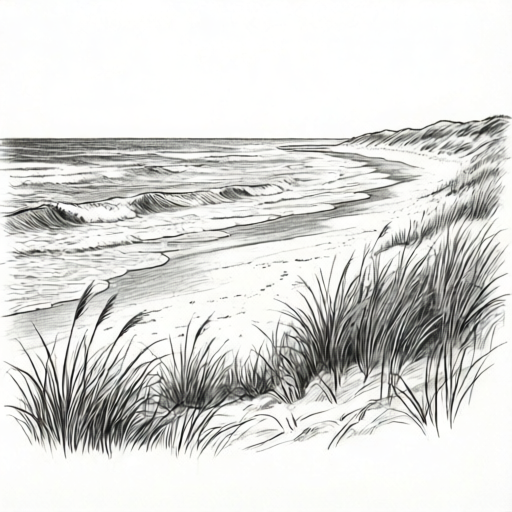
Use the stated measurements and conventions for each exercise.
Set the frame and horizon
Work on a sheet at least 15 cm by 20 cm. Draw a light border 1 cm from each edge to create a composition box. Decide whether the horizon sits high, middle, or low; a low horizon gives more sky, a high horizon gives more beach. Mark the horizon as a faint horizontal line across the box.
Use a 2H pencil for construction lines so they erase cleanly. Keep the horizon level by checking its distance from the top border at both ends with a ruler; the two measurements should match within 2 mm. Label any numerical values you choose as hypothetical examples for your own paper size.
- Draw the border and label the corners lightly.
- Choose a horizon height, for example 6 cm from the top on a 20 cm sheet.
- Measure the horizon height at the left and right edges and adjust until equal.
- Keep construction lines faint and avoid pressing hard.
Curve the shoreline and place wave bands
The shoreline is the boundary between sand and water. Draw it as a gentle curve that enters one side of the box and exits another, never as a straight line. A simple S-curve or a shallow arc both work. Mark three points along the curve and check that the middle point is offset from the straight line between the outer points; this confirms the curve is visible.
Wave bands are parallel-ish curves between the shoreline and the horizon. Place two or three bands, spacing them wider near the horizon and narrower near the shore to suggest distance. Keep band gaps consistent within each zone. Use light strokes and vary pressure slightly to suggest foam without drawing detailed wave anatomy.
- Mark the shoreline entry and exit points on the border.
- Draw a shallow curve through a middle point offset by about 1 cm.
- Add two or three wave bands between shoreline and horizon.
- Check spacing: wider near horizon, narrower near shore.
Add dune grass and tonal shading
Dune grass grows in clumps on the sand side of the shoreline. Draw each clump as a small fan of strokes rising from a base point. Use a convention: strokes lean away from the water, and clump height is about one-third of the distance from shoreline to horizon. Vary stroke length and angle within a clump; this is a convention, not a single correct shape, so alternative lean directions are valid if they read as grass.
Shade sand with light diagonal strokes and water with horizontal strokes. Keep the darkest tone in the foreground sand and the lightest near the horizon. A tonal guide can show three values: light, medium, dark. Check that at least two values appear in the sand and at least two in the water.
- Place three to five grass clumps on the sand side.
- Draw each clump as a fan of five to seven strokes from a base point.
- Shade sand with light diagonal strokes and water with horizontal strokes.
- Check that foreground sand is darker than distant sand.
Worked example
On a 15 cm by 20 cm sheet with a 1 cm border, place a horizon 6 cm from the top, draw a shoreline entering the left border 10 cm from the top and exiting the right border 12 cm from the top with a middle point offset 1 cm, add two wave bands, and place three grass clumps on the sand side. Describe the checks.
Worked answer
Horizon height is 6 cm at both ends, so it is level within 2 mm. Shoreline entry is 10 cm and exit is 12 cm from the top; the middle point sits 1 cm off the straight line, so the curve is visible. Wave bands are spaced wider near the horizon and narrower near the shore. Three grass clumps sit on the sand side, each about one-third of the shoreline-to-horizon distance tall. Sand shows light and medium tones; water shows light and medium tones.
Four practice exercises
Exercise 1
A 20 cm wide sheet has a border 1 cm from each edge. The horizon is 5 cm from the top at the left edge and 7 cm from the top at the right edge. Is the horizon level within 2 mm? Show the difference.
Show answer and check
No. The difference is 7 cm minus 5 cm equals 2 cm, which is 20 mm, far more than 2 mm.
Why: Level check compares the two measured distances. Convert to the same unit: 2 cm equals 20 mm. Since 20 mm is greater than 2 mm, the horizon is not level within the tolerance.
Check: Subtract the smaller measurement from the larger and compare with 2 mm after converting units.
Exercise 2
A shoreline enters the left border 8 cm from the top and exits the right border 8 cm from the top. The middle point is 0.5 cm from the straight line between them. Is the curve visible under the 1 cm offset convention?
Show answer and check
No. The offset is 0.5 cm, which is less than the 1 cm convention, so the curve is too shallow to read clearly.
Why: The convention requires a middle-point offset of about 1 cm to make the curve visible. A 0.5 cm offset is half that value, so the shoreline would look nearly straight.
Check: Compare the measured offset with 1 cm; if it is less, increase the offset and redraw.
Exercise 3
On a sheet where the shoreline-to-horizon distance is 9 cm, a grass clump is drawn 2 cm tall. Does it follow the one-third height convention? Show the arithmetic.
Show answer and check
No. One-third of 9 cm is 3 cm, so a 2 cm clump is shorter than the convention.
Why: The convention sets clump height at about one-third of the shoreline-to-horizon distance. Divide 9 cm by 3 to get 3 cm. The drawn height of 2 cm is below this target.
Check: Divide the shoreline-to-horizon distance by 3 and compare with the clump height; allow small variation but note large differences.
Exercise 4
A drawing has wave bands spaced 3 cm apart near the horizon and 1 cm apart near the shore. Does this match the distance convention? Explain.
Show answer and check
Yes. Wider spacing near the horizon and narrower spacing near the shore matches the convention for suggesting distance.
Why: The convention places wider gaps near the horizon and narrower gaps near the shore. The values 3 cm and 1 cm follow that pattern, so the spacing is consistent with the lesson.
Check: Compare the two spacings: the horizon-side gap should be larger than the shore-side gap.
Common mistakes
- Drawing the shoreline as a straight line. Mark a middle point offset from the straight line between entry and exit, then curve through it.
- Spacing wave bands evenly from shore to horizon. Widen gaps near the horizon and narrow them near the shore to suggest distance.
- Making dune grass clumps identical. Vary stroke length, angle, and clump height within the one-third height convention.
- Pressing hard on construction lines. Use a 2H pencil and light pressure so lines erase without smudging.
Self-check rubric
- Horizon is level within 2 mm at both ends of the composition box.
- Shoreline is a visible curve with a middle point offset from the straight line between entry and exit.
- Two or three wave bands are present with wider spacing near the horizon and narrower spacing near the shore.
- Three to five dune grass clumps appear on the sand side, each following the one-third height convention with varied strokes.
- Sand and water each show at least two tonal values, with darker foreground sand.
- Construction lines are light and erasable; no heavy smudging.
Questions and answers
Must the shoreline curve in one specific direction?
No. Any gentle curve that enters and exits the box is valid. Check that a middle point is visibly offset from the straight line between the ends.
How many wave bands should I draw?
Two or three bands are enough for this lesson. Keep spacing wider near the horizon and narrower near the shore.
Can I use a different pencil grade?
Yes. A 2H is suggested for construction lines, but any light-grade pencil works if you keep pressure low and erase cleanly.
How do I know my horizon is level?
Measure its distance from the top border at both ends. The two measurements should match within 2 mm on your actual paper.