Free original lessons
Draw a Bear: Standing and Roaring Poses with Body Proportions
Learn bear body proportions, standing and roaring poses, and limb placement using simple construction guides and a clear drawing convention.
Free lesson
Four exercises
Worked answers
Object Drawing Lessons
This lesson teaches you to draw a bear in two poses: standing on all fours and roaring with head raised. You will use a simple proportion system based on head lengths, place limbs at consistent anchor points, and apply a defined drawing convention so your work can be checked fairly. The focus is on body structure and pose, not fur texture or habitat scenes. All measurements are hypothetical examples; measure your own paper and tools before drawing.
Practice materials: Printable downloads are not available for this lesson yet. Use the instructions and four exercises below.
Reference illustration
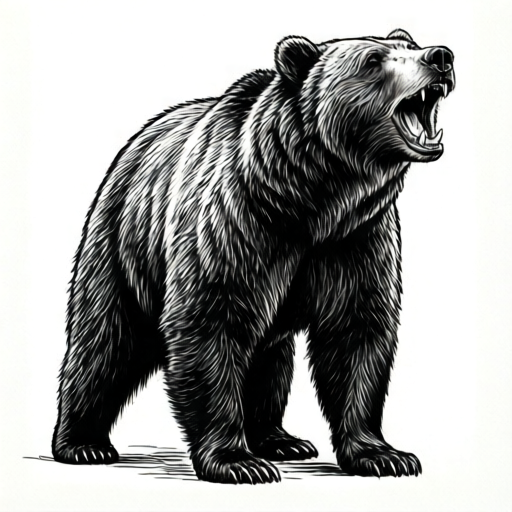
Use the stated measurements and conventions for each exercise.
Body Proportions Using Head Lengths
A bear's body can be planned in head lengths (HL). For a standing side view, the torso from shoulder to hip is about 2 HL long, and the body height at the shoulder is about 1.5 HL. The head is roughly 1 HL long from nose to back of skull. These are hypothetical proportions for practice, not measurements of a real animal.
Use a light construction line for the spine and a second line for the belly. Mark shoulder and hip points first, then build the head and limbs around them. Keep your pencil light so you can adjust before committing to darker lines.
- Draw a horizontal spine line about 2 HL long; mark shoulder at one end and hip at the other.
- Add a belly line below the spine, about 1.5 HL down at the shoulder.
- Sketch the head as an oval about 1 HL long, attached at the shoulder end.
- Place four limb anchors: front limbs under the shoulder, rear limbs under the hip.
- Check that the body length is about twice the head length before adding details.
Standing Pose and Limb Placement
In the standing pose, the bear's weight is spread across four limbs. Front limbs drop nearly straight from the shoulder; rear limbs angle slightly forward from the hip. Each limb is about 1 HL long from anchor to ground. Paws are drawn as rounded rectangles about 0.3 HL wide.
Keep the spine roughly level and the head slightly lower than the shoulder line. This gives a calm, grounded stance. Limb anchors should stay under the body, not spread outward, so the bear looks balanced.
- Mark ground line and place four paw positions: two under the shoulder, two under the hip.
- Draw front limbs as slightly tapered columns from shoulder to paw.
- Draw rear limbs with a gentle forward angle from hip to paw.
- Add a level spine and a head oval at the shoulder end.
- Check that all four paws touch the ground line and limbs stay under the body.
Roaring Pose and Head Lift
For the roaring pose, raise the head above the shoulder line and open the mouth. The neck extends upward, and the front limbs may lift slightly or stay planted. Keep the body length and limb length the same as the standing pose so the bear remains recognizable.
The open mouth is drawn as a wedge shape about 0.4 HL long. The lower jaw drops below the upper jaw line. Ears stay on top of the head oval. Do not change the torso proportions; only the head angle and mouth shape change.
- Start from the standing construction and keep spine and limb anchors unchanged.
- Rotate the head oval upward so the nose points above the shoulder line.
- Add an open mouth wedge below the nose, about 0.4 HL long.
- Keep ears on top of the head oval and check they do not overlap the mouth.
- Confirm body length is still about 2 HL and limbs about 1 HL.
Drawing Convention and Fair Checking
Use this convention: x-height is measured from baseline to midline of lowercase letters in your own handwriting. Draw all guide labels at that x-height so proportions can be compared. Letter styles vary, so accept any legible style as long as the x-height is consistent.
Check proportions by counting head lengths along the spine and comparing limb lengths to the head oval. Valid alternatives include slightly different paw shapes or ear positions, provided the body length, limb length, and pose anchors remain within the stated ranges.
- Write labels at your normal x-height and keep them consistent.
- Measure body length in HL and record the number.
- Measure each limb in HL and record the numbers.
- Compare standing and roaring poses: torso and limb lengths should match.
- Accept any legible letter style if x-height is consistent and proportions fall within ranges.
Worked example
A bear standing side view has a head oval 3 cm long. Using the lesson proportions, find the expected spine length and shoulder height, and state one check.
Worked answer
Spine length is about 2 HL = 6 cm. Shoulder height is about 1.5 HL = 4.5 cm. Check: measure the drawn spine and confirm it is close to 6 cm before adding limbs.
Why: Multiply head length by the proportion factors: 3 cm x 2 = 6 cm for spine, and 3 cm x 1.5 = 4.5 cm for shoulder height. These are hypothetical values for practice.
Check: Use a ruler to measure the spine line and shoulder height on your drawing; compare to 6 cm and 4.5 cm within a small tolerance you choose and record.
Four practice exercises
Exercise 1
A head oval is 4 cm long. Using the lesson proportions, calculate the expected spine length and shoulder height for a standing bear.
Show answer and check
Spine length about 8 cm; shoulder height about 6 cm.
Why: Spine = 2 HL = 2 x 4 cm = 8 cm. Shoulder height = 1.5 HL = 1.5 x 4 cm = 6 cm. Values are hypothetical examples.
Check: Measure your drawn spine and shoulder height with a ruler and compare to 8 cm and 6 cm within a tolerance you record.
Exercise 2
A roaring bear drawing has a spine of 10 cm and a head oval of 5 cm. Is the body length proportion correct? Show the arithmetic.
Show answer and check
Yes, because 10 cm divided by 5 cm equals 2 HL, matching the lesson proportion.
Why: Body length should be about 2 HL. 10 cm / 5 cm = 2, so the proportion is correct.
Check: Re-measure the spine and head oval, divide spine by head length, and confirm the result is close to 2.
Exercise 3
You draw four limbs each 3 cm long for a bear with a 3 cm head oval. State whether limb length matches the lesson proportion and give one placement check.
Show answer and check
Limb length is about 1 HL, which matches. Placement check: each paw should sit near the ground line under the shoulder or hip anchor.
Why: Limb length should be about 1 HL. 3 cm / 3 cm = 1 HL. Placement is checked by confirming anchors stay under the body.
Check: Measure each limb and divide by head length; then verify paw positions relative to shoulder and hip marks.
Exercise 4
In a roaring pose, the mouth wedge is drawn 2 cm long for a 5 cm head oval. Calculate the mouth-to-head ratio and state whether it is close to the lesson value of 0.4 HL.
Show answer and check
Ratio is 2 cm / 5 cm = 0.4 HL, which matches the lesson value.
Why: Divide mouth length by head length: 2 / 5 = 0.4. The lesson suggests about 0.4 HL for the open mouth wedge.
Check: Measure the mouth wedge and head oval, divide mouth by head, and confirm the result is close to 0.4.
Common mistakes
- Making the head too large relative to the body. Measure the head oval and the spine; adjust until the spine is about twice the head length.
- Spreading limbs outward so the bear looks unstable. Keep limb anchors under the shoulder and hip; check paws sit near the ground line.
- Changing torso length in the roaring pose. Keep the same spine length and limb anchors; only rotate the head and open the mouth.
- Using inconsistent label sizes that make proportion checks unreliable. Write all labels at the same x-height from baseline to midline and recheck measurements.
Self-check rubric
- Body length is about 2 HL and shoulder height about 1.5 HL in both poses.
- Head oval is about 1 HL long and attached at the shoulder end.
- Four limb anchors sit under shoulder and hip; limbs are about 1 HL long.
- Standing pose has a level spine and all paws near the ground line.
- Roaring pose raises the head above the shoulder line and opens the mouth about 0.4 HL.
- Labels use a consistent x-height from baseline to midline; any legible letter style is accepted.
- Valid alternatives in paw shape or ear position are allowed if proportions and anchors stay within ranges.
Questions and answers
Do I need to draw fur texture?
No. This lesson focuses on body proportions, pose, and limb placement. Fur texture is outside the boundary.
Can I use different paw shapes?
Yes, as long as limb length and anchor positions stay within the stated ranges. Valid alternatives are accepted.
What does x-height mean here?
It is the distance from the baseline to the midline of lowercase letters in your own handwriting. Keep it consistent for all labels.
Are the proportions real bear measurements?
No. They are hypothetical practice values. Measure your own paper and tools before drawing.