Free original lessons
Hare Drawing Easy: Ear, Hind-Leg and Body Proportions
Learn to draw a hare with long ears, powerful hind legs and balanced body proportions using simple ratio guides and a clear construction order.
Free lesson
Four exercises
Worked answers
Object Drawing Lessons
Hares look different from rabbits mainly because of proportion: very long ears, a leaner body and dramatically powerful hind legs. This lesson gives you a repeatable construction method. You will measure ear length against body length, build the hind leg from clear joint landmarks, and shape the body mass so the hare reads as a hare rather than a generic mammal. All measurements are relative, so the drawing works at any size. Use a pencil and paper; a ruler helps for the first few attempts but is not required. The convention for judging proportions is defined below so that different drawing styles can still be checked fairly.
Practice materials: Printable downloads are not available for this lesson yet. Use the instructions and four exercises below.
Reference illustration
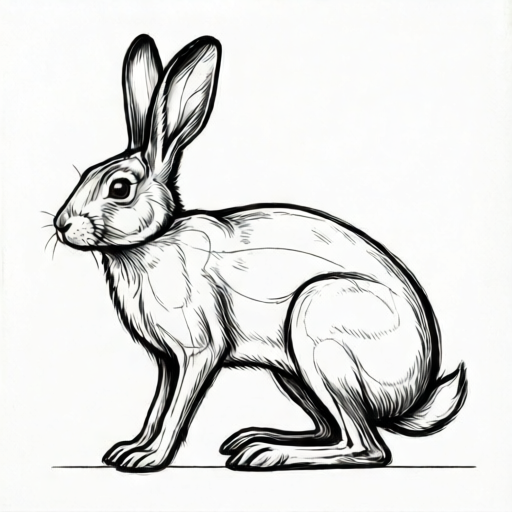
Use the stated measurements and conventions for each exercise.
Set the proportion convention before drawing
Proportion checks need a defined convention because letter styles and drawing styles vary. For this lesson, body length is measured from the base of the neck (where the neck meets the chest) to the base of the tail along the spine, following the body curve. Ear length is measured from the ear base at the skull to the ear tip along the ear's centerline. Hind-leg length is measured from the hip joint to the ground contact point of the foot. These are drawing conventions, not biological standards.
A useful starting ratio for a side-view hare is ear length roughly equal to body length, and hind-leg length roughly three-quarters of body length. Treat these as hypothetical example values for practice, not fixed rules. Measure your own drawing with the same convention each time so comparisons are meaningful.
- Draw a light horizontal ground line.
- Mark a body-length segment along the spine curve from neck base to tail base.
- Mark an ear-length segment from ear base to ear tip and compare it to the body segment.
- Mark a hind-leg segment from hip joint to ground contact and compare it to the body segment.
Build the hind leg from joint landmarks
The hind leg is the most distinctive hare feature. Construct it as a zigzag of three segments: thigh from hip to knee, lower leg from knee to hock, and foot from hock to ground. The knee sits forward and high; the hock sits back and low. This creates the folded, spring-loaded look.
Keep the foot roughly horizontal at ground contact. The thigh should be visibly thicker than the lower leg. If the leg looks like a straight column, the hare will read as a generic mammal.
- Place the hip joint on the body mass near the rear third.
- Draw the thigh forward and down to the knee.
- Draw the lower leg back and down to the hock.
- Draw the foot forward to the ground contact point.
- Check that the knee is forward of the hock and the foot is near horizontal.
Shape the body mass and head
The hare body is lean and wedge-like: deeper at the chest, narrower at the hips, with a gentle curve along the back. Draw the chest as a rounded wedge and the rear as a smaller rounded mass. The neck is short and thick.
The head is elongated with a slight wedge toward the nose. Place the eyes high and on the sides, and keep the muzzle short. Long ears rise from the top of the skull, angled slightly back. Ear width should be narrow relative to length.
- Draw a chest wedge and a smaller rear mass.
- Connect them with a curved back line and a slightly straighter belly line.
- Add a short thick neck and an elongated head.
- Attach the ears at the skull top, angled slightly back.
- Refine the outline only after proportions check out.
Check and refine
Before adding detail, run three checks: ear-to-body ratio, hind-leg joint order, and body taper. Adjust with light erasing rather than redrawing from scratch. Valid alternatives include slightly shorter ears or a more upright pose, as long as the hind-leg zigzag and lean body remain clear.
Use the rubric below to score your drawing. The rubric allows stylistic variation while still checking hare-specific features.
- Compare ear length to body length using the convention.
- Confirm knee is forward of hock and foot is near horizontal.
- Confirm the body is deeper at the chest than at the hips.
- Score each rubric item from 0 to 2.
Worked example
A side-view hare drawing has body length 8 cm, ear length 7 cm and hind-leg length 6 cm. Using the convention, evaluate the proportions and state one adjustment.
Worked answer
Ear-to-body ratio is 7/8 = 0.875, close to the practice target of 1.0. Hind-leg-to-body ratio is 6/8 = 0.75, matching the practice target. One reasonable adjustment is to lengthen the ears slightly to reach about 8 cm, or accept 7 cm as a valid stylistic alternative.
Why: Both ratios are computed with the defined convention. The ear ratio is slightly under target but within a valid alternative range; the hind-leg ratio matches. The adjustment is optional and checkable by re-measuring.
Check: Re-measure ear base to tip and body neck base to tail base along the curve; divide ear by body and compare to 1.0.
Four practice exercises
Exercise 1
A side-view hare has body length 10 cm and ear length 6 cm. Using the convention, compute the ear-to-body ratio and state whether it meets the practice target of 1.0.
Show answer and check
Ratio is 6/10 = 0.6, which is below the practice target of 1.0. The ears should be lengthened for a closer match, or the drawing accepted as a valid alternative only if the hare-specific long-ear feature remains clear.
Why: Divide ear length by body length using the defined convention. 0.6 is well under 1.0, so the ears are short relative to the body.
Check: Re-measure both segments and divide; confirm the result is 0.6.
Exercise 2
A hind leg is drawn with hip at the top, knee forward and high, hock back and low, and foot pointing up. Identify the error and describe the corrected construction.
Show answer and check
The knee and hock heights are correct, but the foot should be near horizontal at ground contact, not pointing up. Correct by rotating the foot down to horizontal while keeping the knee forward and high and the hock back and low.
Why: The hare hind leg is a zigzag: thigh down-forward to knee, lower leg down-back to hock, foot forward to ground. The described drawing has the correct joint order and heights, but the upward-pointing foot breaks ground contact and the spring-loaded look.
Check: Check that knee is higher than hock and that the foot is within about 10 degrees of horizontal.
Exercise 3
A body is drawn as a circle of diameter 6 cm with no taper. Using the convention, describe how to reshape it so the chest is deeper than the hips, and give one checkable measurement.
Show answer and check
Replace the circle with a wedge: chest depth about 6 cm and hip depth about 4 cm, connected by a curved back and a slightly straighter belly. Check that chest depth minus hip depth is about 2 cm.
Why: The hare body tapers from a deeper chest to narrower hips. A uniform circle fails the taper check. The 6 cm and 4 cm values are hypothetical examples.
Check: Measure vertical depth at the chest and at the hips; confirm chest depth is greater and the difference is about 2 cm.
Exercise 4
A drawing has ear length 9 cm, body length 8 cm and hind-leg length 5 cm. Compute both ratios, state which is furthest from the practice targets, and give one adjustment.
Show answer and check
Ear-to-body ratio is 9/8 = 1.125; hind-leg-to-body ratio is 5/8 = 0.625. Both are 0.125 from their targets (ear target 1.0, hind-leg target 0.75), so neither is furthest. One adjustment: lengthen the hind leg to about 6 cm so the ratio becomes 0.75, or shorten the ears toward 8 cm; either change is checkable by re-measuring.
Why: Compute each ratio with the convention. Ear deviation is 1.125 - 1.0 = 0.125; hind-leg deviation is 0.75 - 0.625 = 0.125. The deviations are equal, so the prompt's premise that one is furthest is not satisfied; state that both are equally distant and justify with the arithmetic.
Check: Re-measure all three segments, recompute both ratios, and confirm the chosen adjustment changes the ratio toward the target.
Common mistakes
- Drawing short rabbit-like ears. Measure ear length against body length using the convention; lengthen ears until the ratio is close to the practice target.
- Making the hind leg a straight column. Rebuild the leg as thigh, lower leg and foot with the knee forward and the hock back.
- Making the body uniformly round. Taper the body so the chest is deeper than the hips and the back curves gently.
- Placing ears too far forward on the skull. Attach ears at the top of the skull, angled slightly back.
Self-check rubric
- Ear length is close to body length under the convention (0-2).
- Hind leg shows thigh, lower leg and foot with knee forward of hock (0-2).
- Body tapers from deeper chest to narrower hips (0-2).
- Ears attach at skull top and angle slightly back (0-2).
- Overall drawing reads clearly as a hare rather than a generic mammal (0-2).
Questions and answers
How long should the ears be?
Using this lesson's convention, aim for ear length roughly equal to body length. This is a hypothetical practice value, not a biological rule.
Why does my hare look like a rabbit?
Usually the ears are too short or the hind legs are too straight. Check both against the convention and rebuild the leg zigzag.
Can I draw a front view?
Yes, but proportion checks are easier in side view. For front view, keep ears long and narrow and show the hind-leg fold at the sides.
Do I need a ruler?
No. A ruler helps early attempts, but you can compare segments by eye once the convention is clear.