Free original lessons
Raven Head Drawing: Beak Wedge, Eye Placement, and Head Angles
Learn to draw a raven head by building a beak wedge, placing the eye accurately, and practicing side and three-quarter views on a grid.
Free lesson
Four exercises
Worked answers
Object Drawing Lessons
This lesson teaches a repeatable method for drawing a raven head with a clear beak wedge and correctly placed eye. You will work from simple construction lines rather than copying a finished picture. The method separates the skull mass, the beak wedge, and the eye position so each can be checked independently. You will practice side and three-quarter views, then compare your drawing against a short rubric. All measurements are hypothetical examples; measure your own paper and tools before drawing. The convention for eye placement is defined below so that valid stylistic alternatives are still accepted.
Practice materials: Printable downloads are not available for this lesson yet. Use the instructions and four exercises below.
Reference illustration
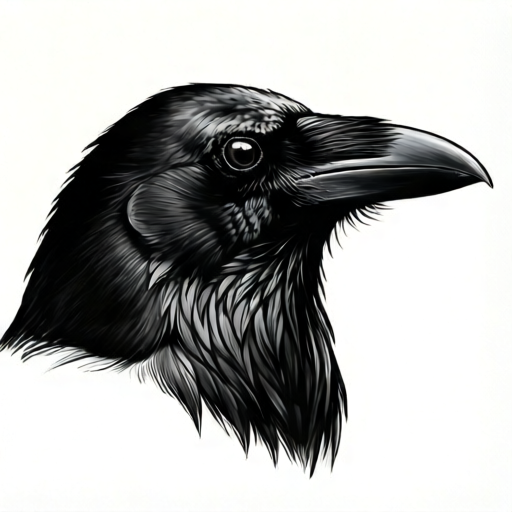
Use the stated measurements and conventions for each exercise.
Building the Skull and Beak Wedge
Start with a light oval for the skull. For a side view, make the oval about twice as long as it is tall. Mark a horizontal midline through the oval; this is your reference for the eye and beak base. The beak attaches at the front of the oval, roughly at the midline. Draw the beak as a wedge: a narrow triangle whose base sits against the skull and whose tip points forward. The upper edge of the wedge should slope slightly downward, and the lower edge should be nearly straight. Keep the wedge shorter than the skull oval in side view; a common beginner error is an overlong beak.
Define the eye position using the midline and a vertical guide. Place the eye center in the front third of the skull, measured from the front edge of the oval; the front-third boundary is inclusive, so an eye center exactly one-third of the skull length back is acceptable (a hypothetical example for practice). Place the eye center above the midline by about one-quarter of the eye diameter (also hypothetical). The eye is small relative to the skull. Draw a circle for the eye, then add a smaller circle inside for the pupil. The pupil should sit slightly forward within the eye, not centered. This forward bias gives the raven a focused look. For the gap check, measure from the near eye edge to the front edge of the skull oval, which is where the beak base sits. Check that this gap is between one-half and one-and-a-half eye diameters, inclusive; a gap above one-and-a-half eye diameters fails and should be corrected by moving the eye forward.
- Draw a light oval for the skull, twice as long as tall for a side view.
- Mark a horizontal midline through the oval.
- Attach a wedge-shaped beak at the front, base against the skull, tip forward.
- Place the eye center about one-third of the skull length back from the front (hypothetical example), just above the midline by about one-quarter of the eye diameter.
- Add a pupil slightly forward inside the eye circle.
- Check the gap between eye and beak base against the eye diameter.
Eye Placement Convention and Valid Alternatives
The convention for this lesson is: eye center sits above the midline by about one-quarter of the eye diameter, and the pupil is offset forward by about one-fifth of the eye diameter. These are hypothetical proportions for practice, not universal rules. Raven head styles vary: some drawings use a larger eye, a rounder skull, or a more curved beak. Any alternative is valid if it keeps the eye within the front third of the skull, keeps the pupil inside the eye circle, and preserves a clear gap between eye and beak base. The rubric rewards consistent internal proportions rather than a single exact shape.
When drawing a three-quarter view, the far eye may be partly hidden by the beak or skull. Place the near eye using the same front-third rule, then place the far eye slightly higher and smaller to suggest rotation. The beak wedge shortens and tilts toward the viewer. Do not force both eyes to be fully visible; partial occlusion is correct for a turned head. Check that the beak base still meets the skull at the midline and that the near eye does not overlap the beak base.
- Mark the midline and front third of the skull.
- Place the near eye above the midline by one-quarter of its diameter.
- Offset the pupil forward by one-fifth of the eye diameter.
- For three-quarter view, shorten the beak wedge and tilt it toward the viewer.
- Place the far eye smaller and slightly higher, allowing partial occlusion.
- Verify the near eye does not overlap the beak base.
Checking Angles and Proportions
Use a simple arithmetic check after each drawing. Measure the skull length and beak length in the same units, such as millimeters on your paper. For side view, the beak length should be between one-half and two-thirds of the skull length. If your beak is longer than two-thirds of the skull, shorten it. Measure the eye diameter and the gap from eye edge to beak base; the gap should be between one-half and one-and-a-half eye diameters. These ranges are hypothetical examples for practice, not standards.
For head-angle variants, compare the near eye and far eye. In a three-quarter view, the far eye should appear smaller than the near eye by roughly one-fifth to one-third. If both eyes are the same size, the head looks flat. Also check that the beak tip points in the direction of the turn. A raven looking left should have the beak tip left of the skull center. Keep all measurements in the same units and record them lightly beside the drawing so you can compare attempts.
- Measure skull length and beak length in the same units.
- Confirm beak length is between one-half and two-thirds of skull length for side view.
- Measure eye diameter and gap to beak base; confirm gap is between one-half and one-and-a-half eye diameters.
- In three-quarter view, confirm far eye is smaller than near eye by about one-fifth to one-third.
- Confirm beak tip points in the direction of the head turn.
- Record measurements beside the drawing for comparison.
Worked example
Draw a raven head in side view facing right. Use a skull oval 60 mm long and 30 mm tall. Place the beak wedge with a base at the front midline and a length of 35 mm. Place the eye center 20 mm back from the front edge and 2 mm above the midline. Use an eye diameter of 8 mm and offset the pupil forward by 1.6 mm. Check the proportions.
Worked answer
The beak length is 35 mm, which is between one-half (30 mm) and two-thirds (40 mm) of the 60 mm skull, so it passes. The eye center is 20 mm back, which is exactly at the front-third boundary (20 mm), so it is acceptable, and it sits 2 mm above the midline, which is one-quarter of the 8 mm eye diameter. The eye radius is 4 mm, so the eye edge nearest the beak is at 20 − 4 = 16 mm from the front, giving a gap of 16 mm, which is two eye diameters. This is above the suggested range of one-half to one-and-a-half eye diameters, so move the eye forward by 4 mm. The eye center then sits 16 mm back, the near eye edge is at 12 mm, and the gap is 12 mm, or one-and-a-half eye diameters. The pupil offset of 1.6 mm is one-fifth of the eye diameter, matching the convention. Final check: beak length 35 mm, skull 60 mm, eye gap 12 mm, pupil offset 1.6 mm.
Four practice exercises
Exercise 1
Side view facing left. Skull oval 50 mm long, 25 mm tall. Beak wedge length 30 mm. Eye center 15 mm back from the front edge, 1.75 mm above midline. Eye diameter 7 mm. Pupil offset forward 1.4 mm. Check beak length and eye gap.
Show answer and check
Beak length 30 mm is between one-half (25 mm) and two-thirds (about 33.3 mm) of skull length, so it passes. Eye center is 15 mm back, within the front third (about 16.7 mm). Eye radius is 3.5 mm, so the eye edge nearest the beak is at 15 − 3.5 = 11.5 mm from the front, giving a gap of about 11.5 mm, or about 1.6 eye diameters. This exceeds the one-and-a-half-eye-diameter upper limit (10.5 mm), so the eye gap fails and must be corrected. Move the eye forward by 2 mm: the eye center becomes 13 mm back, the edge is at 9.5 mm, and the gap is about 9.5 mm, or about 1.4 eye diameters, which is within range. Pupil offset 1.4 mm is exactly one-fifth of 7 mm, so it passes. The eye sits 1.75 mm above the midline, which is one-quarter of the 7 mm eye diameter.
Why: Use the same-unit checks: beak length relative to skull, eye position in front third, gap relative to eye diameter, and pupil offset relative to eye diameter. Adjust only the eye position to bring the gap into range.
Check: Measure skull, beak, eye diameter, and gap with a ruler in millimeters. Confirm beak is between 25 and about 33.3 mm, eye center is within about 16.7 mm of the front, gap is between 3.5 and 10.5 mm, pupil offset is about 1.4 mm (one-fifth of 7 mm), and eye height above midline is about 1.75 mm (one-quarter of 7 mm).
Exercise 2
Three-quarter view facing right. Skull oval 60 mm long, 30 mm tall. Near eye diameter 8 mm, far eye diameter 6 mm. Near eye center 20 mm back from front, 2 mm above midline. Beak wedge length 30 mm, tilted right. Check far-eye size, near-eye height, and beak direction.
Show answer and check
Far eye is 6 mm versus near eye 8 mm, a reduction of 2 mm, which is one-quarter of the near eye diameter; this is within the one-fifth to one-third range, so it passes. Beak length 30 mm is one-half of skull length, within the one-half to two-thirds range. Beak tip points right, matching the head turn. Near eye is 20 mm back, exactly at the front-third boundary, which is acceptable because the boundary is inclusive. Near eye height is 2 mm above midline, one-quarter of the 8 mm eye diameter, matching the convention. The drawing passes the angle and proportion checks.
Why: Compare far eye to near eye as a fraction, check beak length against skull length, and confirm beak tip direction matches the turn. Keep all measurements in millimeters.
Check: Measure near and far eye diameters; confirm far eye is smaller by about one-fifth to one-third. Measure beak length and skull length; confirm beak is between 30 and 40 mm. Confirm beak tip is right of skull center.
Exercise 3
Side view facing right. Skull oval 40 mm long, 20 mm tall. Beak wedge length 28 mm. Eye center 10 mm back from front, 3 mm above midline. Eye diameter 6 mm. Pupil centered. Identify two errors and state fixes.
Show answer and check
Error one: beak length 28 mm is more than two-thirds of skull length (about 26.67 mm), so the beak is too long; shorten it to about 22 mm, which is within the one-half to two-thirds range (20–26.67 mm). Error two: pupil is centered; offset it forward by about 1.2 mm, which is one-fifth of the 6 mm eye diameter. The eye center at 10 mm back is within the front third (about 13.3 mm), so that is acceptable. After fixes, the eye radius is 3 mm, so the eye edge nearest the beak is at 10 − 3 = 7 mm from the front, giving a gap of 7 mm, which is within the one-half to one-and-a-half eye diameter range (3–9 mm).
Why: Use the beak-length range and the pupil-offset convention. The eye position is already within the front third, so only beak length and pupil offset need correction.
Check: Measure beak and skull; confirm beak is between 20 and about 26.67 mm after shortening. Measure pupil offset; confirm it is about 1.2 mm forward. Measure eye gap; confirm it is 7 mm, within the 3–9 mm range.
Exercise 4
Three-quarter view facing left. Skull oval 50 mm long, 25 mm tall. Near eye diameter 7 mm, far eye diameter 7 mm. Near eye center 15 mm back from front, 1.75 mm above midline. Beak wedge length 25 mm, tilted left. Identify the errors and state fixes, then give a final check.
Show answer and check
Error one: far eye is the same size as the near eye, which makes the head look flat. Reduce the far eye to about 5.5 mm, a reduction of about one-fifth of the near eye diameter. Error two: the near eye is too far back for the gap range. With eye center 15 mm back and eye radius 3.5 mm, the eye edge is at 15 − 3.5 = 11.5 mm from the front, giving a gap of 11.5 mm, which exceeds the upper limit of 10.5 mm (one-and-a-half eye diameters). Move the near eye forward to 14 mm back, giving a gap of exactly 10.5 mm, which is at the upper boundary and acceptable because the range is inclusive. Beak length 25 mm is one-half of skull length, within range. Beak tip points left, matching the turn. Final check: far eye about 5.5 mm, near eye 7 mm, beak 25 mm, skull 50 mm, near eye gap 10.5 mm.
Why: Two errors: equal eye sizes in a turned view, and a near-eye gap of 11.5 mm exceeding the 10.5 mm upper limit. Apply the far-eye reduction rule and move the near eye forward to 14 mm back (gap 10.5 mm), then verify beak length and direction with measurements.
Check: Measure both eyes; confirm far eye is smaller by about one-fifth to one-third. Measure beak and skull; confirm beak is between 25 and 33 mm. Confirm beak tip is left of skull center. Measure the near eye gap; confirm it is 10.5 mm or less, within the 3.5–10.5 mm range.
Common mistakes
- Drawing the beak as a long thin triangle that extends far beyond the skull. Shorten the wedge so its length is between one-half and two-thirds of the skull length in side view.
- Placing the eye in the center of the skull oval. Move the eye forward to the front third of the skull, just above the midline.
- Centering the pupil inside the eye circle. Offset the pupil forward by about one-fifth of the eye diameter to create focus.
- Making both eyes the same size in a three-quarter view. Reduce the far eye by about one-fifth to one-third and allow partial occlusion.
- Letting the near eye overlap the beak base. Shift the eye back slightly or narrow the beak base so a clear gap remains.
Self-check rubric
- Skull oval is clearly longer than tall in side view.
- Beak wedge attaches at the front midline with a clear base.
- Beak length is between one-half and two-thirds of skull length in side view.
- Eye center sits in the front third of the skull and above the midline.
- Pupil is offset forward inside the eye circle.
- Gap between eye edge and beak base is between one-half and one-and-a-half eye diameters.
- Three-quarter view shows a smaller far eye and a shortened, tilted beak wedge.
- Beak tip points in the direction of the head turn.
- Measurements are recorded in consistent units.
- Valid stylistic alternatives are accepted if internal proportions remain consistent.
Questions and answers
Do I need to use exact measurements?
No. The numerical ranges are hypothetical examples for practice. Measure your own paper and keep units consistent, but treat the ranges as guides rather than fixed rules.
Can I draw a larger eye or a rounder skull?
Yes. The convention allows valid alternatives. Keep the eye in the front third, the pupil inside the eye circle, and a clear gap between eye and beak base.
How do I know the three-quarter view is correct?
Check that the far eye is smaller than the near eye, the beak wedge is shortened and tilted, and the beak tip points in the direction of the turn.
What if my beak looks too heavy?
Narrow the wedge base and check that the upper edge slopes gently downward. Compare beak length to skull length using the same units.