Free original lessons
Draw a Silly Cat: Exaggerated Expression and Wonky Pose
Learn a comic silly-cat drawing method using exaggerated eyes, a wonky body pose, and clear expression choices, with practice tasks and a simple rubric.
Free lesson
Four exercises
Worked answers
Object Drawing Lessons
This lesson teaches a repeatable way to draw a silly cat that reads as comic rather than realistic. You will exaggerate the eyes, tilt and stretch the body into a wonky pose, and choose facial features that push one clear expression. The method uses simple shapes and a defined convention for judging proportions: x-height is measured from the baseline to the midline of a letter, and letter styles vary, so the rubric accepts valid alternatives rather than one universal answer. All measurements are checkable with a ruler or by counting grid squares. Any numerical values given here are hypothetical examples for practice, not manufacturing standards. Work on plain paper or a printed grid; no special equipment is required.
Practice materials: Printable downloads are not available for this lesson yet. Use the instructions and four exercises below.
Reference illustration
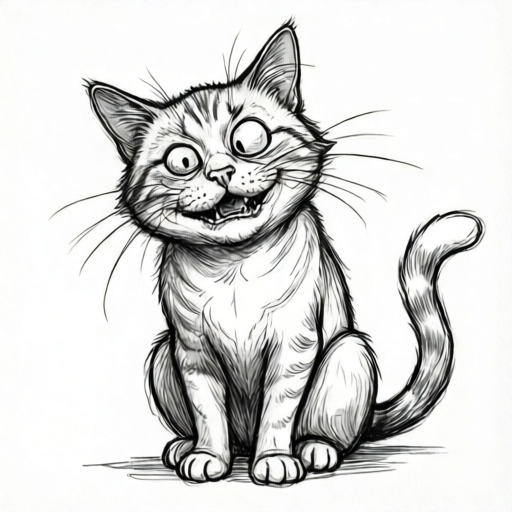
Use the stated measurements and conventions for each exercise.
Build the wonky pose from three simple shapes
Start with a body shape that is deliberately off-balance. Draw a large oval for the torso, then tilt its long axis by about 20 degrees from vertical as a hypothetical example. Add a smaller circle for the head, placed so it overlaps one side of the torso rather than sitting centered. This offset creates the wonky feel immediately.
Next, add two leg shapes as bent rectangles or tapered ovals. Make one leg longer than the other by roughly one grid square, and bend the knees in opposite directions. The asymmetry is the point: a cat that stands perfectly level looks realistic, not silly.
Finally, add a tail that curves in an S shape and crosses the body outline. Keep the tail thick enough to read at a glance. Check the pose by asking whether the silhouette would still look unbalanced if you covered the face; if yes, the wonky pose is working.
- Draw a tilted torso oval about 6 grid squares tall and 4 wide.
- Place a head circle overlapping the upper third of the torso, offset to one side.
- Add two bent legs of unequal length, with knees pointing different ways.
- Draw an S-curve tail that crosses the torso outline.
- Check that the silhouette looks off-balance before adding the face.
Exaggerate the eyes and choose one expression
Comic cat eyes work best when they are much larger than realistic proportions. Draw each eye as a shape that fills roughly one third of the head height, using a hypothetical example of 3 grid squares in a 9-square head. Make the two eyes different shapes: one round and one squinted, or one tall oval and one wide oval. This mismatch adds silliness without losing readability.
Choose one expression and commit to it. For a surprised cat, draw very large circles with small pupils and raise the eyebrows high above the eyes. For a grumpy cat, use half-closed lids and angled eyebrows pointing down toward the nose. For a dizzy cat, draw spiral or crossed pupils and tilt the mouth to one side.
Keep the mouth and whiskers simple. A wide open mouth with a visible tongue reads as comic; three or four whiskers per side are enough. Check the expression by covering the body and asking whether the face alone communicates the chosen emotion.
- Draw two eye shapes that differ from each other and fill about one third of the head height.
- Add pupils sized to match the chosen expression.
- Place eyebrows above the eyes at an angle that supports the expression.
- Draw a simple mouth and three or four whiskers per side.
- Cover the body and check that the face alone reads as the intended expression.
Use a grid to keep proportions checkable
A square grid makes proportions easy to check without claiming any printer tolerance. Draw or print a grid with squares of any convenient size, for example 1 cm squares as a hypothetical example, and measure your actual paper to confirm the grid is even. Count squares rather than estimating distances.
Use the grid to compare the head, torso, and legs. If the head is 3 squares tall and the torso is 6 squares tall, the head-to-body ratio is 1:2, which is a useful comic proportion. Check that the longer leg exceeds the shorter leg by at least one square; if not, increase the difference.
The grid also helps with the x-height convention. When you add any lettering or labels to your drawing, measure x-height from the baseline to the midline of a lowercase letter. Letter styles vary, so accept any consistent measurement within your own drawing rather than forcing one universal size.
- Measure your actual grid squares and confirm they are even.
- Count squares for head height and torso height and record the ratio.
- Compare leg lengths in squares and confirm a difference of at least one square.
- Measure x-height from baseline to midline for any lettering.
- Recheck all counts before finalizing the drawing.
Refine the silhouette and add comic details
Once the pose and face are in place, thicken the outline slightly to make the silhouette read clearly. Add two or three comic details such as a lopsided collar, a small hat, or a patch of fur sticking up. Keep details away from the eyes so the expression stays the focus.
Check the drawing by viewing it from a short distance. If the wonky pose and exaggerated eyes are still obvious, the drawing is working. If the cat looks balanced and calm, increase the tilt of the torso or enlarge one eye by one grid square.
Finish by erasing construction lines and confirming that every measurement you used is consistent in the same units. The rubric below accepts valid alternatives, so a different eye shape or pose direction can still score well if the exaggeration and expression are clear.
- Thicken the outline to clarify the silhouette.
- Add two or three comic details away from the eyes.
- View from a short distance and check that the pose and expression read clearly.
- Adjust tilt or eye size by one grid square if the drawing looks too balanced.
- Erase construction lines and confirm consistent units.
Worked example
Draw a surprised silly cat on a grid. Use a head 3 squares tall, a torso 6 squares tall tilted 20 degrees, one leg 4 squares and one leg 3 squares, and eyes each 1 square tall with small pupils.
Worked answer
The drawing shows a tilted torso oval 6 squares tall, a head circle 3 squares tall offset to the left, two bent legs of 4 and 3 squares, and an S-curve tail crossing the body. Each eye is 1 square tall, one round and one tall oval, with small pupils and raised eyebrows. The mouth is wide open with a small tongue. The silhouette looks off-balance and the face alone reads as surprised.
Four practice exercises
Exercise 1
Draw a grumpy silly cat on a grid. Use a head 3 squares tall, a torso 6 squares tall tilted 15 degrees, legs of 4 and 3 squares, and half-closed eyes with angled eyebrows.
Show answer and check
A tilted torso oval 6 squares tall, a head circle 3 squares tall offset to one side, bent legs of 4 and 3 squares, and an S-curve tail. The eyes are half-closed slits, the eyebrows angle down toward the nose, and the mouth is a small frown.
Why: The unequal legs and tilted torso create the wonky pose, while the half-closed eyes and downward eyebrows communicate grumpiness without extra details.
Check: Count grid squares to confirm the 3:6 head-to-torso ratio and the one-square leg difference. Cover the body and confirm the face alone reads as grumpy.
Exercise 2
Draw a dizzy silly cat on a grid. Use a head 4 squares tall, a torso 8 squares tall tilted 25 degrees, legs of 5 and 3 squares, and spiral pupils in eyes each 1 square tall.
Show answer and check
A strongly tilted torso oval 8 squares tall, a head circle 4 squares tall offset to the right, bent legs of 5 and 3 squares, and a tail curling over the back. Each eye is 1 square tall with a spiral pupil, and the mouth tilts to one side.
Why: The larger tilt and two-square leg difference increase the wonky feel, while spiral pupils and a tilted mouth signal dizziness.
Check: Count squares to confirm the 4:8 ratio and the two-square leg difference. Check that each eye is 1 square tall and that the spiral pupils are visible from a short distance.
Exercise 3
Draw a surprised silly cat on a grid. Use a head 3 squares tall, a torso 6 squares tall tilted 20 degrees, legs of 4 and 3 squares, and eyes each 1 square tall with small pupils and raised eyebrows.
Show answer and check
A tilted torso oval 6 squares tall, a head circle 3 squares tall offset to the left, bent legs of 4 and 3 squares, and an S-curve tail. Each eye is 1 square tall with a small pupil, the eyebrows are raised high, and the mouth is wide open.
Why: Small pupils and raised eyebrows are strong surprise signals, and the mismatched leg lengths keep the pose wonky.
Check: Count squares for the 3:6 ratio and the one-square leg difference. Cover the body and confirm the face alone reads as surprised.
Exercise 4
Draw a sleepy silly cat on a grid. Use a head 3 squares tall, a torso 6 squares tall tilted 10 degrees, legs of 4 and 3 squares, and eyes drawn as flat lines with one eye 1 square wide and the other half a square wide.
Show answer and check
A slightly tilted torso oval 6 squares tall, a head circle 3 squares tall offset to one side, bent legs of 4 and 3 squares, and a tail drooping downward. The eyes are flat lines of different widths, and the mouth is a small open oval.
Why: Flat-line eyes read as sleepiness, and the unequal eye widths add silliness while the leg difference keeps the pose wonky.
Check: Count squares for the 3:6 ratio and the one-square leg difference. Measure the two eye widths in grid squares and confirm they differ. Cover the body and confirm the face alone reads as sleepy.
Common mistakes
- Making both eyes the same shape and size. Change one eye to a different shape or size so the pair is mismatched but still readable.
- Keeping the torso vertical and the legs equal. Tilt the torso by about 20 degrees and make one leg at least one grid square longer.
- Adding many details that hide the expression. Limit comic details to two or three and keep them away from the eyes and mouth.
- Mixing measurement units when checking proportions. Choose one unit, such as grid squares, and record every measurement in that unit.
Self-check rubric
- Wonky pose: torso tilted and legs unequal by at least one grid square.
- Exaggerated eyes: each eye fills roughly one third of head height and the two eyes differ in shape or size.
- Clear expression: face alone communicates one chosen emotion.
- Readable silhouette: outline is clear and comic details do not hide the expression.
- Consistent measurement: all proportions checked in one unit, with x-height measured baseline to midline where lettering appears.
- Valid alternatives accepted: different eye shapes, pose directions, or detail choices score well if exaggeration and expression remain clear.
Questions and answers
Do I need to draw a realistic cat first?
No. This lesson starts from simple shapes and deliberately exaggerates them. Realistic anatomy is outside the scope.
How large should the eyes be?
A useful hypothetical example is one third of the head height, but any size that clearly reads as exaggerated is acceptable under the rubric.
What does x-height mean here?
X-height is the distance from the baseline to the midline of a lowercase letter. Letter styles vary, so measure consistently within your own drawing.
Can I use a different pose direction?
Yes. The rubric accepts valid alternatives as long as the pose is clearly wonky and the expression is readable.