Free original lessons
Draw a Singing Person: Open-Mouth Shape and Posture Construction
Learn to construct a singing figure with a tilted head, open-mouth shape, and expressive torso posture using simple guides and two intensity levels.
Free lesson
Four exercises
Worked answers
Object Drawing Lessons
This lesson teaches a repeatable construction for a singing person: a tilted head, an open-mouth shape that reads clearly, and a torso posture that supports the voice. You will use a defined drawing convention, measure your own paper and pencil, and practice at two singing intensities. The focus is on the figure's gesture and mouth shape, not on portrait feature placement or instruments. All measurements are hypothetical examples; measure your actual equipment before drawing.
Practice materials: Printable downloads are not available for this lesson yet. Use the instructions and four exercises below.
Reference illustration
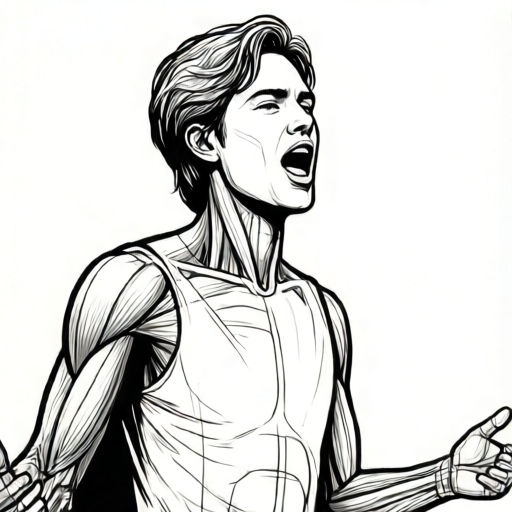
Use the stated measurements and conventions for each exercise.
Set Up a Checkable Drawing Space
Choose a sheet of paper and a pencil. Measure the paper's width and height in centimetres and write the values at the top corner. Measure the pencil's full length and the length from the tip to your natural grip point. These measurements let you check proportions without guessing.
Define a head unit: the vertical distance from the top of the head to the chin in your drawing. For this lesson, a hypothetical head unit of 3 cm is used in examples. If your paper is smaller than 15 cm wide, use a 2 cm head unit instead. Mark the head unit on a scrap strip so you can compare it to the figure as you draw.
- Measure paper width and height; record both in centimetres.
- Measure pencil length and grip distance; record both.
- Choose a head unit (hypothetical example: 3 cm) and mark it on a scrap strip.
- Draw a light vertical centre line for the figure's spine.
Construct the Head Tilt and Open-Mouth Shape
A singing head often tilts slightly back or to one side. Draw an oval for the head, then rotate its long axis by a chosen angle from vertical. A hypothetical tilt of 10 degrees is used in the worked example; any tilt from 5 to 20 degrees is valid if the mouth remains visible.
For the open mouth, use a defined convention: draw an oval whose width is about one-third of the head width and whose height is about one-half of its own width. Place the oval so its centre sits on the lower third of the head oval. This convention is not a universal answer; a wider oval for a louder note or a narrower oval for a softer note is equally valid if the shape stays clear. For width checks, use a stated head-width convention: head width is about 0.8 of the head unit. A 3 cm head unit therefore gives a hypothetical head width of about 2.4 cm, and a one-third mouth width of about 0.8 cm.
- Draw the head oval and mark its long axis.
- Rotate the axis by your chosen tilt angle and redraw the oval lightly.
- Mark the lower third of the head oval.
- Draw the mouth oval using the one-third width and one-half height convention.
- Check that the mouth oval does not touch the head oval's edge.
Build Torso Posture for Two Singing Intensities
Posture carries the singing gesture. For a soft intensity, draw the spine nearly vertical with shoulders level and a small lift at the chest. For a strong intensity, lean the spine back by a hypothetical 8 degrees, lift the chest more, and open the shoulders wider. Keep the head tilt consistent with the chosen intensity so the figure reads as one action.
Use the head unit to check torso length: a hypothetical torso of two head units from chin to hip is used in examples. If your paper is short, reduce to one and a half head units. Draw shoulder lines perpendicular to the spine, not to the paper edge, so the lean reads correctly.
- Draw the spine line from the head oval's base to the hip point.
- For soft intensity, keep the spine vertical; for strong intensity, lean it back by your chosen angle.
- Draw shoulder lines perpendicular to the spine.
- Add a chest lift curve above the shoulder line.
- Check torso length against the head unit strip.
Refine and Self-Check the Figure
Refine the mouth oval's edge thickness and the shoulder curve, but keep the construction lines visible for checking. Compare the mouth oval's width to the head oval's width: the ratio should be close to one-third under the convention, though valid alternatives may range from one-quarter to one-half.
Check the tilt angle by comparing the head axis to the vertical centre line. Check the torso lean by comparing the spine to the same vertical. Record your chosen angles and ratios beside the drawing so the check is repeatable.
- Measure the mouth oval width and head oval width; record the ratio.
- Measure the head tilt angle from vertical; record it.
- Measure the torso lean angle from vertical; record it.
- Confirm the mouth oval sits on the lower third of the head oval.
- Erase construction lines only after all checks pass.
Worked example
Construct a singing figure on a 15 cm by 21 cm sheet using a 3 cm head unit, a 10-degree head tilt, a soft-intensity vertical spine, and a mouth oval following the one-third width and one-half height convention. Record all measurements.
Worked answer
Paper: 15 cm wide, 21 cm high. Pencil: 17 cm long, 4 cm grip distance. Head unit: 3 cm. Head width: about 2.4 cm (0.8 of the head unit). Head oval long axis rotated 10 degrees from vertical. Mouth oval width: 0.8 cm (one-third of the 2.4 cm head width); height: 0.4 cm (one-half of its own width); centred on the lower third of the head oval. Spine vertical; shoulder lines perpendicular to the spine; torso length 6 cm (two head units). Checks: mouth-to-head width ratio 1:3; head tilt 10 degrees; torso lean 0 degrees; mouth centre on lower third. All values are hypothetical examples measured on the chosen paper.
Four practice exercises
Exercise 1
On a 12 cm by 18 cm sheet, draw a soft-intensity singing figure with a 2 cm head unit, a 5-degree head tilt, and a mouth oval one-quarter of the head width. Use the lesson's head-width convention (head width about 0.8 of the head unit). Record the head width, mouth width, and mouth height using the one-half height convention.
Show answer and check
Head unit 2 cm; head width about 1.6 cm (0.8 of 2 cm); mouth width 0.4 cm (one-quarter of 1.6 cm); mouth height 0.2 cm (one-half of 0.4 cm); head tilt 5 degrees; spine vertical; torso length 4 cm (two head units), which fits within the 18 cm sheet height. All values are hypothetical examples.
Why: The convention sets mouth height as one-half of its own width, so 0.4 cm width gives 0.2 cm height. The head unit and torso length use the two-head-unit rule from the lesson.
Check: Measure the head oval width and confirm it is about 0.8 of the 2 cm head unit (about 1.6 cm). Measure the mouth oval width and height with a ruler; confirm the width is one-quarter of the measured head width and the height is one-half of the mouth width (ratio 1:2). Compare the head axis to the vertical line to confirm 5 degrees, and confirm the 4 cm torso fits on the 18 cm sheet.
Exercise 2
Draw a strong-intensity singing figure with an 8-degree torso lean and a 15-degree head tilt. Use a 3 cm head unit and a mouth oval one-half of the head width. State the mouth height and the torso length.
Show answer and check
Head unit 3 cm; head width about 2.4 cm (0.8 of 3 cm); mouth width 1.2 cm (one-half of 2.4 cm); mouth height 0.6 cm (one-half of 1.2 cm); head tilt 15 degrees; torso lean 8 degrees; torso length 6 cm (two head units). All values are hypothetical examples.
Why: Strong intensity uses a leaned-back spine and a wider mouth oval. The one-half height convention still applies, so 1.2 cm width gives 0.6 cm height.
Check: Measure the head oval width and confirm it is about 0.8 of the 3 cm head unit (about 2.4 cm). Measure the spine angle against the vertical line to confirm 8 degrees; measure the head axis to confirm 15 degrees; check the mouth width-to-height ratio is 2:1 and the mouth width is one-half of the measured head width.
Exercise 3
A drawing shows a mouth oval 1.5 cm wide on a head oval 3 cm wide, centred on the upper third of the head. Identify two problems and state corrections using the lesson convention.
Show answer and check
Problem 1: the mouth is one-half of the head width, which is a valid alternative only if stated; the convention target is one-third, so reduce to 1 cm or record the alternative. Problem 2: the mouth is on the upper third instead of the lower third; move it down so its centre sits on the lower third. All values are hypothetical examples.
Why: The convention places the mouth on the lower third and targets one-third width. Valid alternatives exist but must be stated and checked.
Check: Measure the mouth width and divide by the head width; confirm the ratio is recorded. Mark the lower third of the head oval and confirm the mouth centre lies within it.
Exercise 4
Draw two versions of the same singing figure on one sheet: soft intensity with a vertical spine and narrow mouth, and strong intensity with a leaned spine and wider mouth. Record one measurement that differs between them and one that stays the same.
Show answer and check
Differing measurement: mouth width (for example, 0.8 cm soft versus 1.2 cm strong on a 2.4 cm head width, using the 0.8 head-width convention). Same measurement: head unit (3 cm) and head tilt angle if kept constant. Torso lean differs: 0 degrees soft versus 8 degrees strong. All values are hypothetical examples.
Why: Intensity changes mouth width and torso lean while the head unit and chosen tilt can stay constant, making the comparison checkable.
Check: Measure both mouth widths and both spine angles; confirm the head unit strip matches both figures. Record the differing and same values beside each drawing.
Common mistakes
- Drawing the mouth oval too large so it touches the head oval's edge. Reduce the mouth width to about one-third of the head width and re-centre it on the lower third.
- Tilting the head but keeping the shoulders level to the paper edge. Draw shoulder lines perpendicular to the tilted spine so the posture reads as one action.
- Using the same mouth shape for both soft and strong intensities. Widen the mouth oval slightly for strong intensity and narrow it for soft intensity, keeping the convention ratio checkable.
- Guessing paper and pencil sizes instead of measuring. Measure paper width, height, pencil length, and grip distance in centimetres and record them before drawing.
Self-check rubric
- Head oval is drawn and its long axis is rotated by a recorded tilt angle between 5 and 20 degrees.
- Mouth oval follows the defined convention or a stated valid alternative, with width between one-quarter and one-half of the measured head width, where head width is about 0.8 of the head unit.
- Mouth oval is centred on the lower third of the head oval and does not touch its edge.
- Spine and shoulder lines are consistent with the chosen singing intensity (soft: near vertical; strong: leaned back).
- Torso length is checked against the head unit strip and recorded.
- All measurements (paper, pencil, head unit, angles, ratios) are recorded beside the drawing.
- Two intensity versions are drawn and their differences are described in words.
Questions and answers
Is there one correct mouth shape for a singing person?
No. The lesson defines a convention (width about one-third of head width, height about one-half of its own width) so checks are possible, but valid alternatives from one-quarter to one-half width are accepted if the shape stays clear and sits on the lower third of the head oval.
How do I know my head tilt is acceptable?
Any tilt from 5 to 20 degrees from vertical is valid if the mouth oval remains visible and the torso posture matches the chosen intensity. Record the angle and compare it to the vertical centre line.
What if my paper is smaller than the hypothetical example?
Reduce the head unit to 2 cm and the torso to one and a half head units. The ratios and angle checks stay the same; only the absolute sizes change.
Can I use a pen instead of a pencil?
Yes, but keep construction lines light. Measure the pen's length and grip distance the same way and record them so proportion checks remain repeatable.