Free original lessons
Draw a Person Playing Guitar: Posture, Hold, and Hand Placement
Learn to draw a seated or standing guitarist with correct instrument hold, fretting-hand placement, and strumming-hand position using clear guides and practice tasks.
Free lesson
Four exercises
Worked answers
Object Drawing Lessons
Drawing someone playing guitar is less about perfect anatomy and more about believable relationships: how the instrument rests against the body, where the hands meet the strings, and how posture supports the pose. This lesson breaks the figure into checkable parts—torso angle, guitar hold, fretting hand, strumming hand—so you can draw a convincing guitarist from imagination or reference. You will use a simple convention for hand size and finger spacing, then test your drawing with arithmetic and visual checks. All measurements are hypothetical examples; measure your own paper and tools if you adapt them.
Practice materials: Printable downloads are not available for this lesson yet. Use the instructions and four exercises below.
Reference illustration
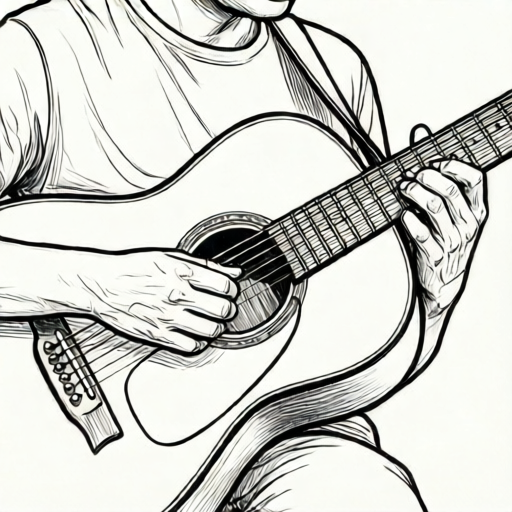
Use the stated measurements and conventions for each exercise.
Establish the figure and guitar hold
Start with a light construction line for the spine and a tilted oval for the ribcage. For a seated player, the torso leans back slightly and the guitar body sits on the right thigh (for a right-handed player). The guitar neck points left and slightly upward. The instrument's waist should align near the player's hip crease, and the soundboard faces outward, not flat against the chest.
Use a simple box or oval for the guitar body and a long rectangle for the neck. Check that the neck angle is consistent: if the body is 30 cm wide in your drawing, the neck should extend about 60 cm to the left (a 2:1 neck-to-body ratio). These numbers are hypothetical; adjust to your paper size. The key is that the guitar looks supported, not floating.
- Draw a vertical spine line and a tilted oval for the ribcage; mark the hip line.
- Place the guitar body oval on the right thigh, with its waist near the hip crease.
- Draw the neck as a long rectangle from the body toward the left, angled up about 15–20 degrees.
- Add a light line for the right forearm resting on the guitar's upper bout, and a line for the left arm reaching toward the neck.
Place the fretting hand and strumming hand
The fretting hand (left hand for a right-handed player) wraps around the neck with the thumb behind the neck and fingers curved over the fretboard. The fingertips press strings just behind the frets. In your drawing, show the hand as a rounded shape with four finger lines spaced about one finger-width apart. The wrist should be slightly bent, not collapsed.
The strumming hand (right hand) rests near the soundhole or bridge. The forearm lies along the guitar's edge, and the hand is relaxed with fingers slightly curled. For a strumming motion, show the hand at a slight angle, not flat. Use a consistent hand-size convention: draw both hands at the same scale unless your chosen viewpoint clearly places one hand farther away; if so, scale that hand slightly smaller. Keep finger spacing consistent within each hand.
- Draw the left forearm from the elbow to the neck, then add a rounded palm shape behind the neck.
- Add four curved finger lines over the fretboard, each ending just behind a fret line.
- Draw the right forearm resting on the guitar's upper bout, then add a relaxed hand shape near the soundhole.
- Check that the right hand does not cover the entire soundhole; leave at least half visible.
Refine posture and check proportions
A seated guitarist often has one foot slightly forward and the guitar's lower bout resting on the thigh. The head tilts slightly toward the neck, and the shoulders stay relaxed. For a standing player, the guitar hangs from a strap, and the body is more vertical; the same hand placement rules apply.
Use a simple proportion check: the guitar body length should be about one-third of the figure's total height in your drawing. If your figure is 18 cm tall, the guitar body should be about 6 cm long. These are hypothetical examples; measure your own drawing and adjust. Also check that the neck does not cross the face and that the fretting elbow is not higher than the shoulder.
- Add the head and tilt it slightly toward the guitar neck.
- Draw the legs: seated pose with one thigh supporting the guitar; standing pose with feet apart and strap line.
- Check guitar body length against figure height using the one-third rule (hypothetical).
- Erase construction lines and darken the final contours of hands, guitar, and posture.
Worked example
Draw a seated right-handed guitarist with the guitar body on the right thigh, neck angled up 15 degrees, fretting hand behind the neck, and strumming hand near the soundhole. Use a figure height of 18 cm and a guitar body length of 6 cm (hypothetical).
Worked answer
The drawing shows a seated figure with a tilted ribcage oval and a hip line. The guitar body oval sits on the right thigh, its waist near the hip crease. The neck rectangle extends left and up at about 15 degrees, roughly 9 cm long (hypothetical). The left forearm reaches to the neck, with a rounded palm behind it and four curved finger lines over the fretboard, each fingertip just behind a fret line. The right forearm rests on the upper bout, and the right hand is relaxed near the soundhole, leaving half of it visible. The head tilts slightly toward the neck, and the shoulders are relaxed. A proportion check confirms the guitar body is about one-third of the figure height.
Four practice exercises
Exercise 1
A seated guitarist drawing has a figure height of 15 cm. Using the hypothetical one-third rule, what should the guitar body length be?
Show answer and check
5 cm.
Why: The rule states guitar body length is about one-third of figure height. One-third of 15 cm is 5 cm.
Check: Measure the guitar body in your drawing and compare to 5 cm; adjust if it is more than 1 cm off.
Exercise 2
You draw a guitar neck 12 cm long and the body 6 cm wide. If the neck-to-body ratio should be about 2:1, is your drawing acceptable?
Show answer and check
Yes, because 12 cm to 6 cm is exactly 2:1.
Why: Divide neck length by body width: 12 ÷ 6 = 2. The ratio matches the hypothetical guide.
Check: Measure both lengths with a ruler and divide; accept if the result is between 1.8 and 2.2.
Exercise 3
A standing guitarist drawing shows the guitar body hanging from a strap. The figure is 20 cm tall and the guitar body is 8 cm long. Does this meet the hypothetical one-third rule?
Show answer and check
No, because one-third of 20 cm is about 6.7 cm, and 8 cm is too long.
Why: One-third of 20 is 6.67 cm. The drawn body is 8 cm, which is more than 1 cm over the guide.
Check: Recalculate one-third of the figure height and compare; adjust the guitar body length to within 1 cm of the result.
Exercise 4
In a drawing, the fretting hand has four finger lines spaced 1 cm apart, and the hand width is 4 cm. The strumming hand is drawn 5 cm wide. The viewpoint places both hands at roughly the same distance from the viewer. Using the convention that hands are drawn at the same scale unless depth clearly differs, is this acceptable?
Show answer and check
No, because the hands are at roughly the same distance but are drawn at different widths (4 cm vs 5 cm).
Why: The convention says to draw both hands at the same scale unless the viewpoint clearly places one farther away. Here the depths are similar, so the 1 cm width difference is inconsistent with the convention.
Check: Measure both hand widths; if the viewpoint places them at similar depth, accept only if the widths differ by 0.5 cm or less. If one hand is clearly farther away, a slightly smaller width for that hand is acceptable.
Common mistakes
- Drawing the guitar flat against the chest like a shield. Angle the soundboard outward and rest the body on the thigh or strap so the waist sits near the hip.
- Making both hands the same size regardless of depth. Use the convention that the fretting hand is slightly smaller because it is farther from the viewer; keep finger spacing consistent.
- Placing the fretting fingers on top of the frets instead of behind them. Draw each fingertip just behind a fret line, with the thumb visible behind the neck.
- Letting the strumming hand cover the entire soundhole. Position the hand near the soundhole but leave at least half of it visible; curl the fingers slightly.
Self-check rubric
- Guitar body rests on thigh or strap and is not flat against the chest.
- Neck angle is consistent and the guitar looks supported.
- Fretting hand has thumb behind the neck and fingertips behind fret lines.
- Strumming hand is relaxed near the soundhole and does not cover it entirely.
- Posture shows relaxed shoulders and slight head tilt toward the neck.
- Proportions follow the one-third guitar-body-to-figure-height check (hypothetical example).
- Valid alternative hand styles are accepted if finger spacing and placement rules are met, and hand sizes follow the stated convention: equal scale unless the viewpoint clearly places one hand farther away.
Questions and answers
Do I need to draw every string and fret?
No. Show a few fret lines and string lines as guides, but keep the focus on hand placement and instrument hold. Too many lines can clutter the drawing.
How do I draw a left-handed guitarist?
Mirror the entire composition: guitar neck points right, fretting hand is the right hand, strumming hand is the left. The same posture and hand-placement rules apply.
What if my figure looks stiff?
Check that the shoulders are relaxed and the head tilts slightly. The guitar should feel supported by the thigh or strap, not gripped by the arms.
Can I use a ruler for the guitar neck?
Yes, a ruler helps keep the neck straight. Label any measured lengths as hypothetical examples and adjust to your paper size.