Free original lessons
Prawn Drawing: Segmented Shell and Leg Placement
Learn to draw a side-view prawn with a clear rostrum, cephalothorax, six-part abdomen, thoracic legs, antennae, and tail fan.
Free lesson
Four exercises
Worked answers
Object Drawing Lessons
Build a side-view prawn from two main body regions: the cephalothorax at the head end and the segmented abdomen behind it. This lesson follows the anatomy shown in the FAO species guide for the giant freshwater prawn: the thorax carries five pairs of pereiopods, the abdomen has six segments, and the tail fan includes the telson and uropods. Other prawn species vary, so use a species-specific reference when matching exact shapes. The measurements below are hypothetical drawing choices, not biological ratios.
Practice materials: Printable downloads are not available for this lesson yet. Use the instructions and four exercises below.
Reference illustration
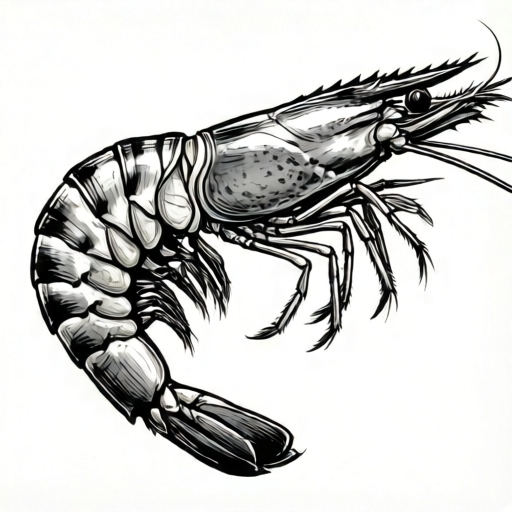
Use the stated measurements and conventions for each exercise.
Set the body axis and overall proportions
Start with a gently curved body axis and mark the head end and tail tip. At the front, sketch a cephalothorax covered by the carapace; extend a pointed rostrum forward, and add two long antennae from the head. Behind the carapace, draw a narrower abdomen that curves toward the tail. The abdomen ends in a tail fan formed by the telson and paired uropods.
Choose a paper length that leaves room for the antennae and tail fan. For a hypothetical 16 cm body from the back of the carapace to the tail tip, reserve a little extra page space in front for the rostrum and antennae. Keep the axis light so you can adjust the curve before darkening the outline.
- Mark the head end, tail tip, and a gently curved body axis.
- Draw the carapace over the cephalothorax and extend the rostrum forward.
- Add two antennae at the head and a narrowing six-part abdomen behind the carapace.
- Finish the abdomen with a tail fan, using a central telson and paired uropods.
Divide the shell into overlapping segments
Draw the abdomen as six successive plates. That requires five internal segment boundaries between the head end of the abdomen and the tail fan; do not confuse six segments with six dividing lines. Let each boundary curve across the abdomen and angle slightly toward the tail so the plates follow the body bend. A six-part pattern can be spaced evenly for a simple drawing, or adjusted to match the selected species reference.
The carapace belongs to the cephalothorax, not the abdomen. Keep the abdomen's six plates visually separate from the carapace and taper the final plate into the tail fan. Use overlapping edges consistently: choose whether each plate's rear edge sits over the next plate, then repeat the same convention along the abdomen.
- Mark the beginning and end of the abdomen behind the carapace.
- Divide that span into six plates using five internal boundaries.
- Curve each boundary with the body axis and keep the plate order consistent.
- Check that the final abdominal plate meets the tail fan rather than adding an extra segment.
Place legs under their segments
For the cited giant freshwater prawn reference, five pairs of pereiopods attach to the thorax beneath the cephalothorax. In this practice model, draw five paired, jointed legs under that front body region; do not place them along the six abdominal plates. Some species have conspicuous elongated claws, while others look different, so match the reference if you choose a named species.
Abdominal pleopods are a separate set of smaller appendages under the abdomen and can be included as light shapes if the chosen view shows them. They are not the same as the five pairs of thoracic walking legs. Draw far-side appendages lighter or partly hidden only as a depth convention, not as a rule about their anatomy.
- Mark the thorax beneath the carapace before adding legs.
- Draw five pairs of pereiopods attached under the thoracic region for the cited practice model.
- If shown, add smaller abdominal pleopods separately beneath the abdomen.
- Keep leg attachments off the six abdominal plates and compare species-specific details with the selected reference.
Refine the outline and check the construction
Refine the rostrum, antennae, carapace edge, six abdominal plates, thoracic legs, and tail fan. Use the rubric to check where each feature attaches. Species differ in body proportions, rostrum shape, claws, and appendage details, so the drawing should identify its reference when it aims for a particular species.
A readable generic illustration may simplify joints and omit tiny details, but keep the two body regions and the tail fan distinct. Erase the axis only after checking the anatomy and the order of the abdomen plates.
- Firm the outline of the cephalothorax and abdomen separately.
- Count six abdominal plates and five boundaries between them.
- Check that pereiopods attach under the thorax and the tail fan closes the abdomen.
- Erase guides and compare any species-specific details with the chosen reference.
Worked example
Draw a side-view giant freshwater prawn using a hypothetical 16 cm body length from the back of the carapace to the tail tip. Include the rostrum, antennae, six abdominal segments, five pairs of thoracic pereiopods, and a tail fan. Give one anatomy check.
Worked answer
Draw the cephalothorax under the carapace at the head end, extend the rostrum forward, and add two antennae. Behind the carapace, draw an abdomen with six plates separated by five internal boundaries, then finish it with a telson and paired uropods. Place five pairs of jointed pereiopods beneath the thorax, not beneath the abdomen plates. Check that the carapace and abdomen remain distinct and the six plates are countable.
Why: The FAO species guide separates the cephalothorax from the six-segment abdomen and places the pereiopods on the thorax. The specified length is only a paper layout choice.
Check: Count six abdominal plates and five boundaries. Count five leg pairs under the thorax, then verify that the abdomen ends at a separate tail fan.
Four practice exercises
Exercise 1
In a side view, draw a cephalothorax covered by a carapace, extend a pointed rostrum forward, and add two antennae from the head end. Describe how you will keep the head region distinct from the abdomen.
Show answer and check
The carapace covers the front body region; a rostrum projects forward, and two antennae start at the head. A narrowing abdomen begins behind the carapace with a visible change in outline.
Why: Separating the cephalothorax from the abdomen prevents the front shell from being mistaken for an abdominal plate.
Check: Trace the outline from rostrum to tail and identify where the carapace ends and the abdomen begins. Confirm both antennae start at the head.
Exercise 2
Draw an abdomen 12 cm long with six plates. Use five internal boundaries at 2 cm, 4 cm, 6 cm, 8 cm, and 10 cm from the front of the abdomen, then connect the last plate to a tail fan.
Show answer and check
Six abdominal plates are formed by the five boundaries at the specified positions; the final 2 cm ends at the tail fan.
Why: Five internal boundaries divide a span into six successive plates. The remaining length from 10 cm to 12 cm is the sixth plate.
Check: Count six plates and five internal lines. Confirm the distances leave 2 cm between the final boundary and the tail fan.
Exercise 3
For a giant freshwater prawn practice model, draw five pairs of pereiopods beneath the thorax and keep them separate from the six abdominal plates. Explain how the attachment points differ from abdominal pleopods.
Show answer and check
Five paired, jointed pereiopods attach beneath the thorax. Any smaller abdominal pleopods are drawn separately under the abdomen, and none of the walking-leg pairs is attached to an abdominal plate boundary.
Why: The cited species guide places pereiopods on the thorax; pleopods are a separate appendage group under the abdomen.
Check: Count five pairs beneath the cephalothorax and trace their attachment points. If pleopods are shown, confirm they are separate and lie under the abdomen.
Exercise 4
Draw a tail fan at the end of a six-segment abdomen. Include one central telson and a paired set of uropods. State how you check that the fan attaches to the last abdominal plate.
Show answer and check
The sixth and final abdominal plate meets the tail fan; the telson occupies the center, with paired uropods extending on either side.
Why: The tail fan is a terminal structure, not another abdominal segment. Keeping the central telson and paired uropods distinct makes the tail readable.
Check: Count six abdominal plates before the fan, identify one central telson, and verify that two uropods flank it.
Common mistakes
- Drawing six segment lines and calling them six abdominal segments. Use six plates with five internal boundaries between them; count the plates, not the lines.
- Attaching the five pereiopod pairs along the abdomen. Place the pereiopods beneath the thorax and keep any abdominal pleopods separate.
- Drawing the carapace as if it covered the whole segmented body. End the carapace at the cephalothorax and draw the abdomen as a distinct six-part region.
- Adding an abdominal plate after the tail fan begins. Count six plates, then draw the terminal telson and paired uropods as the fan.
Self-check rubric
- Cephalothorax and abdomen are drawn as distinct body regions.
- Carapace, rostrum, and antennae are placed at the head end.
- Abdomen shows six plates and five internal boundaries.
- Five pereiopod pairs in the cited practice model attach beneath the thorax.
- Any abdominal pleopods are kept separate from pereiopods.
- Tail fan has a central telson and paired uropods.
- Species-specific features are checked against a named reference.
Questions and answers
How many abdominal segments should this model show?
The FAO giant freshwater prawn reference describes six abdominal segments. In a drawing, six plates require five internal boundaries; follow a species reference if you are drawing another prawn.
Where do the walking legs attach?
For the cited practice model, five pairs of pereiopods attach beneath the thorax. Abdominal pleopods are a separate group.
Do all prawn species look the same?
No. Rostrum, claws, proportions, and appendages vary. Name the species reference when accuracy matters.
Can I simplify the tiny joints?
Yes. Simplify minor joints if needed, while keeping the cephalothorax, six-part abdomen, thoracic legs, and tail fan recognizable.