Free original lessons
Draw a Simple Potted Plant: Stem, Leaf, and Pot Shapes
Learn to draw a simple potted plant using clear shape conventions for the pot, stem, and leaves, with practice tasks and a fair rubric.
Free lesson
Four exercises
Worked answers
Object Drawing Lessons
This lesson teaches a reliable way to draw a simple potted plant. You will use a defined shape convention: the pot is a trapezoid with a rim, the stem is a single curved line rising from the pot center, and each leaf is a pointed oval attached to the stem. Because drawing styles vary, the rubric accepts any leaf arrangement that follows the stated convention. All measurements are hypothetical examples; measure your own paper and tools before drawing.
Practice materials: Printable downloads are not available for this lesson yet. Use the instructions and four exercises below.
Reference illustration
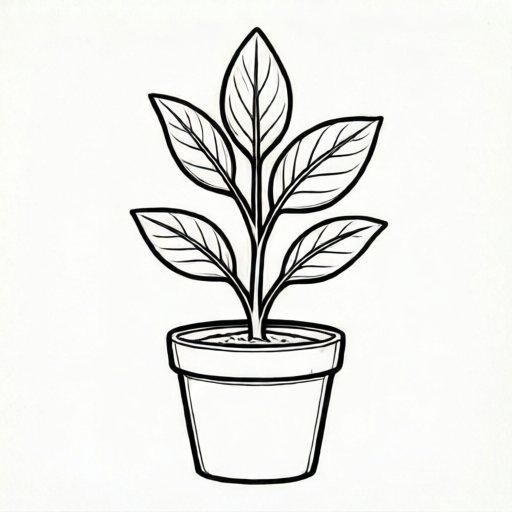
Use the stated measurements and conventions for each exercise.
Set Up the Page and Define the Pot Shape
Place your paper in portrait orientation. Decide a drawing area about 12 cm wide and 16 cm tall; these numbers are hypothetical examples, so adjust to your paper. Lightly mark the vertical centerline. The pot sits in the lower third of the area.
Draw the pot as a trapezoid: a horizontal top edge about 6 cm wide, a horizontal bottom edge about 4 cm wide, and two straight sides that slant inward. Add a rim by drawing a second horizontal line 1 cm below the top edge and connecting the ends with short vertical lines. Keep the pot symmetrical about the centerline.
- Mark the centerline and the lower-third boundary.
- Draw the top edge of the pot, centered on the centerline.
- Draw the bottom edge, narrower than the top and centered.
- Connect the edges with straight slanted sides.
- Add the rim line and short side connectors.
Draw the Stem and Place the Leaves
Start the stem at the center of the pot rim and draw one smooth curve upward. The stem should end about 8 cm above the rim. A slight S-curve is acceptable; keep the line continuous and not too thick.
Each leaf is a pointed oval. Attach the narrow end to the stem and let the wide part extend outward. Use a simple convention: leaves alternate sides along the stem, with the lowest leaf about 2 cm above the rim and the highest about 1 cm below the stem tip. Space leaves roughly 2 cm apart. You may vary the number of leaves from four to six and adjust angles, as long as each leaf touches the stem and points outward.
- Draw the stem curve from rim center to the chosen height.
- Mark leaf attachment points along the stem.
- Draw each leaf as a pointed oval touching the stem.
- Check that leaves alternate sides and do not cross the pot rim.
- Erase unnecessary guide marks.
Refine Proportions and Check the Drawing
Compare the pot width to the leaf span. A balanced simple plant often has a leaf span about equal to the pot's top width, but this is a convention, not a rule. Check that the stem meets the rim center and that no leaf floats free of the stem.
Use a simple arithmetic check: count leaves, count attachment points, and confirm they match. Measure the pot top and bottom widths with a ruler; the bottom should be narrower. If you used the hypothetical 6 cm and 4 cm, the difference is 2 cm.
- Count leaves and attachment points; they should be equal.
- Measure pot top and bottom widths; bottom should be smaller.
- Confirm the stem starts at rim center.
- Confirm every leaf touches the stem.
- Adjust any leaf that crosses the rim or floats free.
Worked example
Draw a potted plant with a trapezoid pot, a single stem, and five leaves alternating sides. Use a pot top width of 6 units and bottom width of 4 units.
Worked answer
The drawing shows a centered trapezoid pot with a rim, a stem rising from the rim center, and five pointed-oval leaves attached alternately along the stem. The bottom pot width is visibly narrower than the top, and every leaf touches the stem.
Four practice exercises
Exercise 1
Draw a potted plant with a pot top width of 8 units and bottom width of 5 units. Add four leaves, two on each side, attached to a straight stem.
Show answer and check
A centered trapezoid pot with top 8 units and bottom 5 units, a straight stem from rim center, and four pointed-oval leaves attached two per side.
Why: The pot satisfies the trapezoid convention because the bottom is narrower. The stem starts at rim center. Each leaf touches the stem, and the count is four.
Check: Measure top and bottom widths; confirm bottom is smaller. Count four leaves and four attachment points. Confirm no leaf floats free.
Exercise 2
Draw a potted plant with a curved stem and five leaves alternating sides. The lowest leaf should be about 2 units above the rim and the highest about 1 unit below the stem tip.
Show answer and check
A pot with a rim, a curved stem from rim center, and five pointed-oval leaves attached alternately, with the lowest near 2 units above the rim and the highest near 1 unit below the tip.
Why: The curved stem is allowed. Alternating leaves satisfy the arrangement convention. The stated heights guide placement without requiring exact measurement.
Check: Count five leaves and five attachment points. Confirm leaves alternate sides. Check that the lowest leaf is above the rim and the highest is below the stem tip.
Exercise 3
Draw a potted plant with six leaves all attached on the same side of the stem. State whether this follows the lesson convention and why.
Show answer and check
The drawing has six pointed-oval leaves attached to one side of the stem. It follows the shape convention because each leaf touches the stem, but it departs from the alternating arrangement example.
Why: The lesson defines leaf shape and attachment, while arrangement may vary. A one-sided arrangement is a valid alternative if the rubric accepts stated arrangements.
Check: Confirm six leaves touch the stem. Check that the pot is a trapezoid and the stem starts at rim center. Verify the arrangement is clearly one-sided.
Exercise 4
Draw a potted plant and then check it: pot top 7 units, bottom 4 units, stem from rim center, five leaves attached. Identify one possible improvement.
Show answer and check
A centered trapezoid pot with top 7 units and bottom 4 units, a stem from rim center, and five attached leaves. A possible improvement is adjusting one leaf that crosses the rim.
Why: The arithmetic difference between top and bottom is 3 units, confirming a narrower bottom. The leaf count matches attachment points. Any leaf crossing the rim can be moved upward.
Check: Subtract bottom width from top width to confirm a positive difference. Count leaves and attachment points. Inspect for leaves crossing the rim or floating free.
Common mistakes
- Drawing the pot with parallel sides instead of a trapezoid. Make the bottom edge narrower than the top edge and keep both edges horizontal.
- Letting leaves float away from the stem. Attach the narrow end of each pointed oval directly to the stem line.
- Starting the stem outside the pot rim center. Begin the stem at the midpoint of the rim's top edge.
- Making all leaves the same height on one side. Alternate sides and space attachment points along the stem.
Self-check rubric
- Pot is a trapezoid with a horizontal top, horizontal bottom, and narrower bottom width.
- Pot includes a rim line and is centered on the page.
- Stem is a single continuous line starting at the rim center.
- Each leaf is a pointed oval attached to the stem.
- Leaves alternate sides or follow another stated arrangement without floating free.
- Drawing is clean enough to identify pot, stem, and leaves clearly.
Questions and answers
Must every leaf be identical?
No. The convention requires pointed ovals attached to the stem, but size and angle may vary within the rubric.
Can the stem be straight?
Yes. A straight stem is acceptable; a slight curve is also allowed.
How many leaves should I draw?
Four to six leaves is a practical range for this simple drawing.
Do I need to measure in centimeters?
No. The centimeter values are hypothetical examples; use any consistent unit or relative proportions.