Free original lessons
Draw an Anime Romantic Two-Figure Scene with Framing
Plan a two-figure romantic pose with contact points and gaze lines, then frame the scene in an anime panel using measured composition choices.
Free lesson
Four exercises
Worked answers
Object Drawing Lessons
This lesson solves a specific drawing problem: placing two anime figures in a romantic scene and framing them so the relationship reads clearly. Use head height, measured from crown to chin, as a convenient scale unit; it is a drawing aid, not a typographic measurement or a fixed body standard. Define contact points, gaze lines, and a framing box before adding detail. All measurements are hypothetical and use consistent units.
Practice materials: Printable downloads are not available for this lesson yet. Use the instructions and four exercises below.
Reference illustration
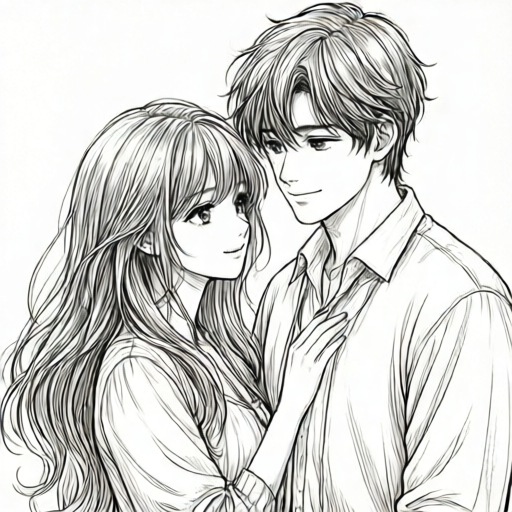
Use the stated measurements and conventions for each exercise.
Set the two-figure pose with contact points
Start with two vertical center lines on a 20 cm by 28 cm sheet. Place figure A at 8 cm from the left edge and figure B at 13 cm from the left edge, so their center lines are 5 cm apart. These numbers are hypothetical examples; measure your own paper and keep units consistent. Before drawing shoulders, measure each figure's shoulder width from its center line to its outer shoulder edge. The 5 cm separation only gives a small positive shoulder gap if the two half-shoulder widths add up to less than 5 cm; if they add up to 5 cm or more, the shoulders overlap or touch, so widen the separation or narrow the shoulders until the gap is small but positive. Mark a shared ground line at 16 cm from the top for both figures, leaving 16 cm above it and 12 cm below it. Use head height as a simple unit: if each head is 3 cm from crown to chin, a four-head figure is 12 cm tall and fits within the 16 cm above the baseline.
Define three contact points: a hand on a shoulder, a forehead near a temple, and a hip near a hip. Draw small circles at these points before any clothing. The romantic read comes from proximity and gaze, not from a single correct pose. Valid alternatives include a hand hovering near the shoulder instead of touching, or foreheads close but not touching, as long as the gaze lines and framing still show the relationship.
- Draw two center lines 5 cm apart and a shared ground line.
- Mark head-height units at 3 cm intervals to check figure height.
- Place three contact-point circles: shoulder, temple, hip.
- Draw gaze lines from each figure's eye midline toward the other figure's face.
- Check that no contact point forces a limb to cross the other figure's center line awkwardly.
Build the framing box and composition notes
Draw a framing box 16 cm wide and 20 cm tall, centered on the sheet. On a 20 cm by 28 cm sheet this leaves a 2 cm margin on the left and a 2 cm margin on the right, plus a 4 cm margin on the top and a 4 cm margin on the bottom (8 cm total vertical margin). Place the two figures so their eyes sit near the upper third line of the box, about 6.7 cm from the top edge (20 divided by 3). This keeps the gaze lines readable and gives space for hair and shoulders.
Composition notes: keep the negative space on the side where the figures lean, so the lean has room. If figure A leans right, leave more space on the right. Use a simple background cue such as a window edge or a curtain line, but keep it behind the figures. The framing box is a planning tool, not a printer tolerance; measure your actual paper and adjust the box to fit.
- Draw the 16 cm by 20 cm framing box with a 2 cm side margin and 4 cm top and bottom margins.
- Mark the upper third line at about 6.7 cm from the top (20 divided by 3).
- Place both figures' eye midlines on or near that line.
- Add one background cue behind the figures, not between them.
- Check that the leaning side has more negative space than the other side.
Refine anime style and romantic cues
Anime style here means clear shapes, simplified facial features, and readable hair masses. Use the head midline as the eye line and keep the eyes large enough to show gaze direction. Hair can overlap the framing box edge slightly, but keep the faces inside the box. Romantic cues include a shared gaze, a slight lean, and one small gesture such as a hand near the shoulder.
Valid alternatives: figures can be same height or different heights; the lean can be left or right; the contact can be touching or hovering. The rubric rewards a clear relationship and a readable frame, not a single universal pose. Avoid adding detail that hides the contact points or gaze lines.
- Draw eye shapes on the eye midline and check gaze direction.
- Simplify hair into two or three masses per figure.
- Keep faces inside the framing box; allow hair to cross the edge.
- Add one small romantic gesture and check it does not hide a contact point.
- Erase planning lines only after the gaze and contact points read clearly.
Worked example
On a 20 cm by 28 cm sheet, place two figures with a shared ground line at 16 cm from the top. Figure A center line is 8 cm from the left; figure B center line is 13 cm from the left. Each head is 3 cm from crown to chin; each shoulder extends 2.2 cm from its center line. Draw a 16 cm by 20 cm framing box centered on the sheet and place the eye midline at 6.5 cm from the top of the box. Mark three contact points: hand on shoulder, temple near temple, hip near hip. Describe the gaze lines and the negative space on the leaning side.
Worked answer
The center lines are 5 cm apart. Each shoulder extends 2.2 cm from its center line, so the shoulder gap is 5−2.2−2.2=0.6 cm. This example gives a small positive gap; adjust the centers or shoulder widths if your drawing differs. The ground line at 16 cm from the top leaves 16 cm above it, enough for a 12 cm four-head figure, and 12 cm below it. The framing box is centered, leaving a 2 cm margin on each side of the 20 cm width and 4 cm on each of the top and bottom edges of the 28 cm height (8 cm total vertical margin). The eye midline sits near the upper third line (6.5 cm versus about 6.7 cm). Gaze lines run from each eye midline toward the other figure's face, crossing near the temple contact point. If figure A leans right, the right side of the box has more negative space. The three contact points are visible and no limb crosses the other figure's center line awkwardly.
Four practice exercises
Exercise 1
A 20 cm by 28 cm sheet has a shared ground line at 24 cm from the top. Figure A center line is 7 cm from the left; figure B center line is 12 cm from the left. Each head height is 3 cm from crown to chin. What is the horizontal distance between center lines, and how many head units tall is a four-head figure?
Show answer and check
The center lines are 5 cm apart. A four-head figure is 12 cm tall because 4 times 3 cm equals 12 cm.
Why: Subtract the smaller center-line distance from the larger: 12 minus 7 equals 5 cm. Multiply head units by head height: 4 times 3 equals 12 cm.
Check: Re-add 5 cm to 7 cm to get 12 cm, and divide 12 cm by 3 cm to get 4 head units.
Exercise 2
A framing box is 16 cm wide and 20 cm tall. The eye midline is placed 6.5 cm from the top. What is the distance from the eye midline to the bottom of the box? If the box is centered on a 20 cm wide sheet, what is the left margin?
Show answer and check
The eye midline is 13.5 cm from the bottom. The left margin is 2 cm.
Why: Subtract 6.5 cm from 20 cm to get 13.5 cm. Subtract the box width from the sheet width: 20 minus 16 equals 4 cm total margin, so each side is 2 cm.
Check: Add 6.5 cm and 13.5 cm to get 20 cm. Add 2 cm, 16 cm, and 2 cm to get 20 cm.
Exercise 3
Two figures share a ground line. Figure A leans right and its outer edge is 3 cm from the right edge of the framing box; its outer edge is 6 cm from the left edge. Which side has more negative space, and by how much?
Show answer and check
The left side has more negative space by 3 cm.
Why: Compare the two distances: 6 cm on the left and 3 cm on the right. The left side is larger by 6 minus 3 equals 3 cm.
Check: Add 3 cm to the right-side distance to get 6 cm, matching the left-side distance.
Exercise 4
A figure is planned as five head units tall. Each head height is 2.5 cm from crown to chin. The shared ground line is 16 cm from the top of a 28 cm sheet. Does the figure fit above the ground line without crossing the top edge? Show the arithmetic.
Show answer and check
The figure is 12.5 cm tall and fits above the ground line. Because the ground line is 16 cm from the top edge, the available height above it is 16 cm. The remaining space to the top edge is 16 minus 12.5, or 3.5 cm.
Why: Multiply 5 head units by 2.5 cm to get 12.5 cm. With the ground line 16 cm down from the top edge, the space from the top edge to the ground line is 16 cm, so 16 minus 12.5 leaves 3.5 cm. The other 12 cm on the page lies below the ground line.
Check: Measure from the top edge down to the ground line (16 cm), then compare with the 12.5 cm figure height. Confirm 3.5 cm remains above the figure and 12 cm remains below the ground line on the 28 cm sheet.
Common mistakes
- Placing both figures on the same center line, so the pose looks like one figure. Separate center lines by at least 4 cm so the figures sit close with a small gap instead of stacking bodies.
- Putting the eyes below the upper third line, which crowds the framing box. Move the eye midline to about 6.5 cm from the top of a 20 cm box, then adjust hair and shoulders.
- Adding background detail between the figures, which breaks the romantic read. Keep background cues behind the figures and leave the space between them clear.
- Hiding contact points under clothing or hair before checking them. Draw contact circles first and keep them visible until the pose reads clearly.
Self-check rubric
- Two distinct figures are readable, with separate center lines and a shared ground line.
- Three contact points are marked and remain visible after detailing.
- Gaze lines connect the figures and sit near the upper third line of the framing box.
- The framing box is measured and centered, with a clear margin.
- The leaning side has more negative space than the other side.
- Anime style is simplified and consistent, with faces inside the box.
- Valid alternatives are accepted if the relationship and framing stay clear.
Questions and answers
Do both figures need the same head height?
No. Use the same unit for both, but different heights are valid if the gaze lines and contact points still read. Measure each figure's head from crown to chin and keep units consistent.
Can the figures touch foreheads instead of a hand on a shoulder?
Yes. Any contact point works if it supports the romantic read and stays visible. Keep three contact points total and check that none forces an awkward limb crossing.
How much negative space should the leaning side have?
Leave visibly more space on the leaning side than the other side. A simple check is to compare the distance from the figure's outer edge to the framing box edge on each side.
Is the framing box a printer tolerance?
No. It is a planning tool. Measure your actual paper and adjust the box dimensions; the 16 cm by 20 cm example is hypothetical.