Free original lessons
Goat Eyes Drawing: Rectangular Pupil and Lid Shape
Learn to draw goat eyes with a horizontal rectangular pupil, lid contour, and fur edge using a clear convention, worked example, and four practice tasks.
Free lesson
Four exercises
Worked answers
Object Drawing Lessons
Goat eyes are distinctive because the pupil is a horizontal rectangle rather than a circle or slit. This lesson teaches a repeatable drawing method: establish the eye opening, place the rectangular pupil, shape the lids, and add a fur edge. The convention is that the pupil is a horizontal rectangle with rounded corners, centered in the eye opening, and the upper lid sits slightly above the pupil while the lower lid follows the eye curve. Letter styles and fur textures vary, so the rubric rewards proportion, placement, and clarity rather than a single exact outline. All measurements are hypothetical examples; measure your own paper and tools before drawing.
Practice materials: Printable downloads are not available for this lesson yet. Use the instructions and four exercises below.
Reference illustration
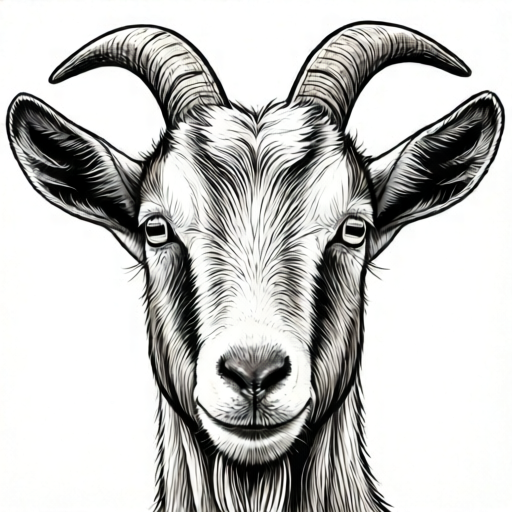
Use the stated measurements and conventions for each exercise.
Set the eye opening and pupil guide
Begin with a light horizontal oval for the eye opening. The oval should be wider than it is tall, roughly two parts width to one part height as a hypothetical starting proportion. Mark the center point and a horizontal midline. The pupil will sit on this midline.
Draw a horizontal rectangle centered on the midline. Its width should be about half the eye-opening width, and its height about one third of the eye-opening height. Round the corners slightly so the pupil reads as organic rather than mechanical. Keep the rectangle level; a tilted pupil changes the expression and is harder to check.
- Draw a light horizontal oval for the eye opening.
- Mark the center and a horizontal midline.
- Draw a centered horizontal rectangle with rounded corners.
- Check that the rectangle is level and centered before adding lids.
Shape the lids around the pupil
The upper lid is a curved line that sits just above the pupil, leaving a narrow band of visible eye white or iris above the rectangle. The lower lid follows the bottom curve of the oval and sits just below the pupil. Both lids should be thicker than a single pencil line to suggest the eyelid edge.
Avoid drawing the lids as perfect circles. Goat lids are slightly angular at the corners, and the outer corner often lifts a little. Keep the lid lines smooth and continuous, and check that the pupil remains fully inside the eye opening with a small margin on all sides.
- Draw the upper lid as a curved line above the pupil.
- Draw the lower lid along the bottom curve of the oval.
- Thicken both lid lines to show the eyelid edge.
- Confirm the pupil has a visible margin inside the opening.
Add the fur edge and final checks
The fur edge is a broken, slightly jagged line around the eye opening. It should not cover the pupil or the lid lines. Use short strokes that follow the direction of the fur, and vary their length to avoid a uniform border. The fur edge frames the eye and helps it read as a goat rather than a generic animal.
Final checks: the pupil is horizontal and rectangular, the lids are above and below it, the fur edge is outside the eye opening, and the whole eye is wider than tall. If any check fails, adjust lightly before darkening lines.
- Draw short, varied strokes around the eye opening for fur.
- Keep fur outside the lid lines and pupil.
- Check pupil orientation, lid placement, and overall width.
- Darken final lines only after all checks pass.
Worked example
Draw a goat eye on a 10 cm by 10 cm area. Use a hypothetical eye opening 6 cm wide and 3 cm tall. Place a horizontal rectangular pupil 3 cm wide and 1 cm tall, centered. Add upper and lower lids and a fur edge.
Worked answer
The eye opening is a horizontal oval 6 cm wide and 3 cm tall. The pupil is a level rectangle 3 cm wide and 1 cm tall, centered on the midline, leaving about 1.5 cm of eye opening on each side and 1 cm above and below. The upper lid curves just above the pupil, the lower lid follows the bottom curve, and short fur strokes surround the opening without touching the pupil. All checks pass: pupil horizontal, centered, margins visible, eye wider than tall.
Four practice exercises
Exercise 1
Draw a goat eye opening 8 cm wide and 4 cm tall. Place a centered horizontal rectangular pupil 4 cm wide and 1.5 cm tall. Add lids and a fur edge. Check all margins.
Show answer and check
Eye opening 8 cm by 4 cm; pupil 4 cm by 1.5 cm centered. Margins: 2 cm left and right, 1.25 cm above and below. Lids above and below the pupil; fur outside the opening.
Why: Half of 8 cm is 4 cm for pupil width; half of 4 cm is 2 cm side margins. Pupil height 1.5 cm leaves (4 - 1.5) / 2 = 1.25 cm above and below.
Check: Measure the pupil width and height, confirm it is level, and verify equal side margins and equal top and bottom margins.
Exercise 2
A student draws an eye opening 7 cm wide and 3.5 cm tall with a pupil 3.5 cm wide and 1 cm tall, but the pupil is 0.5 cm left of center. Describe the correction and the new margins.
Show answer and check
Move the pupil 0.5 cm right to center it. New margins: left and right each (7 - 3.5) / 2 = 1.75 cm; top and bottom each (3.5 - 1) / 2 = 1.25 cm.
Why: Centering requires equal side margins. The original left margin was 1.25 cm and right was 2.25 cm; shifting right by 0.5 cm equalizes them at 1.75 cm.
Check: Measure left and right margins after the shift; they should both read 1.75 cm. Check top and bottom margins are both 1.25 cm.
Exercise 3
Draw a goat eye with a pupil 2 cm wide and 0.8 cm tall inside an eye opening 5 cm wide and 2.5 cm tall. Then draw a second version with the pupil tilted 10 degrees. Explain which version better meets the convention and why.
Show answer and check
The level version meets the convention. Margins for the level version: 1.5 cm left and right, 0.85 cm above and below. The tilted version is less clear because the pupil is no longer horizontal.
Why: The convention requires a horizontal rectangle. Tilting changes the orientation and makes the pupil harder to check against the midline.
Check: Compare the pupil's top edge to the horizontal midline. The level version should be parallel; the tilted version will cross the midline.
Exercise 4
An eye opening is 9 cm wide and 4.5 cm tall. The pupil is 4.5 cm wide and 1.5 cm tall. The fur edge is drawn 0.5 cm inside the eye opening on the left side. Identify the error and state the corrected fur placement.
Show answer and check
The fur edge should be outside the eye opening, not inside. Move the left fur strokes 0.5 cm outward so they sit outside the opening. The pupil and lid margins remain unchanged.
Why: Fur frames the eye and must not cover the pupil or lids. Drawing it inside reduces the visible eye opening and can obscure the pupil margin.
Check: Trace the eye opening and confirm all fur strokes lie outside it. Check that the pupil still has 2.25 cm side margins and 1.5 cm top and bottom margins.
Common mistakes
- Drawing a vertical slit or round pupil. Redraw the pupil as a horizontal rectangle with rounded corners, centered on the midline.
- Making the pupil touch the lids. Shrink the rectangle slightly or widen the eye opening so a margin remains on all sides.
- Drawing the fur edge over the pupil or lids. Keep fur strokes outside the eye opening and lid lines.
- Tilting the pupil so it is not level. Use the horizontal midline as a guide and redraw the rectangle level.
Self-check rubric
- Pupil is a horizontal rectangle with rounded corners and is level.
- Pupil is centered in the eye opening with a visible margin on all sides.
- Upper lid sits above the pupil and lower lid follows the bottom curve.
- Eye opening is wider than tall and reads as a goat eye.
- Fur edge is outside the eye opening and does not cover the pupil or lids.
- Lines are clear and intentional; alternative fur textures are acceptable if checks pass.
Questions and answers
Why is the pupil rectangular?
Goats have horizontal rectangular pupils that help them see a wide field. In drawing, the rectangle is a clear convention that distinguishes goat eyes from other animal eyes.
How wide should the pupil be?
As a hypothetical example, make the pupil about half the eye-opening width and one third of its height. Adjust to your own drawing size and check that a margin remains.
Can the fur edge be smooth?
A slightly broken edge reads more like fur, but a smooth edge is acceptable if the pupil and lids are clear. The rubric rewards clarity and placement over texture style.
What if my eye looks too round?
Widen the oval and flatten the top and bottom curves slightly. The eye should be noticeably wider than tall.