Free original lessons
Draw a Dream Catcher: Ring, Web, and Feathers
Learn to draw a dream catcher with a ring, radial web, and hanging feathers using a repeatable layout and simple checks.
Free lesson
Four exercises
Worked answers
Object Drawing Lessons
This lesson teaches a clear method for drawing a dream catcher: a circular ring, a radial web pattern, and feathers hanging below. You will use a defined drawing convention so that your result can be checked fairly even when your line style differs. The convention is simple: the ring is a circle, the web is a set of straight or gently curved lines connecting the ring to a small center, and feathers hang from the lower half of the ring. X-height is not used here; instead, spacing and proportion are checked by counting and measuring. All measurements in examples are hypothetical and should be replaced by measurements of your actual paper and tools. The practice tasks are self-contained and can be solved from the text alone.
Practice materials: Printable downloads are not available for this lesson yet. Use the instructions and four exercises below.
Reference illustration
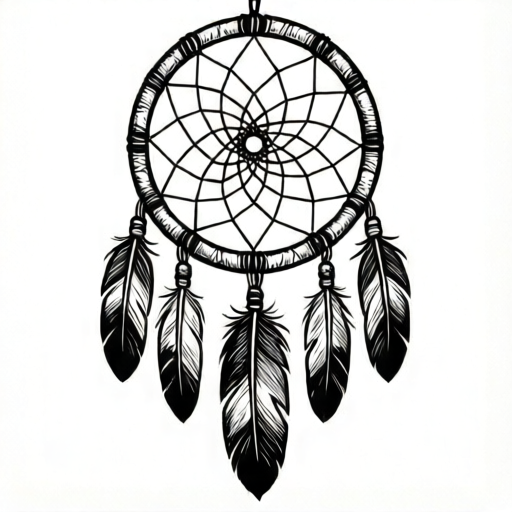
Use the stated measurements and conventions for each exercise.
Set the ring and center
Begin by drawing a circle for the ring. Choose a diameter that fits your paper with room below for feathers. For example, on a 20 cm by 25 cm sheet, a ring diameter of 10 cm is a hypothetical choice that leaves about 7 cm below the ring for feathers and hanging lines. Mark the center with a light dot. The center is the reference for the web.
Draw a second, slightly smaller circle inside the ring if you want a double ring. Keep the gap even by measuring at four points: top, bottom, left, and right. If the gaps differ by more than 2 mm in this example, adjust the inner circle. These numbers are examples only; measure your own paper and use consistent units.
- Mark the center of the page area where the ring will go.
- Draw the outer ring circle using a compass or a traced round object.
- Mark the center dot of the ring.
- Optional: draw an inner ring with an even gap, checking four points.
Build the radial web
The web is a radial pattern. Decide how many anchor points you want on the ring. A common choice is 8 or 12 points, spaced evenly around the circle. For an 8-point web, the angle between neighboring anchors is 45 degrees. For a 12-point web, it is 30 degrees. You can mark these by folding a paper circle or by using a protractor. The web lines connect anchors to the center or to a small inner circle.
Keep the web lines straight or gently curved, but do not let them cross randomly. A simple pattern is to connect each anchor to the center, then add a second set of lines that connect midpoints between anchors to a small inner circle. This creates a woven look without needing a single correct design. The convention allows any even number of anchors from 6 to 16, as long as spacing is even and the pattern is consistent.
- Choose an even number of anchor points between 6 and 16.
- Mark the anchors evenly around the ring.
- Draw lines from each anchor toward the center or a small inner circle.
- Optional: add a second layer connecting midpoints to the inner circle.
- Check that no web line extends outside the ring.
Place the feathers
Feathers hang from the lower half of the ring. Decide how many feathers you want. A balanced layout uses an odd number such as 3, 5, or 7, placed symmetrically around the bottom center. For 5 feathers, place one at the bottom center, then two on each side at equal spacing along the lower arc. The hanging lines should be similar lengths, for example 4 cm, 5 cm, and 6 cm in a hypothetical layout, creating a gentle curve.
Each feather can be drawn as a long oval with a central shaft and small side lines. The convention does not require a specific feather species. A feather is valid if it has a visible shaft, a rounded or pointed tip, and side barbs that are roughly symmetrical. You may vary feather size, but keep the largest feather no more than twice the length of the smallest in your drawing.
- Choose an odd number of feathers from 3 to 7.
- Mark hanging points on the lower half of the ring.
- Draw hanging lines of similar length from ring to feather top.
- Draw each feather with a shaft and symmetrical side barbs.
- Check that feathers do not overlap the ring or each other excessively.
Refine and check
Refine the drawing by darkening the ring, web, and feathers. Keep the web lines lighter than the ring so the structure reads clearly. Check the layout by counting anchors, feathers, and hanging lines. Measure the ring diameter and the longest feather length. In a hypothetical check, if the ring diameter is 10 cm and the longest feather is 6 cm, the feather is 60 percent of the ring diameter, which is a reasonable proportion for this convention.
Use the rubric to evaluate your drawing. The rubric allows valid alternatives: different anchor counts, feather shapes, and line styles are acceptable if the structure is clear and the spacing is even. Do not erase lightly drawn guide marks until the final check is complete.
- Darken the ring and feathers; keep web lines lighter.
- Count anchors and feathers; confirm even spacing.
- Measure ring diameter and feather lengths in consistent units.
- Compare your drawing to the rubric and adjust if needed.
Worked example
Draw a dream catcher on a 15 cm by 20 cm sheet using a ring diameter of 8 cm, 8 web anchors, and 3 feathers. Describe the layout and check the proportions.
Worked answer
Place the ring center about 7 cm from the top of the sheet. Draw an 8 cm diameter ring. Mark 8 anchors evenly around the ring, spaced 45 degrees apart. Connect each anchor to the center with a straight line, then add a small inner circle of 2 cm diameter and connect midpoints between anchors to it. Hang 3 feathers from the lower half: one at bottom center, one 30 degrees to the left, one 30 degrees to the right. Use hanging lines of 4 cm, 5 cm, and 4 cm. Draw each feather about 5 cm long with a shaft and side barbs. Check: ring diameter 8 cm, longest feather 5 cm, which is 62.5 percent of the ring diameter. The layout is balanced and fits the sheet with room below.
Four practice exercises
Exercise 1
A drawing has a ring diameter of 12 cm and 6 web anchors. What is the angle between neighboring anchors? Show your arithmetic.
Show answer and check
60 degrees.
Why: A full circle is 360 degrees. With 6 evenly spaced anchors, divide 360 by 6: 360 / 6 = 60 degrees.
Check: Multiply the angle by the number of anchors: 60 x 6 = 360 degrees, which confirms even spacing.
Exercise 2
A dream catcher has 5 feathers with hanging lines of 3 cm, 4 cm, 5 cm, 4 cm, and 3 cm. What is the total length of hanging line used?
Show answer and check
19 cm.
Why: Add the lengths: 3 + 4 + 5 + 4 + 3 = 19 cm.
Check: Add in a different order, for example 5 + 4 + 4 + 3 + 3 = 19 cm, to confirm the total.
Exercise 3
On a 20 cm by 25 cm sheet, a ring of 10 cm diameter is placed with its center 8 cm from the top. How much vertical space remains below the ring for feathers? Use the bottom of the ring as the reference.
Show answer and check
About 12 cm.
Why: The ring radius is 10 / 2 = 5 cm. The bottom of the ring is 8 + 5 = 13 cm from the top. The sheet height is 25 cm, so space below is 25 - 13 = 12 cm.
Check: Add the space below to the bottom position: 12 + 13 = 25 cm, which matches the sheet height.
Exercise 4
A drawing uses 12 web anchors. If you add a second layer connecting midpoints between anchors to an inner circle, how many midpoint connections are there?
Show answer and check
12 midpoint connections.
Why: There is one midpoint between each pair of neighboring anchors. With 12 anchors around a closed ring, there are 12 such gaps, so 12 midpoint connections.
Check: Count the gaps around the ring: each anchor has one gap to its right, and the last anchor connects back to the first, giving 12 gaps.
Common mistakes
- Drawing web lines that cross randomly or extend outside the ring. Mark anchors evenly first, then connect each anchor to the center or inner circle without letting lines pass beyond the ring.
- Placing feathers only on one side or with very different hanging lengths. Use an odd number of feathers centered on the bottom, and keep hanging lines within a small length range, such as 4 to 6 cm in a hypothetical example.
- Making the ring too large so feathers have no room below. Measure your paper first; choose a ring diameter that leaves at least one-third of the page height below the ring for feathers.
- Drawing feathers without a visible shaft or with no side barbs. Add a central shaft line and small symmetrical side lines to each feather so it reads as a feather rather than a leaf.
Self-check rubric
- Ring is circular and clearly drawn; diameter is measurable.
- Web anchors are even in number and spacing; lines connect to center or inner circle without random crossing.
- Feathers hang from the lower half; number is odd and placement is symmetric.
- Each feather has a visible shaft and side barbs; sizes are within the allowed range.
- Overall layout fits the page and leaves room for hanging lines.
- Valid alternatives in anchor count, feather shape, and line style are accepted if structure and spacing are clear.
Questions and answers
How many web anchors should I use?
Any even number from 6 to 16 is acceptable if the anchors are evenly spaced. Eight or twelve are common choices.
Do the feathers have to be the same size?
No. Vary sizes if you like, but keep the largest feather no more than twice the length of the smallest in your drawing.
Can I use curved web lines?
Yes. Gently curved lines are allowed as long as they connect anchors to the center or inner circle and do not cross randomly.
What if my ring is not a perfect circle?
A slightly imperfect circle is acceptable if the ring reads as circular and the web anchors are spaced evenly around it.