Free original lessons
Easy Kitten Pencil Drawing: Head Proportions, Ears, Paws, and Fur Strokes
Learn a simple kitten pencil drawing method using head proportion guides, ear and paw placement boxes, and short fur strokes for a clear, friendly result.
Free lesson
Four exercises
Worked answers
Object Drawing Lessons
This lesson teaches an easy kitten pencil drawing built around a clear head proportion guide, simple ear and paw placement boxes, and short fur strokes. You will use a pencil, paper, and an eraser. The method favors a friendly, simplified kitten rather than adult cat anatomy or realistic fur shading. Work lightly at first, then darken only the lines you want to keep. A useful convention for this lesson: the kitten's head height is measured from the baseline of the chin to the midline of the eyes, and the head width is measured across the widest part of the cheeks. Letter styles and fur directions may vary; the rubric rewards consistent proportions and deliberate strokes, not one universal drawing.
Practice materials: Printable downloads are not available for this lesson yet. Use the instructions and four exercises below.
Reference illustration
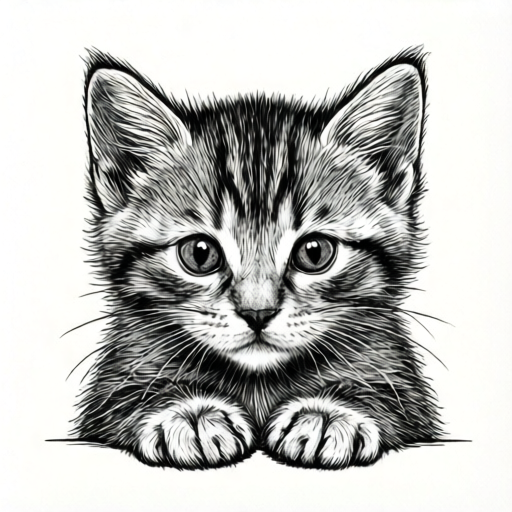
Use the stated measurements and conventions for each exercise.
Set up the head proportion guide
Draw a light rectangle for the head. For this lesson, use a hypothetical example width of 8 units and height of 6 units, where one unit is any convenient pencil length you choose. Mark the vertical midline and a horizontal eye midline about halfway down the rectangle. The chin baseline sits at the bottom edge. These marks are guides, not final lines.
Place two eye ovals on the eye midline, leaving a gap of about one eye width between them. Add a small nose triangle just below the eye midline, then a short mouth line. Keep the muzzle area simple and centered.
- Draw a light 8-by-6 head rectangle and mark the vertical midline.
- Mark the eye midline halfway down and place two eye ovals with a one-eye-width gap.
- Add a small centered nose and a short mouth line below it.
- Check that both eyes sit on the same midline before continuing.
Place ears and paws with boxes
Use two small ear boxes on top of the head rectangle. Each ear box can be about 2 units wide and 2 units tall in the hypothetical example. Draw a triangle inside each box, angling the tips slightly outward. The ear bases should touch the top of the head rectangle.
For the paws, draw two small rounded boxes below the head, spaced about one head-width apart. Each paw box can be about 2 units wide and 1.5 units tall. Add three short toe lines inside each paw. Keep the paw boxes level with each other.
- Draw two 2-by-2 ear boxes on the top edge of the head.
- Inside each ear box, draw a triangle with a slightly outward tip.
- Draw two 2-by-1.5 paw boxes below the head, level and spaced apart.
- Add three short toe lines inside each paw box.
Add fur strokes and finish
Fur strokes are short pencil marks that follow the direction of the fur. On the head, draw strokes outward from the center toward the cheeks. On the ears, use short strokes from the base toward the tip. On the paws, use tiny strokes around the toe lines. Keep strokes separated and light so the kitten does not look shaded.
Erase the rectangle, midline, and box guides only after the final lines are clear. Darken the eyes, nose, ear outlines, and paw outlines. Leave the fur strokes light and varied. A valid alternative is to use curved strokes instead of straight ones, as long as the direction stays consistent.
- Add short outward fur strokes on the cheeks and head sides.
- Add base-to-tip strokes inside each ear.
- Add tiny strokes around the paw toes.
- Erase guides, then darken eyes, nose, ears, and paws.
Worked example
A learner draws a head rectangle 8 units wide and 6 units tall, marks the eye midline at 3 units from the top, and places two eye ovals with a 1-unit gap. They add two 2-by-2 ear boxes on top and two 2-by-1.5 paw boxes below, level with each other. Describe a valid finish.
Worked answer
The proportions match the lesson example. A valid finish is to draw triangles inside the ear boxes with slightly outward tips, add three toe lines in each paw box, and use short light fur strokes outward on the cheeks and base-to-tip in the ears. Erase the guides, then darken the eyes, nose, ear outlines, and paw outlines. Curved fur strokes are also valid if they stay short and consistent.
Four practice exercises
Exercise 1
A head rectangle is 10 units wide and 8 units tall. Where should the eye midline be placed if it is halfway down?
Show answer and check
4 units from the top.
Why: Half of 8 units is 4 units, so the midline sits 4 units below the top edge.
Check: Measure from the top edge to the marked line and confirm it equals half the rectangle height.
Exercise 2
Two ear boxes are each 2 units wide and sit on a head 8 units wide. If they are centered with a 1-unit gap between them, how much space remains on each side?
Show answer and check
1.5 units on each side.
Why: The ear boxes and gap use 2 + 1 + 2 = 5 units. The remaining width is 8 - 5 = 3 units, split equally as 1.5 units per side.
Check: Add the two ear widths, the gap, and both side spaces: 2 + 1 + 2 + 1.5 + 1.5 = 8 units.
Exercise 3
A learner draws paw boxes 2 units wide and 1.5 units tall. If the two boxes are level and spaced 3 units apart, what is the total width across both paws and the gap?
Show answer and check
7 units.
Why: Add the two paw widths and the gap: 2 + 3 + 2 = 7 units.
Check: Measure across the outer edges of both paw boxes and compare with 7 units.
Exercise 4
A kitten head is 6 units tall. The nose is placed 1 unit below the eye midline, and the eye midline is halfway down. How far is the nose from the chin baseline?
Show answer and check
2 units.
Why: The eye midline is 3 units from the top and 3 units from the bottom. The nose is 1 unit below the midline, so it is 3 - 1 = 2 units above the chin baseline.
Check: Measure from the nose to the chin baseline and confirm it is 2 units, then check that nose to eye midline is 1 unit.
Common mistakes
- Making the head rectangle too tall so the kitten looks like an adult cat. Use the hypothetical 8-by-6 proportion and keep the eye midline halfway down.
- Placing ears too far apart or too low on the head. Keep each ear box touching the top edge and angle the tips slightly outward.
- Drawing paw boxes at different heights. Mark a light horizontal line first and place both paw boxes on it.
- Using long, heavy fur strokes that look like shading. Use short, separated strokes and keep them lighter than the final outlines.
Self-check rubric
- Head rectangle uses a consistent width-to-height proportion, such as the hypothetical 8-by-6 example.
- Eye midline is marked halfway down the head and both eyes sit on it.
- Ear boxes touch the top edge and ear tips angle slightly outward.
- Paw boxes are level and spaced apart, with three toe lines each.
- Fur strokes are short, light, and directionally consistent; curved or straight strokes are both valid.
- Guides are erased and final lines are clear without heavy shading.
Questions and answers
Do I need special pencils?
No. A regular pencil and an eraser are enough. Work lightly at first so guides are easy to remove.
Can the fur strokes curve instead of staying straight?
Yes. Curved strokes are valid if they follow a consistent direction and remain short and light.
How do I know the head proportion is correct?
Check that the eye midline is halfway down the head rectangle and that the eyes sit on that same line.
Should I erase all guides?
Erase the rectangle, midline, and boxes after the final lines are clear. Keep the fur strokes and final outlines.