Free original lessons
Drawing a Magazine Cover: Masthead, Coverlines, and Focal Image
Plan and draw a magazine cover using a frame, masthead band, coverline boxes, and a focal image area. Includes layout conventions, a worked example, and four practice tasks.
Free lesson
Four exercises
Worked answers
Object Drawing Lessons
A magazine cover is a designed page: a masthead names the publication, coverlines promise stories, and a focal image anchors attention. This lesson teaches a repeatable drawing method using a simple convention: treat the cover as a rectangle divided into a masthead band at the top, a focal image area in the center or lower two-thirds, and coverline placement boxes along the sides or bottom. You will measure your own paper and chosen frame, label any numerical values as hypothetical examples, and use consistent units. The goal is a clear, readable cover sketch, not a printed product. All four exercises are self-contained; where an example diagram is needed, it is described in words.
Practice materials: Printable downloads are not available for this lesson yet. Use the instructions and four exercises below.
Reference illustration
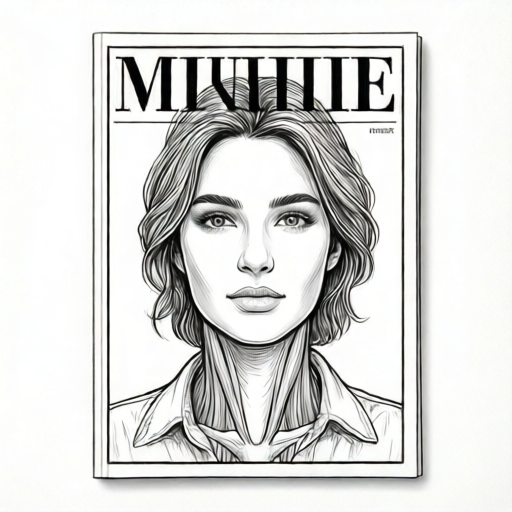
Use the stated measurements and conventions for each exercise.
Set the frame and masthead band
Start by drawing a rectangle for the cover frame. Measure your paper with a ruler and record width and height in the same unit, such as centimeters. For planning, choose a masthead band height that is roughly one-fifth to one-sixth of the frame height; these are hypothetical proportions, not a standard. Draw a horizontal line across the top of the frame to mark the bottom of the masthead band. The masthead sits inside this band, centered or aligned to one side, and should be the largest text on the cover.
Keep the masthead readable by leaving clear space around it. If the focal image will overlap the band, decide in advance which part of the masthead remains unobstructed. Use pencil for construction lines and a darker pencil or pen for final lettering.
- Measure the paper and draw the cover frame rectangle.
- Mark the masthead band with a horizontal line at a chosen fraction of the frame height.
- Letter the masthead inside the band, keeping it the largest text.
- Check that the masthead is readable from arm's length.
Place the focal image area
The focal image is the main visual: a face, object, or scene that draws the eye. Reserve an area for it, often the central or lower two-thirds of the frame. Draw a light boundary box for this area, then sketch the image inside it. The image may extend beyond the box if you plan the overlap, but keep the masthead and at least one coverline clear.
Use simple shapes first: an oval for a head, a rectangle for a product, or a triangle for a landscape element. Add detail only after the placement is settled. The focal image should not compete with the masthead for the same space.
- Draw a light boundary box for the focal image area.
- Sketch the main shape of the image inside the box.
- Decide whether the image overlaps the masthead band or coverline boxes.
- Refine details after placement is confirmed.
Add coverlines in placement boxes
Coverlines are short text blocks that hint at inside stories. Draw small rectangular placement boxes along the sides or bottom of the frame, outside the focal image area where possible. Each box holds one coverline. Use a consistent letter height smaller than the masthead. A useful convention is to make coverlines roughly half the height of the masthead letters, but this is a hypothetical example, not a rule.
Keep coverlines short and legible. Align them to a common edge or center them within their boxes. Leave a small margin between boxes and the frame edge so the layout does not feel crowded.
- Draw two to four coverline placement boxes.
- Letter one short coverline in each box.
- Keep coverline letter height smaller than the masthead.
- Check alignment and margins.
Review and refine the layout
Review the cover at arm's length and at a glance. The masthead should be identifiable first, the focal image second, and coverlines third. Check that no text is hidden by the image and that the frame edges are clean. Erase construction lines that are no longer needed, or leave them light if they help explain the layout.
Because letter styles vary, there is no single correct handwriting. The rubric rewards clear hierarchy, readable text, and deliberate placement, and it accepts valid alternatives such as centered or left-aligned mastheads, or coverlines placed at the bottom instead of the sides.
- View the cover from a short distance and identify the reading order.
- Confirm masthead, image, and coverlines are all visible.
- Adjust any crowded or hidden text.
- Finalize with darker lines where needed.
Worked example
A cover frame is 12 cm wide and 18 cm high. Choose a masthead band height of 3 cm, draw a focal image boundary box from 6 cm to 15 cm from the top, and place two coverline boxes: one 2 cm wide by 3 cm high at the left side starting 6 cm from the top, and one 4 cm wide by 2 cm high at the bottom starting 1 cm from the left edge. Describe the layout and check that the masthead band and coverline boxes do not overlap the focal image box.
Worked answer
The masthead band occupies the top 3 cm. The focal image box occupies from 6 cm to 15 cm from the top, leaving a 3 cm gap below the masthead band. The left coverline box starts at 6 cm from the top and is 3 cm high, so it spans 6 cm to 9 cm; it sits to the left of the focal image box if the image box starts at least 2 cm from the left edge. The bottom coverline box spans 1 cm to 5 cm from the left and 2 cm high at the bottom, below the focal image box which ends at 15 cm from the top (3 cm above the bottom). No overlap occurs if the focal image box is placed centrally with at least 2 cm margins on each side. The masthead is largest, the image is central, and coverlines are smaller and outside the image area.
Four practice exercises
Exercise 1
A cover frame is 10 cm wide and 15 cm high. Draw a masthead band 2.5 cm high at the top. Draw a focal image boundary box from 5 cm to 12 cm from the top, centered with 1 cm margins on each side. Place one coverline box 3 cm wide by 2 cm high at the bottom left, starting 1 cm from the left edge and 1 cm from the bottom. Describe the layout and state whether the coverline box overlaps the focal image box.
Show answer and check
The masthead band is the top 2.5 cm. The focal image box spans 5 cm to 12 cm from the top and is 8 cm wide (10 cm minus 1 cm margins on each side). The coverline box spans 1 cm to 4 cm from the left and 1 cm to 3 cm from the bottom, which is 12 cm to 14 cm from the top. The focal image box ends at 12 cm from the top, so the coverline box starts exactly at the image box bottom edge and does not overlap.
Why: Convert bottom measurements to top measurements: 15 cm height minus 1 cm bottom margin gives 14 cm from top for the box bottom, and minus 2 cm height gives 12 cm from top for the box top. The image box ends at 12 cm, so the coverline box is below it.
Check: Measure the frame height, subtract the bottom margin and box height to find the coverline top position, and compare with the image box bottom position. Confirm no overlap by checking that the coverline top is at or below the image bottom.
Exercise 2
A cover frame is 14 cm wide and 20 cm high. Choose a masthead band height of 4 cm. Draw a focal image boundary box from 7 cm to 17 cm from the top, with 2 cm margins on each side. Place two coverline boxes on the right side: one 3 cm wide by 4 cm high starting 7 cm from the top, and one 3 cm wide by 3 cm high starting 12 cm from the top. Describe the layout and check whether either coverline box overlaps the focal image box.
Show answer and check
The masthead band is the top 4 cm. The focal image box spans 7 cm to 17 cm from the top and is 10 cm wide (14 cm minus 2 cm margins on each side), so it occupies from 2 cm to 12 cm from the left. The right coverline boxes start at 11 cm from the left (14 cm minus 3 cm width) and are 3 cm wide, so they occupy 11 cm to 14 cm from the left. The first coverline box spans 7 cm to 11 cm from the top and overlaps the image box vertically (7 cm to 17 cm) and horizontally (11 cm to 12 cm overlap). The second coverline box spans 12 cm to 15 cm from the top and overlaps vertically (12 cm to 15 cm is within 7 cm to 17 cm) and horizontally (11 cm to 12 cm overlap). Both overlap the image box.
Why: The image box right edge is at 12 cm from the left. The coverline boxes start at 11 cm from the left, so they overlap the image box by 1 cm horizontally. Vertically, both coverline boxes fall within the image box range, so overlap occurs.
Check: Calculate the image box left and right edges from the margins, calculate the coverline box left and right edges from the right margin, and compare horizontal ranges. Compare vertical ranges using top measurements. Overlap exists if both horizontal and vertical ranges intersect.
Exercise 3
A cover frame is 9 cm wide and 12 cm high. Draw a masthead band 2 cm high. Draw a focal image boundary box from 4 cm to 10 cm from the top, centered with 1.5 cm margins on each side. Place one coverline box 2 cm wide by 2 cm high at the top left, starting 0.5 cm from the left edge and 2.5 cm from the top. Describe the layout and state whether the coverline box overlaps the masthead band or the focal image box.
Show answer and check
The masthead band is the top 2 cm. The coverline box spans 2.5 cm to 4.5 cm from the top, so it is below the masthead band and does not overlap it. The focal image box spans 4 cm to 10 cm from the top and is 6 cm wide (9 cm minus 1.5 cm margins on each side), occupying 1.5 cm to 7.5 cm from the left. The coverline box spans 0.5 cm to 2.5 cm from the left, so it overlaps the image box horizontally from 1.5 cm to 2.5 cm. Vertically, the coverline box spans 2.5 cm to 4.5 cm and the image box starts at 4 cm, so they overlap vertically from 4 cm to 4.5 cm. The coverline box overlaps the focal image box.
Why: The coverline box bottom is at 4.5 cm from the top, which is below the masthead band bottom at 2 cm, so no masthead overlap. The image box starts at 4 cm from the top and 1.5 cm from the left; the coverline box extends to 4.5 cm from the top and 2.5 cm from the left, creating a small overlap.
Check: Compare the coverline box bottom position with the masthead band bottom to check masthead overlap. Compare horizontal and vertical ranges of the coverline box and image box to check image overlap.
Exercise 4
A cover frame is 16 cm wide and 24 cm high. Choose a masthead band height of 5 cm. Draw a focal image boundary box from 8 cm to 20 cm from the top, with 3 cm margins on each side. Place three coverline boxes at the bottom: each 4 cm wide by 3 cm high, starting 1 cm from the left, 6 cm from the left, and 11 cm from the left, all 1 cm from the bottom. Describe the layout and check whether any coverline box overlaps the focal image box.
Show answer and check
The masthead band is the top 5 cm. The focal image box spans 8 cm to 20 cm from the top and is 10 cm wide (16 cm minus 3 cm margins on each side), occupying 3 cm to 13 cm from the left. The bottom coverline boxes span 1 cm to 5 cm, 6 cm to 10 cm, and 11 cm to 15 cm from the left, and 20 cm to 23 cm from the top (24 cm minus 1 cm bottom margin minus 3 cm height). The image box ends at 20 cm from the top, so the coverline boxes start exactly at the image box bottom edge and do not overlap. Horizontally, the first and third coverline boxes extend beyond the image box left and right edges, but vertical separation prevents overlap.
Why: Convert bottom measurements to top measurements: 24 cm height minus 1 cm bottom margin gives 23 cm from top for the box bottom, and minus 3 cm height gives 20 cm from top for the box top. The image box ends at 20 cm, so the coverline boxes are below it.
Check: Calculate the coverline box top position from the frame height, bottom margin, and box height. Compare with the image box bottom position. Confirm no overlap by checking that the coverline top is at or below the image bottom.
Common mistakes
- Making the masthead the same size as the coverlines. Increase masthead letter height or reduce coverline height so the masthead is clearly largest.
- Letting the focal image cover the entire masthead. Plan the overlap so at least part of the masthead remains unobstructed, or move the image boundary.
- Placing coverlines inside the focal image area without planning. Draw coverline boxes outside the image boundary or decide which part of the image they may overlap.
- Using inconsistent units when measuring the frame and band. Record all measurements in one unit, such as centimeters, and label hypothetical values as examples.
Self-check rubric
- Frame is a clear rectangle with measured width and height in one unit.
- Masthead band is marked and the masthead is the largest text.
- Focal image area is bounded and the image is sketched inside or deliberately overlapping.
- Two to four coverlines are placed in boxes with letter height smaller than the masthead.
- Reading order is clear at arm's length: masthead, image, coverlines.
- Valid alternatives such as centered or left-aligned mastheads, or bottom coverlines, are accepted if hierarchy and readability are maintained.
Questions and answers
Do I need a ruler?
A ruler helps keep the frame and band consistent, but you can use any straight edge. Measure your actual paper and record the unit.
How large should the masthead band be?
A common planning choice is one-fifth to one-sixth of the frame height, but this is a hypothetical example. Choose a height that keeps the masthead readable.
Can the focal image overlap the masthead?
Yes, if you plan it. Keep enough of the masthead visible to read the publication name.
Is there one correct lettering style?
No. Letter styles vary. The rubric rewards clear hierarchy and readability, and accepts valid alternatives.