Free original lessons
Molcajete Drawing: Bowl, Three Legs, and Rough Grinding Texture
Learn to draw a three-legged stone molcajete with a clear bowl ellipse, balanced leg placement, and convincing rough interior grinding texture.
Free lesson
Four exercises
Worked answers
Object Drawing Lessons
A molcajete is a three-legged stone mortar with a thick, rough bowl and a wide rim. This lesson teaches a reliable drawing sequence: establish the bowl ellipse and rim thickness, place three legs so the vessel looks stable, then build interior grinding texture with short, varied marks. You will use a simple convention for judging proportions and a rubric that accepts valid stylistic alternatives. All measurements are hypothetical examples; measure your own paper and reference object if you use one.
Practice materials: Printable downloads are not available for this lesson yet. Use the instructions and four exercises below.
Reference illustration
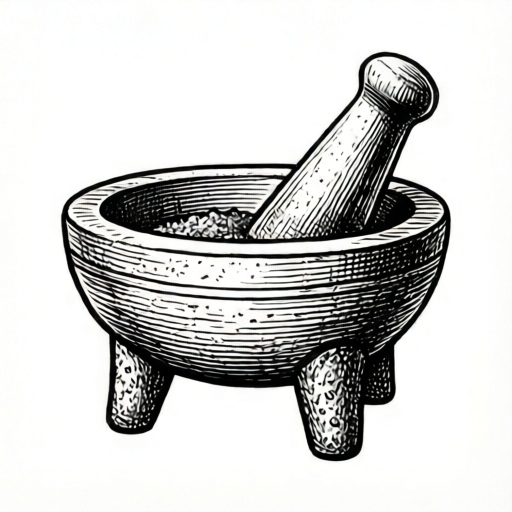
Use the stated measurements and conventions for each exercise.
Set the bowl ellipse and rim thickness
Begin with a light horizontal baseline for the bowl opening. Draw an ellipse that is wider than it is tall; a common hypothetical ratio is 3:1 width to height. Mark the ellipse center and the left and right extremes. The rim is a thick band, so draw a second ellipse slightly inside the first, concentric with it and scaled inward by about one-tenth of the bowl width on all sides. This creates the visible rim thickness.
Check symmetry by measuring from the center to each side with a pencil or ruler. The two halves should be close, not identical; slight variation is acceptable in hand drawing. Keep the ellipse edges smooth and continuous rather than faceted.
- Draw a light horizontal baseline and mark the bowl width.
- Draw the outer ellipse with a width-to-height ratio near 3:1.
- Draw the inner ellipse concentric with the outer one, scaled inward uniformly to show rim thickness.
- Mark the center and compare left and right distances.
Place three legs for stability
A molcajete stands on three legs, so the drawing must show all three without making the bowl look tilted. Place two legs at the front left and front right, and one leg at the back center. The front legs should sit slightly inside the bowl's outer width, and the back leg should be partly hidden by the bowl body. Use short vertical or slightly tapered forms.
Check stability by drawing an imaginary triangle through the three leg tips. The bowl's center of mass should fall inside that triangle. If the back leg is too far to one side, the vessel looks unstable. Keep leg lengths similar; a hypothetical leg height is one-quarter of the bowl width.
- Mark front-left and front-right leg positions inside the bowl width.
- Mark the back-center leg position behind the bowl.
- Draw each leg as a short tapered form with a flat foot.
- Check that the three tips form a triangle containing the bowl center.
Build rough interior grinding texture
The interior of a molcajete is rough, not smooth. Show this with short, varied marks that follow the bowl's curvature. Use a mix of small dots, short dashes, and tiny crescent strokes. Vary direction and spacing so the texture reads as stone rather than a uniform pattern. Keep marks inside the inner ellipse and avoid covering the rim.
Use a convention for texture density: light, medium, and heavy. Light means sparse marks with visible paper; medium means marks cover about half the interior; heavy means dense marks with small gaps. Any of these can be valid if consistent. Do not invent a universal stone standard; the goal is a readable rough surface.
- Outline the inner bowl area lightly.
- Add sparse short marks following the curve.
- Increase density in the lower interior where grinding occurs.
- Leave small gaps so the texture does not become a solid patch.
Refine contour and shadow
Strengthen the outer contour and the rim edge, then add a simple shadow under the bowl and legs. The shadow should sit on the ground plane and connect the leg tips. Keep the light direction consistent; a hypothetical light from upper left means shadows fall to the lower right.
Check the final drawing by comparing the bowl width, rim thickness, leg height, and texture density. Adjust any part that looks inconsistent with the others. Valid alternatives include a rounder bowl, a wider rim, or a different texture density, as long as the three-legged stone mortar form remains clear.
- Darken the outer contour and rim edge.
- Add a ground shadow connecting the leg tips.
- Compare bowl width, rim thickness, and leg height.
- Adjust texture density for consistency.
Worked example
Draw a molcajete with a bowl width of 12 units, a bowl height of 4 units, a rim offset of 1 unit, and three legs each 3 units tall. Place two front legs and one back-center leg. Use medium interior texture.
Worked answer
The outer ellipse is 12 units wide and 4 units tall. The inner ellipse is concentric with the outer one and scaled inward uniformly by about 1 unit on all sides to show rim thickness. The front legs sit inside the bowl width at about 3 units from each side, and the back leg sits at the center behind the bowl. Each leg is 3 units tall. The interior uses medium-density short marks following the bowl curve, with small gaps. A ground shadow connects the three leg tips.
Why: The 3:1 width-to-height ratio keeps the bowl wide and shallow. The 1-unit inward scaling is one-twelfth of the width, which is visible but not exaggerated. The leg triangle contains the bowl center, so the vessel looks stable. Medium texture is a consistent convention, not a universal standard.
Check: Measure the drawn ellipse width and height; the ratio should be close to 3:1. Check that the inner ellipse is scaled inward by a similar amount on all sides. Confirm the three leg tips form a triangle containing the bowl center. Confirm texture marks are varied and cover about half the interior.
Four practice exercises
Exercise 1
Draw a molcajete with a bowl width of 10 units and a bowl height of 5 units. Add a rim offset of 1 unit and three legs each 2 units tall. Use light interior texture.
Show answer and check
Outer ellipse 10 wide by 5 tall; inner ellipse concentric with the outer one and scaled inward uniformly by 1 unit; two front legs inside the width and one back-center leg; each leg 2 units tall; sparse short marks inside the inner ellipse.
Why: The 2:1 width-to-height ratio makes a shallower bowl than the worked example. The 1-unit inward scaling is one-tenth of the width. Leg height is one-fifth of the width, which is short but stable if the leg triangle contains the bowl center.
Check: Measure the ellipse ratio (close to 2:1), check the inner ellipse is scaled inward by a similar amount all around, confirm three leg tips form a triangle containing the center, and confirm texture marks are sparse with visible paper.
Exercise 2
A drawing shows a bowl ellipse 8 units wide and 4 units tall, but all three legs are placed in a straight line across the front. Describe the correction and the check you would use.
Show answer and check
Move one leg to the back center and keep two legs at the front left and front right. The leg tips should form a triangle that contains the bowl center.
Why: Three legs in a straight line do not show the three-legged mortar form and make the vessel look unstable. A triangular arrangement with one back-center leg is the correct boundary.
Check: Draw an imaginary triangle through the three leg tips and mark the bowl center. The center should fall inside the triangle, not outside or on an edge.
Exercise 3
Draw a molcajete with a bowl width of 12 units, a rim offset of 1.5 units, and heavy interior texture. Explain how you keep the texture from becoming a solid patch.
Show answer and check
Use dense short marks with small gaps between them, vary mark direction, and leave the rim clear. Heavy texture means dense coverage but not a filled-in area. Draw the inner ellipse concentric with the outer one and scaled inward uniformly by 1.5 units.
Why: Heavy density is a convention for rough stone, but small gaps keep the surface readable. Varying direction prevents a uniform pattern.
Check: Check that small gaps remain visible across the interior, that marks follow the bowl curve, that the rim band is not covered by texture marks, and that the inner ellipse is scaled inward by a similar amount all around.
Exercise 4
Draw a molcajete with a bowl width of 9 units and a bowl height of 3 units. Place the front legs 2 units from each side and the back leg at center. Use medium texture. State one valid alternative you could use instead.
Show answer and check
Outer ellipse 9 wide by 3 tall; front legs at 2 units from each side; back leg at center; medium texture with varied marks. A valid alternative is a slightly wider rim offset or a rounder bowl, as long as the three-legged form remains clear.
Why: The 3:1 ratio keeps the bowl wide and shallow. Front leg positions inside the width and a back-center leg create a stable triangle. Medium texture is a consistent convention.
Check: Measure the ellipse ratio (close to 3:1), check front leg distances from each side, confirm the leg triangle contains the bowl center, and confirm texture density is medium with varied marks.
Common mistakes
- Drawing the bowl as a perfect circle instead of an ellipse. Flatten the ellipse by reducing its height relative to its width, then check the width-to-height ratio.
- Placing all three legs in a straight line or too close together. Use a triangular arrangement with two front legs and one back-center leg, then check that the bowl center falls inside the leg triangle.
- Making the interior texture a uniform pattern of identical marks. Vary mark length, direction, and spacing, and use a consistent light, medium, or heavy density convention.
- Drawing the rim as a single line with no thickness. Add an inner ellipse concentric with the outer one and scaled inward uniformly to show the rim band, then keep the inward scaling consistent around the bowl.
Self-check rubric
- Bowl is drawn as a wide ellipse with a visible thick rim.
- Three legs are present: two front and one back center.
- Leg placement forms a stable triangle containing the bowl center.
- Interior texture is rough, varied, and follows the bowl curvature.
- Texture density convention is consistent (light, medium, or heavy).
- Outer contour and rim edge are clear and continuous.
- Ground shadow connects the leg tips and is consistent with light direction.
- Valid alternatives in proportion, rim width, and texture density are accepted if the three-legged stone mortar form remains clear.
Questions and answers
How many legs should the molcajete have?
Three legs: two at the front and one at the back center. This three-legged form is the key boundary of the task.
Can I use a rounder bowl shape?
Yes, as long as the bowl reads as a wide mortar with a thick rim and three legs. The rubric accepts valid alternatives in proportion and style.
How rough should the interior texture be?
Choose a light, medium, or heavy density convention and keep it consistent. There is no single universal texture standard.
Do I need exact measurements?
No. Use simple checkable ratios and label any numerical values as hypothetical examples. Measure your own paper if needed.