Free original lessons
Monochromatic Landscape Drawing: Single-Hue Value Steps
Learn to draw a landscape using one hue and a value scale. Mix tints and shades, plan sky, land, and foreground layers, and check contrast with simple steps.
Free lesson
Four exercises
Worked answers
Object Drawing Lessons
A monochromatic landscape uses one hue plus black and white to create a full range of values. This lesson teaches you to build a value strip, mix tints and shades, and apply them in layers from sky to foreground. You will plan values before drawing, use a simple convention for judging lightness, and check your work with arithmetic and visual tests. All examples use hypothetical measurements; measure your own tools and materials.
Practice materials: Printable downloads are not available for this lesson yet. Use the instructions and four exercises below.
Reference illustration
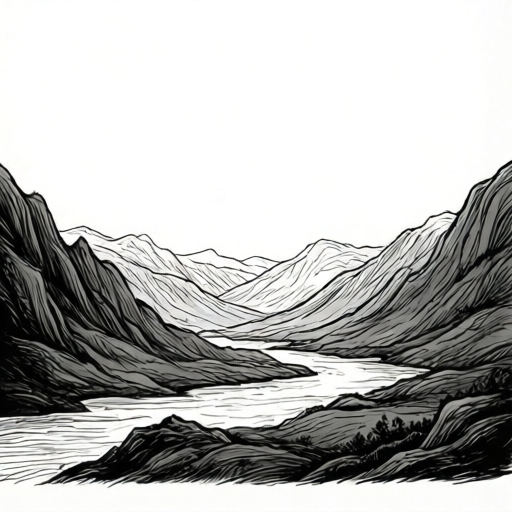
Use the stated measurements and conventions for each exercise.
Build a Single-Hue Value Strip
Start by choosing one hue, such as ultramarine blue or burnt sienna. You will create a strip of at least five value steps from lightest tint to darkest shade. Label each step with a number from 1 (lightest) to 5 (darkest). This strip becomes your reference for the whole landscape.
Mix tints by adding white to the hue; mix shades by adding black. Keep the hue consistent: avoid adding other colors. If your medium is digital, use a single color and adjust lightness. For dry media, test each step on scrap paper before committing to the final drawing.
- Place a small amount of your hue on the palette.
- Mix step 1: mostly white with a touch of hue.
- Mix step 2: equal parts white and hue.
- Mix step 3: the pure hue.
- Mix step 4: hue plus a small amount of black.
- Mix step 5: hue plus more black for the darkest shade.
- Paint or draw a small square of each step in order and label 1–5.
Plan Values for Sky, Land, and Foreground
Assign a value number to each major area before drawing. A common plan is sky 1–2, distant land 2–3, middle ground 3–4, and foreground 4–5. This creates depth because lighter values recede and darker values advance. You may reverse the plan if your light source is behind the land, but keep the steps distinct.
Use a simple outline of the landscape with three horizontal bands: sky, land, and foreground. Within each band, mark where you will use each value. Avoid gradients; use flat steps or clear boundaries. The goal is a readable landscape, not a smooth sunset.
- Draw a light outline with three bands: sky, land, foreground.
- Write the planned value number in each band.
- Check that adjacent bands differ by at least one step.
- Mark any small shapes, such as trees or rocks, with their value numbers.
- Confirm your value strip has the needed steps before applying color.
Apply Values in Layers and Check Contrast
Work from lightest to darkest to avoid contaminating light mixtures. Fill the sky first with step 1 or 2, then the distant land, middle ground, and foreground. Let each layer dry if using wet media. Keep edges clean where values meet; a crisp boundary helps the eye read the steps.
After filling, check contrast by squinting or viewing the drawing from a distance. Adjacent areas should differ by at least one value step. If two areas merge, adjust one by one step lighter or darker. Use a simple arithmetic check: list the value numbers for each band and confirm the differences.
- Fill sky with the lightest planned value.
- Fill distant land with the next value.
- Fill middle ground with a darker value.
- Fill foreground with the darkest value.
- Squint to test separation; adjust any merged areas by one step.
- Record the final value numbers for each band.
Worked example
A landscape has three bands: sky, land, foreground. Using a 1–5 value strip, plan values so the sky is lightest and the foreground is darkest, with each adjacent band differing by at least one step. State the values and the differences.
Worked answer
Sky = 1, land = 3, foreground = 5. Differences: sky to land = 2 steps; land to foreground = 2 steps. All adjacent differences are at least 1, and the sky is lightest while the foreground is darkest.
Four practice exercises
Exercise 1
You have a 1–5 value strip. Plan a landscape with sky = 2, distant land = 3, middle ground = 4, foreground = 5. List the adjacent differences and state whether the plan meets the rule that each adjacent pair differs by at least one step.
Show answer and check
Differences: sky to distant land = 1; distant land to middle ground = 1; middle ground to foreground = 1. The plan meets the rule because every adjacent difference is at least 1.
Why: Subtract each value from the next: 3−2=1, 4−3=1, 5−4=1. All results are ≥1, so the plan is valid.
Check: Re-list the values in order and subtract adjacent pairs. Confirm no difference is 0.
Exercise 2
A drawing uses sky = 1, land = 2, foreground = 2. Identify the problem and propose one fix that keeps the sky lightest and the foreground darkest.
Show answer and check
The land and foreground share value 2, so they may merge. Fix: change foreground to 3 (or land to 1 and foreground to 3, but sky must remain lightest). One valid fix is sky = 1, land = 2, foreground = 3.
Why: Adjacent land and foreground differ by 0 steps, which violates the contrast rule. Increasing foreground to 3 gives differences of 1 and 1, and keeps sky lightest and foreground darkest.
Check: Compute differences: 2−1=1 and 3−2=1. Confirm sky is smallest and foreground is largest.
Exercise 3
You mix a value strip with steps 1–5. Step 1 is mostly white, step 3 is pure hue, step 5 is hue plus black. Describe how to mix step 2 and step 4 so the strip remains monochromatic and ordered from light to dark.
Show answer and check
Step 2: mix white with a small amount of hue, lighter than pure hue but darker than step 1. Step 4: mix pure hue with a small amount of black, darker than pure hue but lighter than step 5. Keep only the one hue, white, and black.
Why: Step 2 must sit between step 1 and step 3, so it needs more hue than step 1 but less than pure hue. Step 4 must sit between step 3 and step 5, so it needs some black but less than step 5.
Check: Place small squares in order 1–5 and squint. Confirm the sequence appears steadily darker and no other hue is visible.
Exercise 4
A landscape plan uses sky = 3, land = 2, foreground = 1. Does this meet the rule that adjacent bands differ by at least one step? Does it keep the sky lightest and foreground darkest? Explain.
Show answer and check
Adjacent differences: sky to land = 1; land to foreground = 1. The contrast rule is met. However, the sky is not lightest and the foreground is not darkest; the plan reverses the usual order. It is valid only if you intentionally want a dark sky and light foreground, but it does not meet the stated goal of sky lightest and foreground darkest.
Why: Differences are 3−2=1 and 2−1=1, so contrast is fine. But the goal requires sky to be the smallest number and foreground the largest; here sky=3 and foreground=1, so the goal is not met.
Check: Check differences and also compare sky and foreground to the goal: sky should be minimum, foreground maximum. Both checks must pass.
Common mistakes
- Using more than one hue, which breaks the monochromatic rule. Keep one hue and adjust only with white and black. Test mixtures on scrap paper before applying.
- Making adjacent bands too close in value so the landscape looks flat. Ensure each adjacent band differs by at least one step on your 1–5 strip. Adjust one band by one step.
- Applying dark values first and muddying lighter mixtures. Work from lightest to darkest, cleaning tools between steps.
- Creating smooth gradients instead of distinct value steps. Use flat fills or clear boundaries. If blending, stop at the planned step and avoid continuous transitions.
Self-check rubric
- Uses exactly one hue plus white and black; no other colors.
- Includes a labeled value strip with at least five steps from light to dark.
- Assigns distinct value numbers to sky, land, and foreground, with adjacent differences of at least one step.
- Applies values in flat steps or clear boundaries; avoids continuous gradients.
- Checks contrast by squinting or distance viewing and records final value numbers.
- Landscape is readable as sky, land, and foreground using value alone.
Questions and answers
Can I use any hue for a monochromatic landscape?
Yes, any single hue works. Choose one that can produce a clear light-to-dark range with white and black. Test your strip first.
How many value steps do I need?
At least five steps are recommended for clear separation. You can use more if your medium allows, but keep the numbering consistent.
What if my landscape needs a light foreground?
You may reverse the value plan, but keep adjacent areas at least one step apart. The key is readable contrast, not a fixed order.
How do I check my work without special tools?
Squint or view from a distance. List the value numbers for each band and confirm differences of at least one step.