Free original lessons
Draw an Annoyed Expression: Brow and Mouth Variation Practice
Learn to draw annoyed faces by varying brow angle, mouth shape, and tension cues. Includes a convention, rubric, worked example, and four self-contained exercises.
Free lesson
Four exercises
Worked answers
Object Drawing Lessons
An annoyed expression sits between mild irritation and anger. The key is controlled tension: brows pull together and down slightly, eyes narrow, and the mouth tightens or flattens rather than opens wide. This lesson isolates two variables—brow shape and mouth shape—so you can produce clear, readable variants without relying on a single universal face. You will use a simple drawing convention: the face is an oval; the eye line is halfway down; the nose base is halfway between eye line and chin; the mouth line is one-third of the way from nose base to chin. X-height means the distance from baseline to midline for lettering, but here we use it only as a scale reference for small features. All numerical values are hypothetical examples for practice, not manufacturing standards. Measure your own paper and tools if you need exact sizes.
Practice materials: Printable downloads are not available for this lesson yet. Use the instructions and four exercises below.
Reference illustration
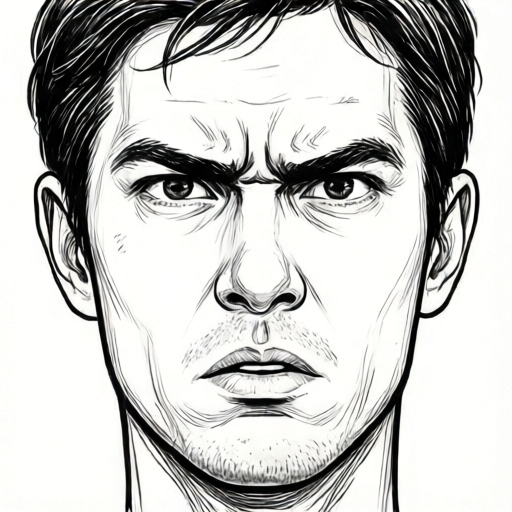
Use the stated measurements and conventions for each exercise.
Convention and setup
Draw a vertical oval about 8 cm tall and 6 cm wide on plain paper. Mark a horizontal eye line at the vertical midpoint. Mark the nose base halfway between the eye line and the chin. Mark the mouth line one-third of the way from the nose base to the chin. These proportions are a convention, not a rule; you may adjust them, but keep them consistent within one sheet so variations are comparable.
Use a pencil and a fine-tip pen. Keep line weight light for construction and darker for final features. Label each variant with a short cue word such as 'flat mouth' or 'inner-brow lift' so you can compare later.
- Draw the oval and the three guide lines.
- Place two eye shapes on the eye line, each about 1.5 cm wide.
- Draw the nose as a short vertical tick at the nose base.
- Choose one brow shape and one mouth shape from the lists below.
- Draw the brows above the eyes and the mouth on the mouth line.
- Add one tension cue: a small crease between the brows or a slight lower-lid line.
Brow variation cues
Annoyed brows usually combine inward pull with a slight downward angle at the inner ends. Vary three things: inner-end height, outer-end height, and the gap between the brows. A smaller gap and a sharper inner-down angle read as more intense annoyance; a larger gap and a flatter angle read as milder.
Valid alternatives exist. Some drawings use one brow raised and one lowered; that can read as skeptical annoyance. Others use both brows pulled straight down; that can read as tired annoyance. The rubric accepts any variant that keeps the inner ends closer than the outer ends and avoids wide-eyed surprise.
- Variant A: inner ends 2 mm lower than outer ends, gap 4 mm.
- Variant B: inner ends 4 mm lower, gap 2 mm, slight crease between brows.
- Variant C: one brow flat, one brow inner-down by 3 mm, gap 5 mm.
- Check that the brows do not curve upward at the inner ends, which would read as worry.
Mouth variation cues
Annoyed mouths are usually closed or nearly closed. Vary the line shape: flat, slight downward curve, one corner pulled down, or a small pressed line with a short vertical crease at one corner. Avoid a wide open mouth or a big smile.
Keep the mouth width between 2 cm and 3 cm on the 6 cm-wide oval. A narrower mouth with a pressed corner reads as controlled annoyance; a wider flat line reads as blunt annoyance. Both are valid if the brow cue supports the same intensity.
- Variant 1: flat horizontal line, 2.5 cm wide.
- Variant 2: slight downward curve, 2 cm wide, corners 2 mm lower than center.
- Variant 3: one corner pulled down 3 mm, other corner level.
- Variant 4: short pressed line 1.5 cm wide with a 3 mm vertical crease at one corner.
- Check that the mouth does not curve upward at both corners, which would read as a smile.
Combining and checking readability
Combine one brow variant with one mouth variant. The pair should agree in intensity: a sharp brow with a flat mouth reads as strong annoyance; a mild brow with a slight downward mouth reads as mild annoyance. If the brow is sharp but the mouth is wide and flat, the face may read as bored rather than annoyed; adjust one feature.
Use a simple check: cover the mouth and ask whether the brows alone read as annoyed. Then cover the brows and ask whether the mouth alone reads as annoyed. If both pass, the combination is likely clear. If one fails, change only that feature and compare.
- Draw four combinations on one sheet: A1, A2, B3, C4.
- Label each with the cue words used.
- Ask a peer to point to the most annoyed and least annoyed variant without seeing your labels.
- Record which cue words matched their choice.
Worked example
Draw one annoyed face using brow variant B (inner ends 4 mm lower, gap 2 mm, crease) and mouth variant 2 (slight downward curve, 2 cm wide, corners 2 mm lower than center). Label the cues and state one check you would use.
Worked answer
On the 8 cm by 6 cm oval, place eyes on the eye line. Draw brows with inner ends 4 mm lower than outer ends and a 2 mm gap; add a 3 mm crease between them. Draw the mouth as a 2 cm line with corners 2 mm lower than the center. Label 'inner-down brows' and 'slight down mouth'. Check: cover the mouth; the brows alone should read as annoyed because the inner ends are lower and close. Cover the brows; the mouth alone should read as mildly annoyed because the corners are lower than the center. If either fails, adjust only that feature by 1 mm and compare.
Four practice exercises
Exercise 1
Draw two annoyed faces on one oval template. Face 1 uses brow variant A (inner ends 2 mm lower, gap 4 mm) and mouth variant 1 (flat line 2.5 cm wide). Face 2 uses brow variant B (inner ends 4 mm lower, gap 2 mm, crease) and mouth variant 3 (one corner down 3 mm). Label each cue and state which face reads as more annoyed and why.
Show answer and check
Face 2 should read as more annoyed because the inner brows are lower and closer, and the mouth has a pulled-down corner. Face 1 is milder because the brow angle is shallower and the mouth is flat.
Why: Smaller brow gap and lower inner ends increase tension; a pulled-down corner adds a second tension cue. The combination agrees in intensity.
Check: Cover the mouth of each face and compare brows; cover the brows and compare mouths. Ask a peer to point to the more annoyed face without seeing labels.
Exercise 2
Draw one annoyed face using brow variant C (one brow flat, one brow inner-down by 3 mm, gap 5 mm) and mouth variant 4 (pressed line 1.5 cm wide with a 3 mm vertical crease at one corner). Then draw a second face that changes only the mouth to variant 1 (flat line 2.5 cm wide). State which face reads as more skeptical and which as more bluntly annoyed.
Show answer and check
The first face reads as more skeptical because the uneven brows and pressed corner suggest a reaction. The second face reads as more bluntly annoyed because the flat wide mouth is direct and the uneven brows remain.
Why: Uneven brows can signal skepticism; a pressed corner adds controlled tension. Changing only the mouth isolates the mouth effect, making comparison valid.
Check: Compare the two faces side by side; confirm only the mouth changed. Use the cover test on each feature and ask a peer to match your labels.
Exercise 3
On a 6 cm-wide oval, draw a mild annoyed face and a strong annoyed face. For mild, use inner brows 1 mm lower than outer ends with a 5 mm gap and a flat mouth 2 cm wide. For strong, use inner brows 5 mm lower with a 1 mm gap and a mouth with both corners down 3 mm, 2 cm wide. Measure and record the brow gap and mouth width for each. State one arithmetic check comparing the gaps.
Show answer and check
Mild: brow gap 5 mm, mouth width 20 mm. Strong: brow gap 1 mm, mouth width 20 mm. Arithmetic check: 5 mm minus 1 mm equals 4 mm, so the strong variant has a 4 mm smaller brow gap. Both mouths are 20 mm wide, so the intensity change comes from brows and corner drop.
Why: Keeping mouth width constant isolates brow gap and corner drop as the intensity variables. The arithmetic check confirms the gap difference.
Check: Measure with a ruler; confirm 5 mm and 1 mm gaps and 20 mm mouth widths. Recheck that inner ends are lower than outer ends in both faces.
Exercise 4
Draw four variants on one sheet using the same oval template: A1 (brow A + mouth 1), A2 (brow A + mouth 2), B3 (brow B + mouth 3), and C4 (brow C + mouth 4), using the variant definitions from the lesson. Label each with cue words. Then write a short ranking from least to most annoyed and give one reason per step. Finally, state one valid alternative you could substitute without breaking the rubric.
Show answer and check
Example ranking: A1 least (shallow brow, flat mouth), A2 next (shallow brow, slight down mouth), B3 next (lower inner brows, one corner down), C4 most (uneven brows, pressed corner). A valid alternative is replacing C4 with a one-raised-brow variant and a pressed corner, provided inner ends stay closer than outer ends and the mouth supports tension.
Why: Ranking follows increasing brow tension and mouth tension. The alternative is valid because the rubric accepts one raised brow if tension cues remain.
Check: Ask a peer to rank the four faces without labels; compare their order with yours. Confirm each face passes the cover test and that the alternative still meets the brow and mouth cues.
Common mistakes
- Making the inner brow ends curve upward, which reads as worry or sadness. Keep inner ends level or lower than outer ends; add a small crease between brows to signal tension.
- Using a wide open mouth or a big smile with annoyed brows. Close the mouth or use a flat or downward line; keep the mouth width between 2 cm and 3 cm on the practice oval.
- Changing both brow and mouth intensity at once, making comparison impossible. Change one feature per variant and keep the other fixed; label each variant with its cue word.
- Drawing features too small to read at a glance. Use the eye line and mouth line guides; keep eyes about 1.5 cm wide and mouth at least 1.5 cm wide on the 6 cm oval.
Self-check rubric
- Brow cue: inner ends are level with or lower than outer ends; gap is smaller than outer spacing; no upward inner curve.
- Mouth cue: mouth is closed or nearly closed; line is flat or downward at one or both corners; no wide smile.
- Consistency: brow and mouth intensity agree; one feature is changed per variant when comparing.
- Readability: cover test passes for both features; a peer can rank variants without labels.
- Labeling: each variant has a short cue word and the convention used is noted.
- Valid alternatives: one raised brow or a pressed corner is accepted if tension cues remain and the mouth supports annoyance.
Questions and answers
Do I need to use the exact proportions given?
No. The proportions are a convention for practice. Keep them consistent within one sheet so your variants are comparable, but you may adjust them if you label the change.
Can an annoyed face have one raised brow?
Yes. A raised brow with a lowered inner end can read as skeptical annoyance. The rubric accepts it if the inner ends remain closer than the outer ends and the mouth supports tension.
How do I know if my expression is readable?
Use the cover test: cover the mouth and check the brows; cover the brows and check the mouth. Then ask a peer to rank variants without seeing your labels.
Are the numerical values in this lesson standards?
No. They are hypothetical examples for practice. Measure your own paper and tools if you need exact sizes.