Free original lessons
Eyes Drawing Styles: Cartoon, Anime, and Realistic Side by Side
Compare cartoon, anime, and realistic eye construction with aligned columns, shared proportion guides, and labeled differences in lids, iris, and highlights.
Free lesson
Four exercises
Worked answers
Object Drawing Lessons
This instructional set helps you compare three common approaches to drawing eyes—cartoon, anime, and realistic—by placing them side by side on the same proportion grid. You will learn how each style treats the eyelid, iris, and highlight, then redraw each style in blank rows to test your understanding. The goal is not to produce one correct eye but to recognize the construction choices that make each style distinct and internally consistent. All measurements are simple and checkable; any numerical values are hypothetical examples you can adjust to your own paper and tools.
Practice materials: Printable downloads are not available for this lesson yet. Use the instructions and four exercises below.
Reference illustration
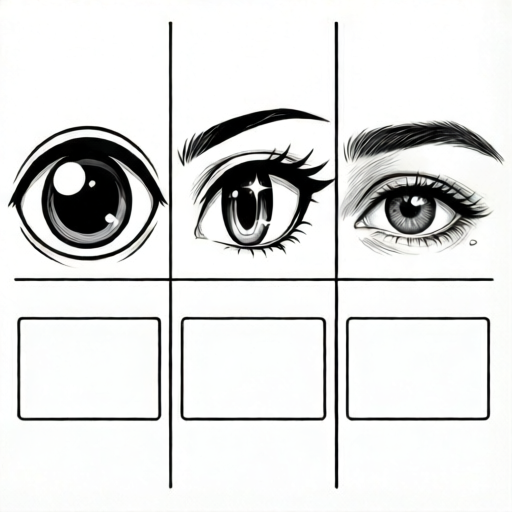
Use the stated measurements and conventions for each exercise.
Shared proportion guide for side-by-side comparison
Begin by drawing three vertical columns of equal width on your page. In each column, mark a horizontal baseline and a midline above it. The distance from baseline to midline is the x-height for the eye opening; this is a working convention, not a universal standard. Letter styles and eye styles vary, so treat these marks as guides you can shift.
Across all three columns, place a light horizontal line at the same height to represent the upper lid edge and another for the lower lid edge. This shared grid lets you compare how much space each style gives to the iris, how thick the lids appear, and where highlights sit. Keep your pencil marks light so you can adjust them.
Label the columns cartoon, anime, and realistic. In each column, note the iris center and the pupil center. For comparison, use the same iris diameter in all three columns as a starting point, then observe how each style changes the visible iris shape by overlapping lids or altering the outline.
- Draw three equal columns and mark a baseline and midline in each.
- Add a shared upper-lid line and lower-lid line across all columns.
- Mark iris and pupil centers in each column using the same diameter.
- Label the columns and note where each style places its highlight.
Cartoon eye: simplified lids and bold shapes
Cartoon eyes often use a thick, simple upper lid and a minimal lower lid. The iris may be a large circle or oval that touches the upper lid, and the pupil is usually a clear dark shape. Highlights are often large and placed near the top of the iris to suggest shine. The white of the eye may be reduced or exaggerated depending on the character design.
In your cartoon column, draw the upper lid as a single bold curve. Keep the lower lid thin or omit it. Draw the iris as a circle that overlaps the upper lid line slightly. Place one large highlight near the top-left or top-right of the iris, and add a small secondary highlight if desired. The key is consistency: the lid thickness, iris size, and highlight size should feel deliberate.
- Draw a bold upper lid curve and a thin or absent lower lid.
- Place a large circular iris that touches or slightly overlaps the upper lid.
- Add a clear pupil and one large highlight near the top of the iris.
- Check that the highlight size matches the simplified style.
Anime eye: layered lids, shaped iris, and sharp highlights
Anime eyes often combine a defined upper lid with a visible eyelash line and a lower lid that may be partially drawn. The iris is frequently taller than it is wide, and the pupil can be small or large. Highlights are often sharp and angular, sometimes split into two shapes. The white of the eye is usually visible but can be minimized by a large iris.
In your anime column, draw the upper lid with a slight thickness and add a short eyelash line at the outer corner. Draw the iris as a vertical oval that overlaps the upper lid. Place a sharp highlight near the top and a smaller secondary highlight opposite it. Keep the lower lid line light and partial. Compare the iris height to the cartoon column to see how the vertical emphasis changes the expression.
- Draw a defined upper lid with a short eyelash line at the outer corner.
- Draw a vertical oval iris that overlaps the upper lid.
- Add a sharp primary highlight and a smaller secondary highlight.
- Keep the lower lid light and partial, then compare iris height with the cartoon column.
Realistic eye: lid folds, visible sclera, and soft highlights
Realistic eyes show a lid fold above the upper lid, a visible lower lid, and a sclera that is usually partly covered by the iris. The iris is often circular but appears partially hidden by the lids. Highlights are smaller and softer, often placed where the cornea catches light. The pupil size can vary with lighting, but for comparison keep it consistent with the other columns.
In your realistic column, draw the upper lid with a subtle fold above it. Draw the lower lid as a thin curve. Place the iris so that its top is slightly covered by the upper lid and its bottom is slightly covered by the lower lid. Add a small, soft highlight near the top of the iris and a tiny secondary highlight if needed. Compare the visible sclera area with the cartoon and anime columns to see how lid coverage changes the read.
- Draw an upper lid with a subtle fold above it.
- Draw a thin lower lid curve.
- Place the iris so both lids slightly cover it.
- Add a small soft highlight and compare visible sclera with the other columns.
Worked example
On a page with three equal columns, draw a shared baseline and midline. In the cartoon column, draw a bold upper lid and a large circular iris that touches the upper lid. In the anime column, draw a defined upper lid with a short eyelash line and a vertical oval iris. In the realistic column, draw an upper lid with a subtle fold and a circular iris slightly covered by both lids. Add one highlight per column: large for cartoon, sharp for anime, small and soft for realistic. Label each column.
Worked answer
The cartoon column shows a thick upper lid, a large iris touching the lid, and a large highlight. The anime column shows a defined upper lid with an eyelash line, a taller iris, and a sharp highlight. The realistic column shows a lid fold, a circular iris partly covered by both lids, and a small soft highlight. All three share the same baseline and midline, making the differences in lid thickness, iris shape, and highlight size easy to compare.
Four practice exercises
Exercise 1
Draw three aligned columns with a shared baseline and midline. In the cartoon column, draw a bold upper lid and a large circular iris that touches the upper lid. In the anime column, draw a defined upper lid with a short eyelash line and a vertical oval iris. In the realistic column, draw an upper lid with a subtle fold and a circular iris slightly covered by both lids. Add one highlight per column: large for cartoon, sharp for anime, small and soft for realistic.
Show answer and check
A completed page shows three columns at the same scale. The cartoon eye has a thick upper lid and a large highlight. The anime eye has a defined upper lid, a taller iris, and a sharp highlight. The realistic eye has a lid fold, a partly covered iris, and a small soft highlight.
Why: The shared baseline and midline keep the comparison fair. Each style uses its characteristic lid thickness, iris shape, and highlight size, so the differences are visible side by side.
Check: Verify that all three columns share the same baseline and midline. Check that the cartoon highlight is the largest, the anime highlight is sharp, and the realistic highlight is the smallest and softest. Confirm that the realistic iris is partly covered by both lids.
Exercise 2
Using the same three-column layout, redraw the cartoon eye but make the lower lid visible and thin. Then redraw the anime eye with a smaller pupil and a second sharp highlight. Finally, redraw the realistic eye with a slightly larger visible sclera area by raising the upper lid line. Label what changed in each column.
Show answer and check
The cartoon eye now has a thin lower lid but keeps its bold upper lid and large highlight. The anime eye has a smaller pupil and two sharp highlights. The realistic eye shows more sclera because the upper lid line is raised, while the iris remains partly covered.
Why: Changing one feature at a time within each style shows how construction choices affect the read. The cartoon remains simplified, the anime gains a sharper highlight pattern, and the realistic eye shows more sclera without losing its lid fold.
Check: Compare the new drawings with the first set. Confirm the cartoon lower lid is thin, the anime pupil is smaller with two sharp highlights, and the realistic sclera area is larger due to the raised upper lid line.
Exercise 3
Draw a single row with three eye outlines side by side, all sharing the same iris diameter. In the first outline, overlap the upper lid by one-third of the iris height. In the second, overlap the upper lid by one-half. In the third, overlap the upper lid by two-thirds. Label each outline with the overlap fraction and describe how the visible iris shape changes.
Show answer and check
As the upper lid overlap increases from one-third to two-thirds, the visible iris becomes shorter and more crescent-like. The first outline shows the most iris, the second shows a moderate amount, and the third shows the least.
Why: The iris diameter stays constant, so the change in visible shape comes only from lid overlap. This isolates the effect of lid coverage, which is a key difference between styles.
Check: Measure the visible iris height in each outline. Confirm that the one-third overlap shows the tallest visible iris and the two-thirds overlap shows the shortest. Check that the labels match the fractions.
Exercise 4
Create a comparison table with three rows (cartoon, anime, realistic) and three columns (upper lid, iris shape, highlight). Fill each cell with a short description based on your drawings. Then draw one new eye in each style that follows your table descriptions.
Show answer and check
The table lists the upper lid as bold for cartoon, defined with eyelash line for anime, and folded for realistic. Iris shape is large circular for cartoon, vertical oval for anime, and circular but partly covered for realistic. Highlight is large and simple for cartoon, sharp and angular for anime, and small and soft for realistic. The new drawings match these descriptions.
Why: Writing the descriptions first forces you to identify the construction choices before drawing. The new drawings test whether you can apply those choices consistently.
Check: Compare each new drawing with its table row. Confirm that the upper lid, iris shape, and highlight match the written description. Check that the three styles remain visually distinct.
Common mistakes
- Using the same iris size in all three columns without adjusting for lid coverage. Keep the iris diameter consistent as a starting point, but adjust how much of the iris is visible by changing lid overlap in each style.
- Placing highlights in the same position and size across all styles. Match highlight size and shape to the style: large and simple for cartoon, sharp and angular for anime, small and soft for realistic.
- Drawing the lower lid with the same thickness in every column. Vary lower lid thickness: minimal or absent for cartoon, light and partial for anime, thin but present for realistic.
- Ignoring the shared proportion guide when comparing columns. Use the baseline, midline, and shared lid lines to compare each style at the same scale before making style-specific adjustments.
Self-check rubric
- Three columns are aligned and share a baseline and midline.
- Cartoon column uses a bold upper lid, minimal lower lid, and a large simple highlight.
- Anime column uses a defined upper lid, vertical iris emphasis, and sharp highlights.
- Realistic column uses a lid fold, visible lower lid, and small soft highlights.
- Labels clearly identify each style and the compared features.
- Valid alternatives are accepted if the construction choices are consistent within each style.
Questions and answers
Do I need to use exact measurements?
No. The baseline-to-midline distance is a working convention. Any numerical values mentioned are hypothetical examples; measure your own paper and adjust as needed.
Can I change the iris size in one column?
Yes, but for a fair comparison start with the same iris diameter in all three columns, then observe how lid overlap changes the visible shape.
What if my cartoon eye looks too realistic?
Simplify the lids, enlarge the highlight, and reduce the number of lid lines. Cartoon styles often use fewer lines and bolder shapes.
How do I know if my anime eye is consistent?
Check that the iris is vertically emphasized, the upper lid is defined, and the highlights are sharp. Compare with the cartoon and realistic columns to see the contrast.