Free original lessons
Octopus Eyes Drawing: Horizontal Slit Pupil and Lidless Socket
Learn to draw an octopus eye with a horizontal slit pupil, skin ridge, and lidless socket using a clear convention, step-by-step construction, and checkable practice.
Free lesson
Four exercises
Worked answers
Object Drawing Lessons
An octopus eye is not a fish eye or a mammal eye. It sits in a lidless socket, the pupil is a horizontal slit, and a raised skin ridge often frames the opening. This lesson isolates that anatomy so you can draw it convincingly without drawing the whole animal. You will use a simple convention: the eye opening is an oval, the pupil is a horizontal slit centered inside it, and the skin ridge is a soft raised band around the socket. Because lettering and line style vary, the rubric rewards anatomical clarity and consistent placement rather than one exact shape. All measurements below are hypothetical examples; measure your own paper and tools before scaling.
Practice materials: Printable downloads are not available for this lesson yet. Use the instructions and four exercises below.
Reference illustration
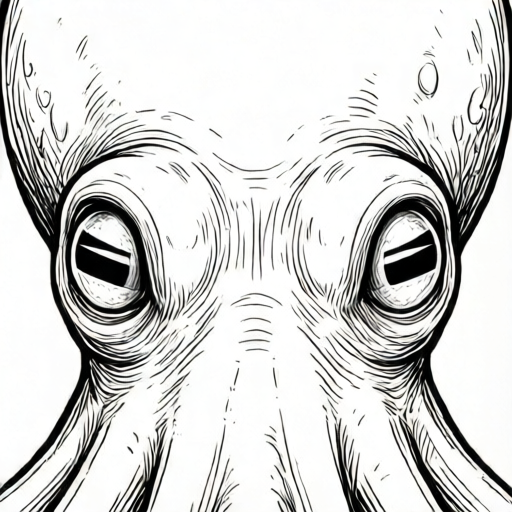
Use the stated measurements and conventions for each exercise.
Anatomy you must show
The octopus eye has three visible features for this task: a lidless socket, a horizontal slit pupil, and a skin ridge. The socket is the opening in the skin, not a human eyelid. It reads as a firm oval or slightly teardrop-shaped rim. The pupil is a narrow horizontal slit, not a round dot and not a vertical cat slit. The skin ridge is a raised band of skin that surrounds or partly surrounds the socket, giving the eye a set-in look.
Keep the pupil horizontal relative to the eye opening. If the socket is tilted, the slit tilts with it. The slit should sit inside the iris area, with visible iris on both left and right sides. Avoid adding eyelashes, eyebrows, or a wet human-style highlight that implies a lid. A small highlight on the iris is acceptable if it does not create a false lid line.
- Draw a light oval for the socket opening; make it wider than tall.
- Draw a horizontal slit inside the oval, centered and narrower than the iris width.
- Add a soft skin ridge as a second, slightly larger oval around the socket.
- Shade the iris darker at the rim and lighter near the slit, then add one small highlight if desired.
Construction sequence
Start with the socket oval because it controls the whole eye. A common error is drawing the pupil first and then forcing the socket around it. Instead, place the socket, then the iris, then the slit. The iris is the colored ring inside the socket; the slit is the dark opening in the iris. The skin ridge is drawn last so it can follow the socket shape without crowding it.
Use a light pencil for the socket and ridge, then darken only the slit and the iris rim. This keeps the lidless socket readable. If your paper is small, reduce the ridge width rather than shrinking the slit; the slit must remain clearly horizontal.
- Mark the socket oval with a light line.
- Draw the iris as a circle or oval inside the socket, leaving a thin rim of socket visible.
- Place the horizontal slit across the middle of the iris.
- Draw the skin ridge as a soft band outside the socket, then shade the socket rim to show depth.
Shading and highlight placement
Shade the socket rim darker than the surrounding skin to show that the eye is set in. The iris can be mid-tone, with the slit nearly black. Keep the skin ridge lighter on its top edge and slightly darker underneath, which suggests a raised band without inventing a lid. A single small highlight on the iris, placed away from the slit, is enough.
Do not shade the slit itself with gray; it should read as a dark opening. If you use color, keep the iris color consistent on both sides of the slit. The highlight should not cross the slit, because that would make the slit look like a surface line rather than an opening.
- Darken the socket rim with short curved strokes.
- Shade the iris from rim to slit, leaving the slit dark.
- Lighten the top of the skin ridge and darken its lower edge.
- Add one small highlight on the iris, not on the slit.
Checking your drawing
Check three things: the slit is horizontal, the socket has no lid line, and the skin ridge surrounds the socket without becoming an eyelid. A quick test is to cover the slit with your finger; the remaining shape should still look like a lidless socket. Another test is to rotate the page; the slit should stay parallel to the socket's long axis.
Use the rubric below to score your own work. Because line style and lettering vary, accept any clean oval socket and any soft ridge as long as the three features are clear and consistently placed.
- Confirm the slit is horizontal and centered in the iris.
- Confirm there is no eyelid line or eyelash.
- Confirm the skin ridge is outside the socket and does not cover the slit.
- Confirm the highlight does not cross the slit.
Worked example
Draw a single octopus eye on a 10 cm by 10 cm area. Use a socket oval 6 cm wide and 4 cm tall, an iris 3 cm wide, and a horizontal slit 1 cm wide centered in the iris. Add a skin ridge 0.5 cm outside the socket.
Worked answer
A correct drawing shows a 6 cm by 4 cm socket oval, a 3 cm iris inside it, and a 1 cm horizontal slit centered in the iris with iris visible on both sides. The skin ridge forms a soft band about 0.5 cm outside the socket. The socket rim is shaded darker, the slit is dark, and one small highlight sits on the iris away from the slit. No eyelid line or eyelash is present.
Four practice exercises
Exercise 1
A learner draws a socket oval 8 cm wide and 5 cm tall, an iris 4 cm wide, and a vertical slit 1 cm tall. Identify the main anatomical error and state the fix.
Show answer and check
The pupil is vertical, not horizontal. Redraw it as a horizontal slit about 1 cm wide, centered in the iris, with iris visible on both sides.
Why: The brief requires a horizontal slit pupil. A vertical slit changes the species cue and fails the anatomy check.
Check: Measure the slit direction against the socket's long axis; it must be parallel, not perpendicular.
Exercise 2
A drawing shows a socket oval, a horizontal slit, and a thick line above the socket that looks like an eyelid. The skin ridge is missing. Name two fixes.
Show answer and check
Remove the eyelid-like line and add a soft skin ridge outside the socket. Keep the slit and iris visible.
Why: The octopus eye is lidless, so an eyelid line is incorrect. The skin ridge is a required feature and must surround the socket without covering the slit.
Check: Confirm no lid line remains and that a ridge band sits outside the socket.
Exercise 3
On a 12 cm by 12 cm page, a socket is 9 cm wide and 6 cm tall. The iris is 5 cm wide. A horizontal slit is 2 cm wide but placed at the top edge of the iris. What is wrong and how do you correct it?
Show answer and check
The slit is not centered; it sits at the top edge. Move it to the middle of the iris so iris is visible above and below, and keep it horizontal.
Why: A centered slit reads as an opening in the iris. An edge-placed slit looks like a surface mark and weakens the anatomy.
Check: Measure the distance from the slit to the iris top and bottom; the two distances should be roughly equal.
Exercise 4
A learner shades the slit gray and puts a bright highlight across it. The socket and ridge are otherwise correct. State the fix and the check.
Show answer and check
Make the slit dark, not gray, and move the highlight onto the iris away from the slit. Check that the highlight does not cross the slit and that the slit reads as an opening.
Why: The slit is a dark opening, and a highlight across it makes it look like a surface line. The highlight belongs on the iris.
Check: Look at the slit: it should be the darkest part of the eye, and no highlight should touch it.
Common mistakes
- Drawing a round pupil instead of a horizontal slit. Redraw the pupil as a narrow horizontal slit and keep iris visible on both sides.
- Adding a human eyelid line above the socket. Remove the lid line and show only the socket rim and skin ridge.
- Making the skin ridge cover the slit. Move the ridge outward so the slit and iris remain fully visible.
- Placing the highlight across the slit. Move the highlight onto the iris only, away from the slit.
Self-check rubric
- Horizontal slit pupil is clear and centered in the iris.
- Socket is lidless: no eyelid line, eyelashes, or eyebrow.
- Skin ridge surrounds the socket without covering the slit.
- Iris is visible on both sides of the slit.
- Shading shows the socket set into the skin.
- Highlight, if present, does not cross the slit.
- Valid alternatives: any clean oval socket, any soft ridge width, and any consistent iris color are accepted if the three features remain clear.
Questions and answers
Should the pupil be perfectly straight?
It should read as horizontal. A slight curve is acceptable if the slit stays parallel to the socket's long axis.
How wide should the slit be?
Narrower than the iris, with visible iris on both sides. A hypothetical example is one-third of the iris width.
Can I add color?
Yes, if the iris color stays consistent on both sides of the slit and the slit remains dark.
Do I need to draw the whole octopus?
No. This task isolates the eye anatomy: socket, slit pupil, and skin ridge.